


Comparing the effectiveness of competing tests for reducing colorectal cancer mortality: a network meta-analysis
- PMID: 25708757
- PMCID: PMC4766592
- DOI: 10.1016/j.gie.2014.10.033
Comparing the effectiveness of competing tests for reducing colorectal cancer mortality: a network meta-analysis
Abstract
Background: Comparative effectiveness data pertaining to competing colorectal cancer (CRC) screening tests do not exist but are necessary to guide clinical decision making and policy.
Objective: To perform a comparative synthesis of clinical outcomes studies evaluating the effects of competing tests on CRC-related mortality.
Design: Traditional and network meta-analyses. Two reviewers identified studies evaluating the effect of guaiac-based fecal occult blood testing (gFOBT), flexible sigmoidoscopy (FS), or colonoscopy on CRC-related mortality.
Interventions: gFOBT, FS, colonoscopy.
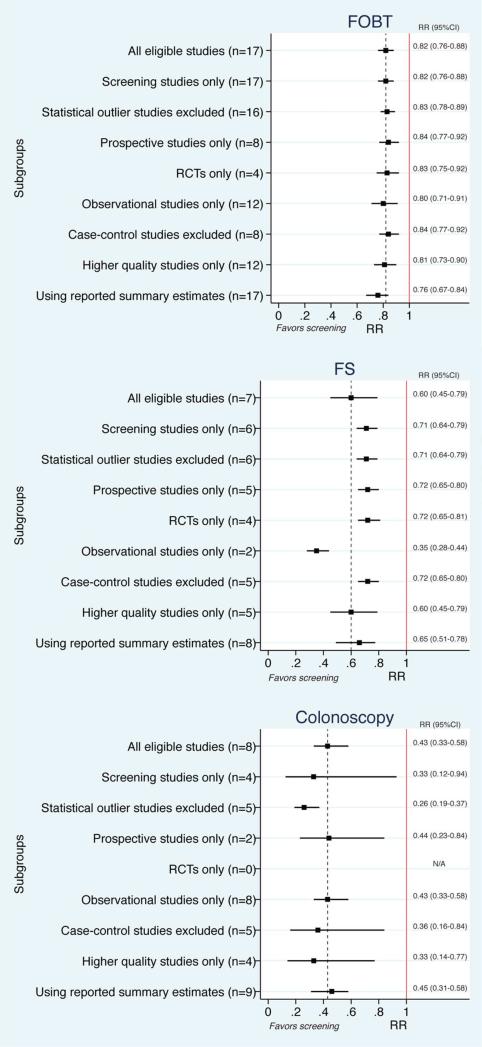
Main outcome measurements: Traditional meta-analysis was performed to produce pooled estimates of the effect of each modality on CRC mortality. Bayesian network meta-analysis (NMA) was performed to indirectly compare the effectiveness of screening modalities. Multiple sensitivity analyses were performed.
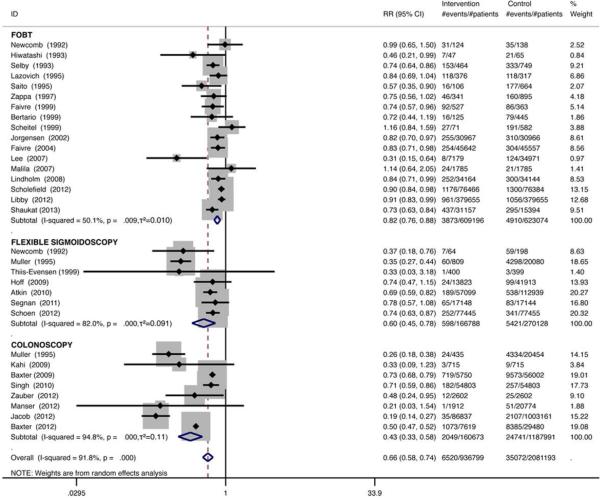
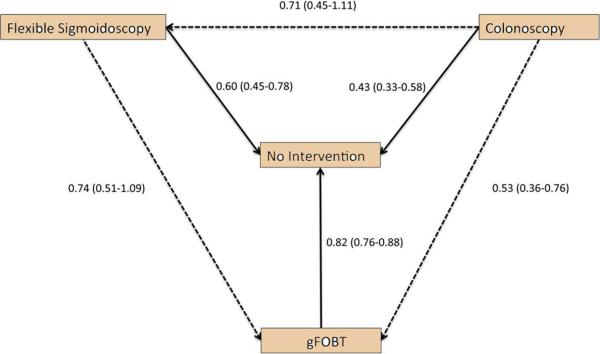
Results: Traditional meta-analysis revealed that, compared with no intervention, colonoscopy reduced CRC-related mortality by 57% (relative risk [RR] 0.43; 95% confidence interval [CI], 0.33-0.58), whereas FS reduced CRC-related mortality by 40% (RR 0.60; 95% CI, 0.45-0.78), and gFOBT reduced CRC-related mortality by 18% (RR 0.82; 95% CI, 0.76-0.88). NMA demonstrated nonsignificant trends favoring colonoscopy over FS (RR 0.71; 95% CI, 0.45-1.11) and FS over gFOBT (RR 0.74; 95% CI, 0.51-1.09) for reducing CRC-related deaths. NMA-based simulations, however, revealed that colonoscopy has a 94% probability of being the most effective test for reducing CRC mortality and a 99% probability of being most effective when the analysis is restricted to screening studies.
Limitations: Randomized trials and observational studies were combined within the same analysis.
Conclusion: Clinical outcomes studies demonstrate that gFOBT, FS, and colonoscopy are all effective in reducing CRC-related mortality. Network meta-analysis suggests that colonoscopy is the most effective test.
Copyright © 2015 American Society for Gastrointestinal Endoscopy. Published by Elsevier Inc. All rights reserved.
Figures
Comment in
-
Colorectal cancer screening: what program is most effective?Gastrointest Endosc. 2015 Mar;81(3):710-2. doi: 10.1016/j.gie.2014.12.030. Gastrointest Endosc. 2015. PMID: 25708758 No abstract available.
References
-
- Siegel R, Naishadham D, Jemal A. Cancer statistics, 2013. CA Cancer J Clin. 2013;63:11–30. - PubMed
-
- Ferlay J, Shin HR, Bray F, Forman D, Mathers C, Parkin DM. Estimates of worldwide burden of cancer in 2008: GLOBOCAN 2008. Int J Cancer. 2010;127:2893–917. - PubMed
-
- Levin B, Lieberman DA, McFarland B, et al. Screening and surveillance for the early detection of colorectal cancer and adenomatous polyps, 2008: a joint guideline from the American Cancer Society, the US Multi-Society Task Force on Colorectal Cancer, and the American College of Radiology. Gastroenterology. 2008;134:1570–95. - PubMed
-
- Screening for colorectal cancer: U.S. Preventive Services Task Force recommendation statement. Ann Intern Med. 2008;149:627–37. - PubMed
-
- Quintero E, Castells A, Bujanda L, et al. Colonoscopy versus fecal immunochemical testing in colorectal-cancer screening. N Engl J Med. 2012;366:697–706. - PubMed
Publication types
MeSH terms
Grants and funding
LinkOut - more resources
Full Text Sources
Other Literature Sources
Medical
