Review
. 2015 Apr;33(4):230-6.
doi: 10.1016/j.tibtech.2015.01.004. Epub 2015 Feb 20.

Biomechanical and biochemical remodeling of stromal extracellular matrix in cancer

Affiliations
Review

Biomechanical and biochemical remodeling of stromal extracellular matrix in cancer

Ruchi Malik et al. Trends Biotechnol. 2015 Apr.

Abstract

The extracellular matrix (ECM) provides structural and biochemical signals that regulate cell function. A well-controlled balance between cells and surroundings (i.e., dynamic reciprocity) is crucial for regulating ECM architecture. During cancer progression, epithelial cells undergo genetic alterations which, together with stromal changes including ECM remodeling, disturb the homeostatic dynamics of the epithelium. A parallel organization of stromal ECM fibrils is associated with tumorigenic responses. In an emerging paradigm, continuous and progressive regulation via mechanical forces and aberrant signaling are believed to be responsible for tumor-associated ECM remodeling. In this review we discuss the discrete biomechanical and biochemical mechanisms that underlie these architectural changes and highlight their particular relevance to the regulation of the alignment of ECM in the mesenchymal stroma.

Keywords: Rho–ROCK; biomechanical and biochemical cues; cell–ECM dynamic reciprocity; desmoplasia; extracellular matrix; integrins.


Figures

Box 1-Fig I
Box 1-Fig I
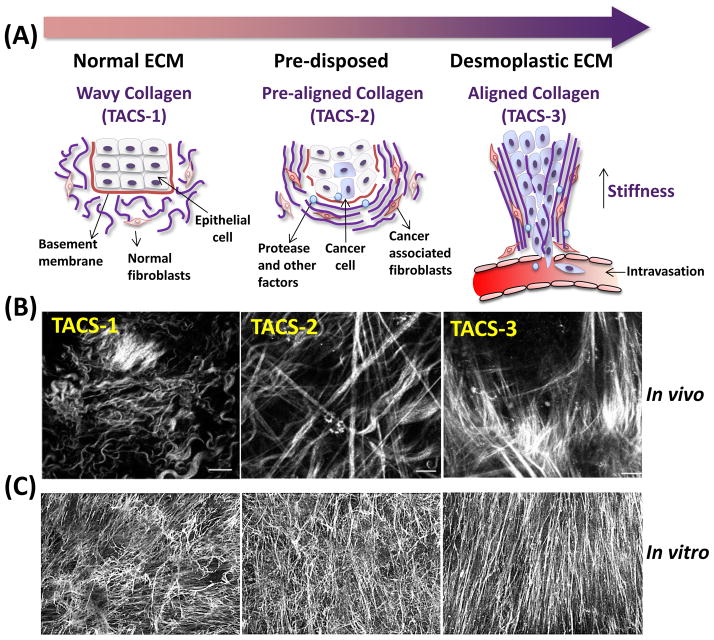
Stromal ECM fiber remodeling stages. (A) Schematic diagram representing progressive remodeling within collagen fibers of ECM during tumorigenesis. (B) Micrographs acquired using multiphoton laser scanning microscopy illustrating TACS in Wnt-1 mouse breast cancer model. Reproduced and modified from open access available [13]. (C) Representative reconstituted confocal images obtained from in vitro fibroblast-derived ECM associated with murine squamous cell carcinoma. Reproduced and modified with permission from [17].
Box 2-Fig. I
Box 2-Fig. I
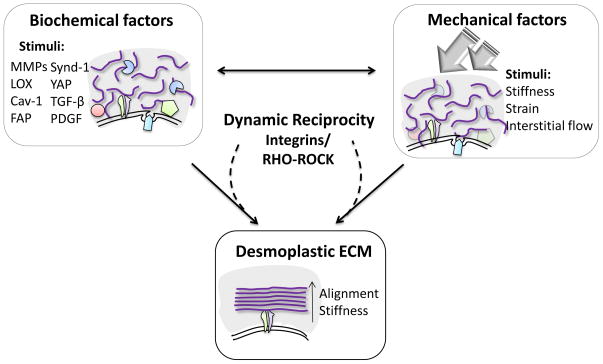
Schematic diagram illustrating the “Dynamic Reciprocity” leading, maintaining and further expanding desmoplastic ECM alignment.

References

    1. Geiger B, Yamada KM. Molecular architecture and function of matrix adhesions. Cold Spring Harbor perspectives in biology. 2011;3:a005033. - PMC - PubMed
    1. Provenzano PP, Inman DR, Eliceiri KW, Trier SM, Keely PJ. Contact guidance mediated three-dimensional cell migration is regulated by Rho/ROCK-dependent matrix reorganization. Biophysical journal. 2008;95:5374–5384. - PMC - PubMed
    1. Goetz JG, Minguet S, Navarro-Lerida I, Lazcano JJ, Samaniego R, Calvo E, Del Pozo MA. Biomechanical remodeling of the microenvironment by stromal caveolin-1 favors tumor invasion and metastasis. Cell. 2011;146:148–163. - PMC - PubMed
    1. Kalluri R. Basement membranes: structure, assembly and role in tumour angiogenesis. Nature Reviews Cancer. 2003;3:422–433. - PubMed
    1. Badylak SF, Freytes DO, Gilbert TW. Extracellular matrix as a biological scaffold material: structure and function. Acta biomaterialia. 2009;5:1–13. - PubMed

Publication types

LinkOut - more resources