Early administration of surfactant via a thin intratracheal catheter in preterm infants with respiratory distress syndrome: Feasibility and outcome
- PMID: 25710048
- PMCID: PMC4326969
- DOI: 10.4103/2279-042X.150053
Early administration of surfactant via a thin intratracheal catheter in preterm infants with respiratory distress syndrome: Feasibility and outcome
Abstract
Objective: Currently, the method of early nasal continuous positive airway pressure (nCPAP) and selective administration of surfactant via an endotracheal tube is widely used in the treatment of respiratory distress syndrome (RDS) in premature infants. To prevent complications related to endotracheal intubation and even a brief period of mechanical ventilation, in this study, we compared the effectiveness of surfactant administration via a thin intratracheal catheter versus the current method using an endotracheal tube.
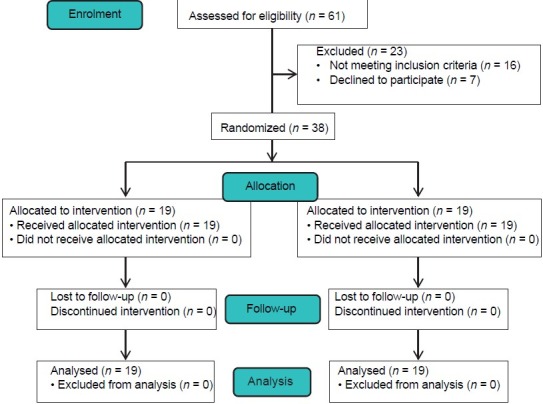
Methods: Thirty eight preterm infants ≤34 weeks' gestation with birth weight of 1000-1800 g who were putted on nCPAP for RDS within the first hour of life, were randomly assigned to receive surfactant either via endotracheal tube (ET group) or via thin intratracheal catheter (CATH group). The primary outcomes were the need for mechanical ventilation and duration of oxygen therapy. Data were analyzed by independent t-test, Mann-Whitney U-test, and Chi-square test, using SPSS v. 21.
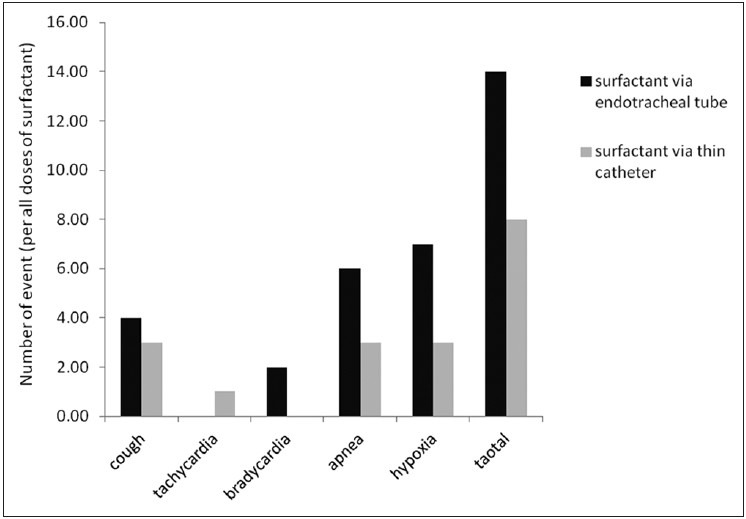
Findings: There was no significant difference between groups regarding to need for mechanical ventilation during the first 72 h of birth (3 [15.8%] in ET group vs. 2 [10.5%] in CATH group; P = 0.99). Duration of oxygen therapy in CATH group was significantly lower than ET group (243.7 ± 74.3 h vs. 476.8 ± 106.8 h, respectively; P = 0.018). The incidence of adverse events during all times of surfactant administration was not statistically significant between groups (P = 0.14), but the number of infants who experienced adverse events during surfactant administration was significantly lower in CATH group than ET group (6 [31.6%] vs. 12 [63.2%], respectively; P = 0.049). All other outcomes, including duration of treatment with CPAP and mechanical ventilation, times of surfactant administration and the need for more than one dose of the drug, the rate of intraventricular hemorrhage, mortality and combined outcome of chronic lung disease or mortality were statistically similar between the groups.
Conclusion: Surfactant administration via thin intratracheal catheter in preterm infants receiving nCPAP for treatment of RDS has similar efficacy, feasibility and safety to its administration via endotracheal tube.
Keywords: Endotracheal tube; preterm infants; respiratory distress syndrome; surfactant; thin catheter.
Conflict of interest statement
Figures
References
-
- Kattwinkel J, Robinson M, Bloom BT, Delmore P, Ferguson JE. Technique for intrapartum administration of surfactant without requirement for an endotracheal tube. J Perinatol. 2004;24:360–5. - PubMed
-
- Kribs A, Vierzig A, Hünseler C, Eifinger F, Welzing L, Stützer H, et al. Early surfactant in spontaneously breathing with nCPAP in ELBW infants - a single centre four year experience. Acta Paediatr. 2008;97:293–8. - PubMed
-
- Morley CJ, Davis PG, Doyle LW, Brion LP, Hascoet JM, Carlin JB, et al. Nasal CPAP or intubation at birth for very preterm infants. N Engl J Med. 2008;358:700–8. - PubMed
-
- Stevens TP, Sinkin RA. Surfactant replacement therapy. Chest. 2007;131:1577–82. - PubMed
LinkOut - more resources
Full Text Sources
Medical