


Pubertal development in HIV-infected African children on first-line antiretroviral therapy
- PMID: 25710288
- PMCID: PMC4342414
- DOI: 10.1097/QAD.0000000000000590
Pubertal development in HIV-infected African children on first-line antiretroviral therapy
Abstract
Objectives: To estimate age at attaining Tanner stages in Ugandan/Zimbabwean HIV-infected children initiating antiretroviral therapy (ART) in older childhood and investigate predictors of delayed puberty, particularly age at ART initiation.
Design: Observational analysis within a randomized trial.
Methods: Tanner staging was assessed every 24 weeks from 10 years of age, menarche every 12 weeks and height every 4-6 weeks. Age at attaining different Tanner stages was estimated using normal interval regression, considering predictors using multivariable regression. Growth was estimated using multilevel models with child-specific intercepts and trajectories.
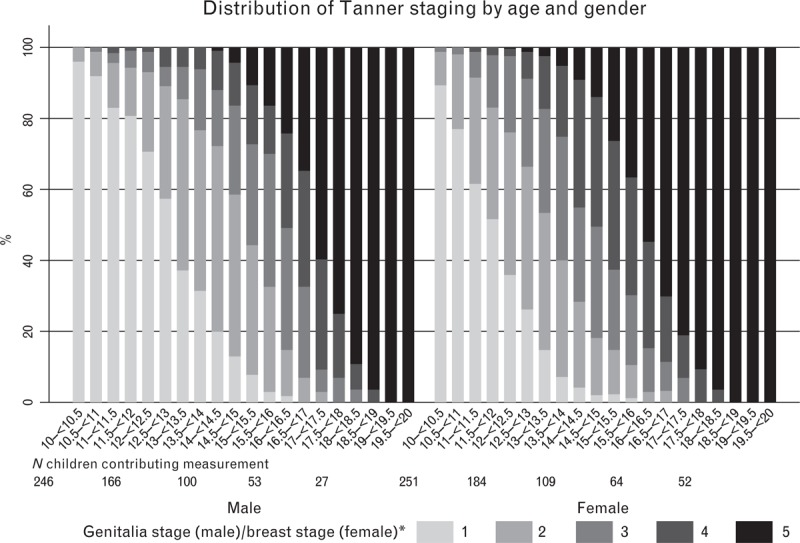
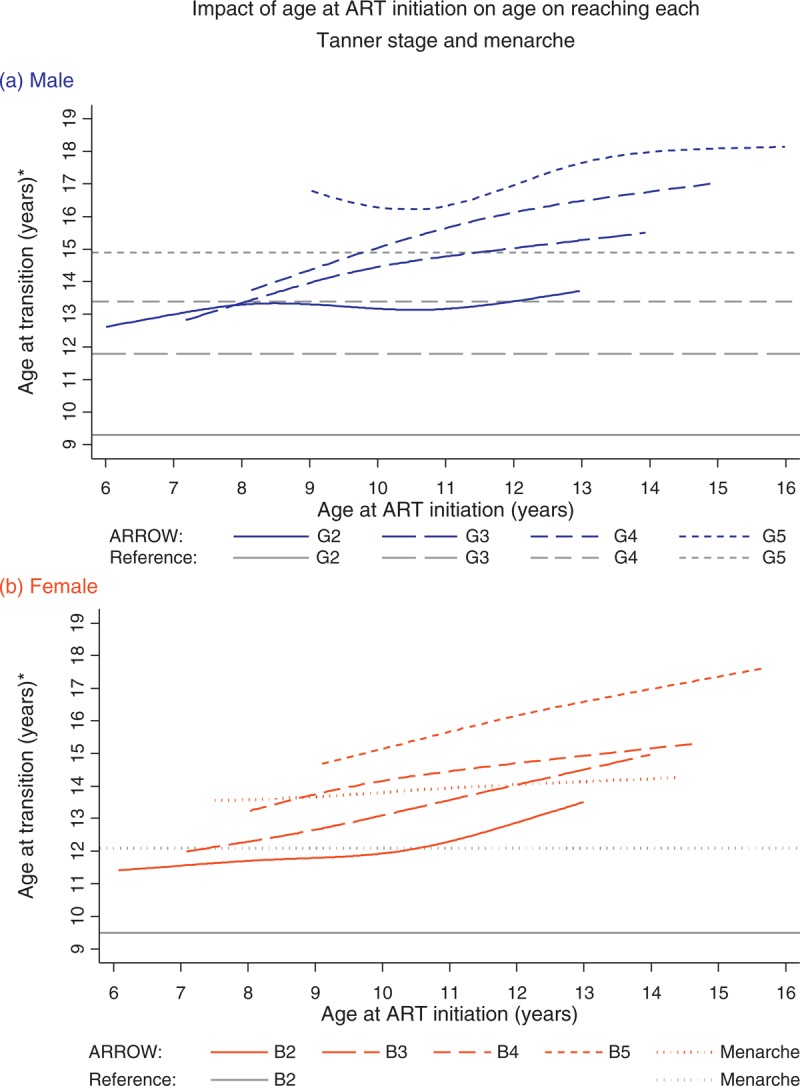
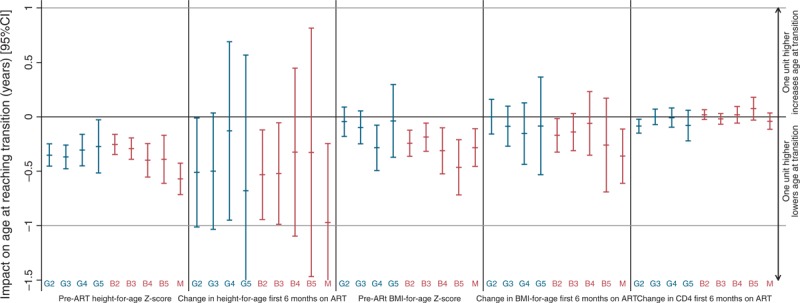
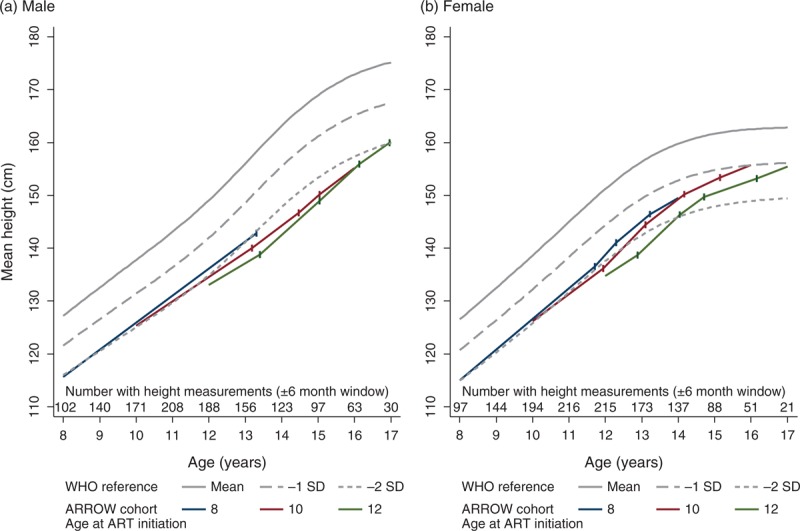
Results: Median age at ART initiation was 9.4 years (inter-quartile range 7.8, 11.3) (n = 582). At the first assessment, the majority (80.2%) were in Tanner stage 1; median follow-up with staging was 2.8 years. There was a strong delaying effect of older age at ART initiation on age at attaining all Tanner stages (P < 0.05) and menarche (P = 0.02); in boys the delaying effect generally weakened with older age. There were additional significant delays associated with greater impairments in pre-ART height-for-age Z-score (P < 0.05) in both sexes and pre-ART BMI-for-age in girls (P < 0.05). There was no evidence that pre-ART immuno-suppression independently delayed puberty or menarche. However, older children/adolescents had significant growth spurts in intermediate Tanner stages, and were still significantly increasing their height when in Tanner stage 5 (P < 0.01).
Conclusion: Delaying ART initiation until older childhood substantially delays pubertal development and menarche, independently of immuno-suppression. This highlights that factors other than CD4, such as pubertal development, need consideration when making decisions about timing of ART initiation in older children.
Figures
References
-
- World Health Organisation. Global update on HIV treatment 2013. Geneva: World Health Organisation; 2013.
-
- Joint United Nations Programme on HIV/AIDS. Global report: UNAIDS report on the global AIDS epidemic 2013. Geneva: UNAIDS; 2013.
-
- World Health Organisation. Antiretroviral therapy for HIV infection in infants and children: towards universal access. Recommendations for a public health approach. Geneva: World Health Organisation; 2010. - PubMed
-
- World Health Organisation. Consolidated guidelines on the use of antiretroviral drugs for treating and preventing HIV infection: Recommendations for a public health approach. Geneva: World Health Organisation; 2013. - PubMed
-
- Bernays S, Jarrett P, Kranzer K, Ferrand RA. Children growing up with HIV infection: the responsibility of success. Lancet 2014; 383:1355–1357. - PubMed
Publication types
MeSH terms
Substances
Grants and funding
LinkOut - more resources
Full Text Sources
Other Literature Sources
Medical
Research Materials
