Review
. 2015 May;22(3):199-205.
doi: 10.1097/MOH.0000000000000132.

New insights into iron regulation and erythropoiesis

Affiliations
Review

New insights into iron regulation and erythropoiesis

Airie Kim et al. Curr Opin Hematol. 2015 May.

Abstract

Purpose of review: Iron homeostasis and erythropoiesis regulate each other to ensure optimal delivery of oxygen and iron to cells and tissues. Defining the mechanisms of this crosstalk is important for understanding the pathogenesis of common conditions associated with disordered iron metabolism and erythropoiesis.

Recent findings: Stress erythropoiesis causes suppression of hepcidin to increase iron availability for hemoglobin synthesis. The erythroid hormone erythroferrone (ERFE) was identified as the mediator of this process. ERFE and additional candidates (TWSG1 and GDF15) may also mediate hepcidin suppression in ineffective erythropoiesis. Several mechanisms by which iron regulates erythropoiesis were also recently identified. Iron deficiency suppresses erythropoietin production via the IRP1-HIF2α axis to prevent excessive iron usage by erythropoiesis during systemic iron restriction. Iron restriction also directly impairs erythroid maturation by inhibiting aconitase, and this can be reversed by the administration of the aconitase product isocitrate. Another novel target is GDF11, which is thought to autoinhibit erythroid maturation. GDF11 traps show promising pharmacologic activity in models of both ineffective erythropoiesis and iron-restricted anemia.

Summary: This review summarizes exciting advances in understanding the mechanisms of iron and erythropoietic regulation, and development of novel therapeutic tools for disorders resulting from dysregulation of iron metabolism or erythropoiesis.


Figures
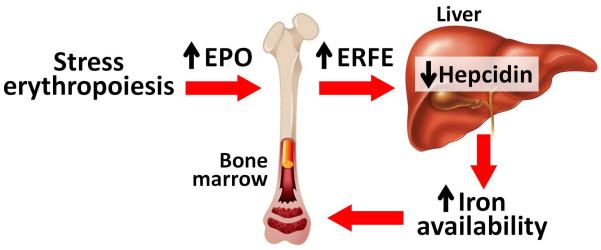
FIGURE 1
FIGURE 1
A novel pathway by which erythropoietic activity regulates iron homeostasis. During stress erythropoiesis (e.g. after blood loss), increased erythropoietin (EPO) levels cause increased production of the hormone erythroferrone (ERFE) by erythroid progenitors in the bone marrow (as well as the spleen in mice). ERFE induction by EPO is dependent on the JAK2/STAT5 signaling. ERFE then targets hepatocytes in the liver via an unidentified pathway to suppress hepcidin expression. As a result, iron availability for hemoglobin synthesis in erythroid precurosors is increased.
FIGURE 2
FIGURE 2
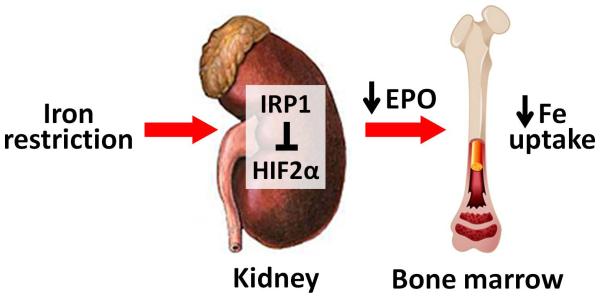
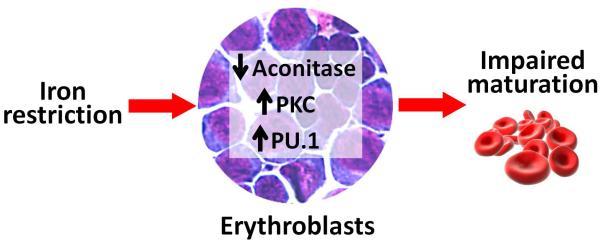
Novel pathways by which iron restriction regulates erythropoietic activity. (a) In iron-restricted conditions, a decrease in intracellular iron in renal interstitial fibroblasts results in iron regulatory protein 1 (IRP1) binding to the 5′ iron-responsive element in hypoxia-inducible factor 2α (HIF2α) mRNA and suppression of HIF2α translation. Lower HIF2α levels lead to decreased production of erythropoietin (EPO) and eventually lesser utilization of iron by developing RBC. This is thought to be a ‘safeguard’ mechanism to balance the usage of iron by erythron vs. other tissues during the times of iron deficiency. (b) Iron restriction directly affects the maturation of erythroblasts by causing inactivation of aconitase, hyperactivation of protein kinase C (PKC) and induction of the erythroid-inhibitory transcription factor PU.1. These effects of iron restriction can be reversed by the treatment with isocitrate, mimicking the enzymatic activity of aconitase.
FIGURE 2
FIGURE 2
Novel pathways by which iron restriction regulates erythropoietic activity. (a) In iron-restricted conditions, a decrease in intracellular iron in renal interstitial fibroblasts results in iron regulatory protein 1 (IRP1) binding to the 5′ iron-responsive element in hypoxia-inducible factor 2α (HIF2α) mRNA and suppression of HIF2α translation. Lower HIF2α levels lead to decreased production of erythropoietin (EPO) and eventually lesser utilization of iron by developing RBC. This is thought to be a ‘safeguard’ mechanism to balance the usage of iron by erythron vs. other tissues during the times of iron deficiency. (b) Iron restriction directly affects the maturation of erythroblasts by causing inactivation of aconitase, hyperactivation of protein kinase C (PKC) and induction of the erythroid-inhibitory transcription factor PU.1. These effects of iron restriction can be reversed by the treatment with isocitrate, mimicking the enzymatic activity of aconitase.

References

    1. Ganz T, Nemeth E. Regulation of iron acquisition and iron distribution in mammals. Biochim Biophys Acta. 2006;1763:690–699. - PubMed
    1. Ramm GA, Ruddell RG. Hepatotoxicity of iron overload: mechanisms of iron-induced hepatic fibrogenesis. Semin Liver Dis. 2005;25:433–449. - PubMed
    1. Finch C. Regulators of iron balance in humans. Blood. 1994;84:1697–1702. - PubMed
    1. Ganz T, Nemeth E. Iron metabolism: interactions with normal and disordered erythropoiesis. Cold Spring Harb Perspect Med. 2012;2:a011668. - PMC - PubMed
    1. Park CH, Valore EV, Waring AJ, Ganz T. Hepcidin, a urinary antimicrobial peptide synthesized in the liver. J Biol Chem. 2001;276:7806–7810. - PubMed

Publication types