Mineral metabolism in European children living with a renal transplant: a European society for paediatric nephrology/european renal association-European dialysis and transplant association registry study
- PMID: 25710805
- PMCID: PMC4422235
- DOI: 10.2215/CJN.06200614
Mineral metabolism in European children living with a renal transplant: a European society for paediatric nephrology/european renal association-European dialysis and transplant association registry study
Abstract
Background and objectives: Data on mineral metabolism in pediatric renal transplant recipients largely arise from small single-center studies. In adult patients, abnormal mineral levels are related to a higher risk of graft failure. This study used data from the European Society for Paediatric Nephrology/European Renal Association-European Dialysis and Transplant Association Registry to study the prevalence and potential determinants of mineral abnormalities, as well as the predictive value of a disturbed mineral level on graft survival in a large cohort of European pediatric renal transplant recipients.
Design, setting, participants, & measurements: This study included 1237 children (0-17 years) from 10 European countries, who had serum calcium, phosphorus, and parathyroid hormone measurements from 2000 onward. Abnormalities of mineral metabolism were defined according to European guidelines on prevention and treatment of renal osteodystrophy in children on chronic renal failure.
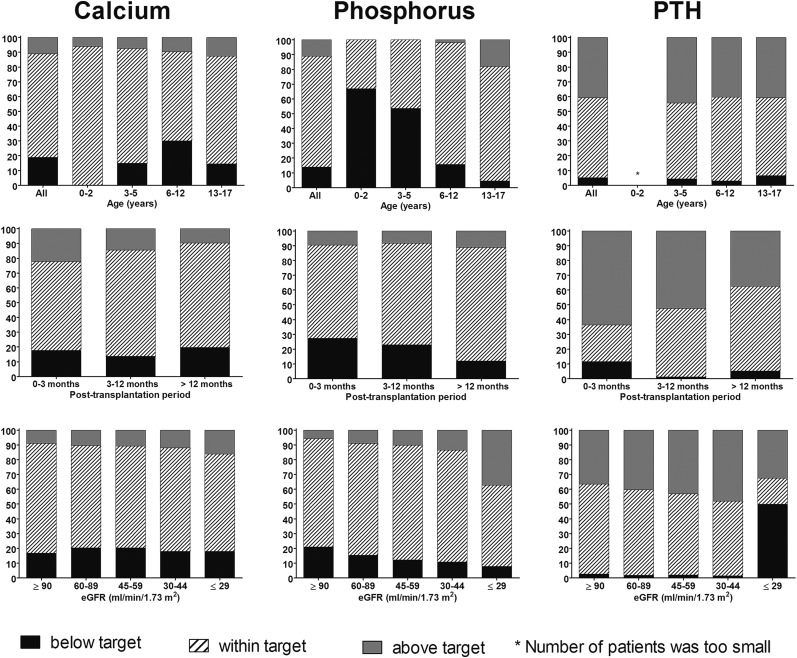
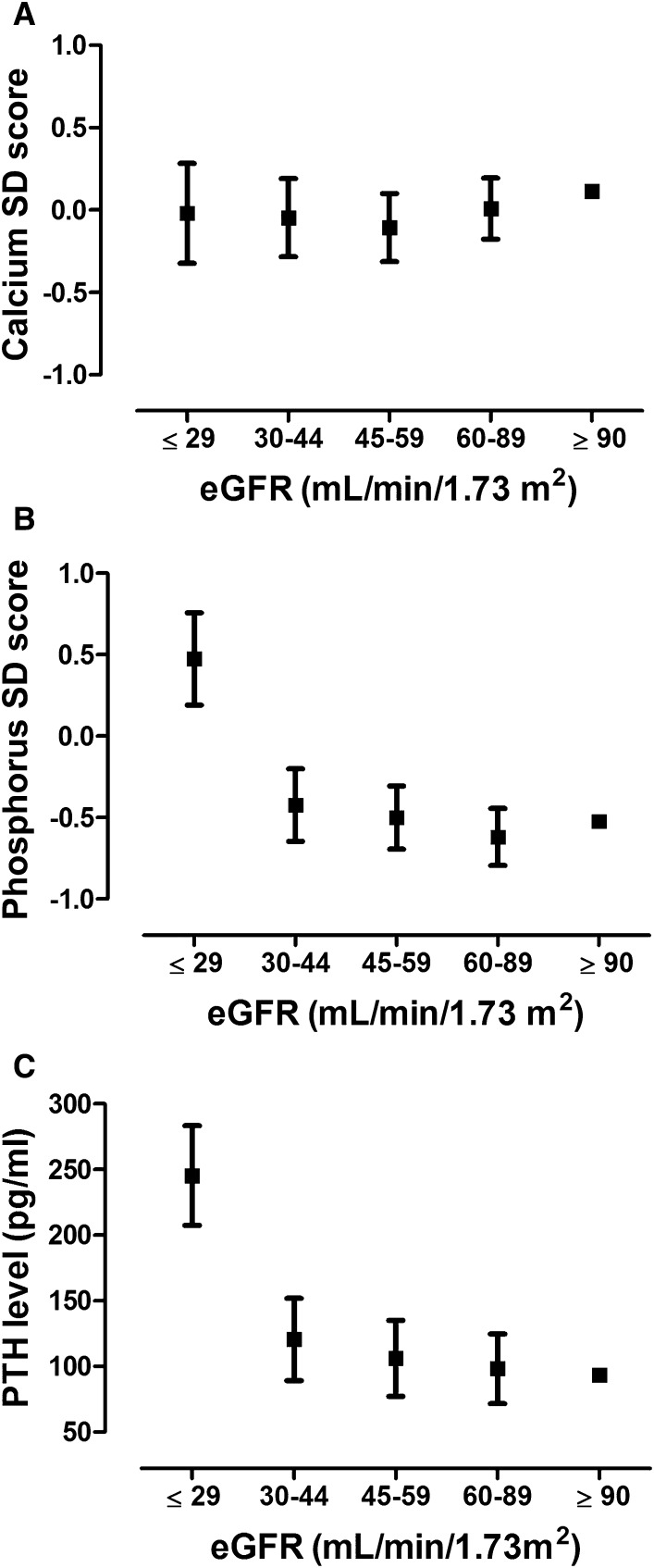
Results: Abnormal serum phosphorus levels were observed in 25% (14% hypophosphatemia and 11% hyperphosphatemia), altered serum calcium in 30% (19% hypocalcemia, 11% hypercalcemia), and hyperparathyroidism in 41% of the patients. A longer time since transplantation was associated with a lower risk of having mineral levels above target range. Serum phosphorus levels were inversely associated with eGFR, and levels above the recommended targets were associated with a higher risk of graft failure independently of eGFR.
Conclusions: Abnormalities in mineral metabolism are common after pediatric renal transplantation in Europe and are associated with graft dysfunction.
Keywords: calcium; epidemiology and outcomes; hyperphosphatemia; pediatric kidney transplantation; transplant outcomes.
Copyright © 2015 by the American Society of Nephrology.
Figures
References
-
- Schmitt CP, Mehls O: Mineral and bone disorders in children with chronic kidney disease. Nat Rev Nephrol 7: 624–634, 2011 - PubMed
-
- Borzych D, Rees L, Ha IS, Chua A, Valles PG, Lipka M, Zambrano P, Ahlenstiel T, Bakkaloglu SA, Spizzirri AP, Lopez L, Ozaltin F, Printza N, Hari P, Klaus G, Bak M, Vogel A, Ariceta G, Yap HK, Warady BA, Schaefer F, International Pediatric PD Network (IPPN) : The bone and mineral disorder of children undergoing chronic peritoneal dialysis. Kidney Int 78: 1295–1304, 2010 - PubMed
Publication types
MeSH terms
Substances
LinkOut - more resources
Full Text Sources
Medical
Research Materials
Miscellaneous