


Efficacy of intravenous administration of combined acid suppressants in healthy dogs
- PMID: 25711717
- PMCID: PMC4895496
- DOI: 10.1111/jvim.12555
Efficacy of intravenous administration of combined acid suppressants in healthy dogs
Abstract
Background: Short-term intravenous co-administration of famotidine and pantoprazole is used by some veterinarians to treat gastrointestinal bleeding in critically ill dogs. However, clinical studies have not evaluated the efficacy of combination acid suppressant treatment in dogs.
Hypothesis/objectives: To compare the effect of intravenous co-administration of famotidine and pantoprazole to monotherapy with pantoprazole on intragastric pH in dogs. We hypothesized that single agent pantoprazole would be more effective than combination with famotidine.
Animals: Twelve healthy adult colony dogs.
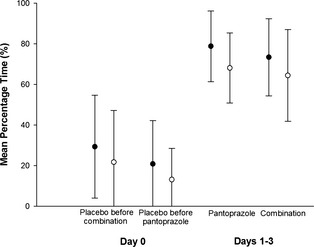
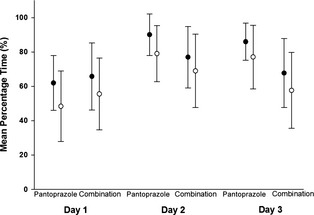
Methods: Randomized, 2-way crossover design. All dogs received placebo (0.9% saline) for 24 hours followed by 1.0 mg/kg i.v. q12h pantoprazole or combination treatment with famotidine and pantoprazole for 3 consecutive days. Intragastric pH monitoring was used to continuously record intragastric pH for 96 hours beginning on day 0 of treatment. Mean percentage time (MPT) that intragastric pH was ≥3 and ≥4 were compared between groups using ANOVA with a posthoc Tukey-Kramer test (α = 0.017).
Results: The MPT ± standard deviation intragastric pH was greater than ≥3 and 4 were 79 ± 17% and 68 ± 17% for pantoprazole and 74 ± 19% and 64 ± 23% for combination treatment, respectively. There were no significant differences in MPT intragastric pH was ≥3 and 4 between groups. Pantoprazole administered alone achieved pH goals established for humans with acid-related disorders.
Conclusions and clinical importance: These results suggest that short-term combination treatment with famotidine and pantoprazole is not superior to pantoprazole alone for increasing intragastric pH in dogs.
Keywords: Bravo monitoring; Canine; Famotidine; Pantoprazole; pH.
Copyright © 2015 The Authors. Journal of Veterinary Internal Medicine published by Wiley Periodicals, Inc. on behalf of the American College of Veterinary Internal Medicine.
Figures
References
-
- Luna SP, Basilio AC, Steagall PV, et al. Evaluation of adverse effects of long‐term oral administration of carprofen, etodolac, flunixin meglumine, ketoprofen, and meloxicam in dogs. Am J Vet Res 2007;68:258–264. - PubMed
-
- Dunayer EK, Gwaltney‐Brant SM. Acute hepatic failure and coagulopathy associated with xylitol ingestion in eight dogs. J Am Vet Med Assoc 2006;229:1113–1117. - PubMed
-
- O'Marra SK, Delaforcade AM, Shaw SP. Treatment and predictors of outcome in dogs with immune‐mediated thrombocytopenia. J Am Vet Med Assoc 2011;238:346–352. - PubMed
-
- Tolbert K, Bissett S, King A, et al. Efficacy of oral famotidine and 2 omeprazole formulations for the control of intragastric pH in dogs. J Vet Intern Med 2011;25:47–54. - PubMed
-
- Bersenas AM, Mathews KA, Allen DG, et al. Effects of ranitidine, famotidine, pantoprazole, and omeprazole on intragastric pH in dogs. Am J Vet Res 2005;66:425–431. - PubMed
Publication types
MeSH terms
Substances
LinkOut - more resources
Full Text Sources
Other Literature Sources
