. 2015 Mar;14(3):769-78.
doi: 10.1158/1535-7163.MCT-14-0926. Epub 2015 Feb 23.

Multiple molecular subtypes of triple-negative breast cancer critically rely on androgen receptor and respond to enzalutamide in vivo

Affiliations

Multiple molecular subtypes of triple-negative breast cancer critically rely on androgen receptor and respond to enzalutamide in vivo

Valerie N Barton et al. Mol Cancer Ther. 2015 Mar.

Abstract

Triple-negative breast cancer (TNBC) has the lowest 5-year survival rate of invasive breast carcinomas, and currently there are no approved targeted therapies for this aggressive form of the disease. The androgen receptor (AR) is expressed in up to one third of TNBC and we find that all AR(+) TNBC primary tumors tested display nuclear localization of AR, indicative of transcriptionally active receptors. While AR is most abundant in the "luminal AR (LAR)" molecular subtype of TNBC, here, for the first time, we use both the new-generation anti-androgen enzalutamide and AR knockdown to demonstrate that the other non-LAR molecular subtypes of TNBC are critically dependent on AR protein. Indeed, AR inhibition significantly reduces baseline proliferation, anchorage-independent growth, migration, and invasion and increases apoptosis in four TNBC lines (SUM159PT, HCC1806, BT549, and MDA-MB-231), representing three non-LAR TNBC molecular subtypes (mesenchymal-like, mesenchymal stem-like, and basal-like 2). In vivo, enzalutamide significantly decreases viability of SUM159PT and HCC1806 xenografts. Furthermore, mechanistic analysis reveals that AR activation upregulates secretion of the EGFR ligand amphiregulin (AREG), an effect abrogated by enzalutamide in vitro and in vivo. Exogenous AREG partially rescues the effects of AR knockdown on proliferation, migration, and invasion, demonstrating that upregulation of AREG is one mechanism by which AR influences tumorigenicity. Together, our findings indicate that non-LAR subtypes of TNBC are AR dependent and, moreover, that enzalutamide is a promising targeted therapy for multiple molecular subtypes of AR(+) TNBC.


Conflict of interest statement

Disclosure of Potential Conflicts of Interest

A. Elias has received other commercial research support from Medivation and Astellas. No potential conflicts of interest were disclosed by the other authors.

Figures

Figure 1
Figure 1
AR expression and nuclear localization in TNBC patient samples and cell lines. A, representative immunohistochemistry (IHC) of AR protein expression (brown) in TNBC patient samples. Photomicrographs represent a 400× magnification. B, Western blotting for AR expression in a panel of TNBC cell lines representing LAR, basal-like 2 (BL2), MSL, and mesenchymal-like (ML; ref. 14) subtypes of TNBC. The prostate cancer cell line LNCaP is shown as a positive control for AR. C, nuclear–cytoplasmic fractionation of TNBC cell lines grown in 5% charcoal-stripped serum for 48 hours and following a 3-hour treatment with vehicle control (Veh), enzalutamide (ENZ), and/or DHT. Topoisomerase I (TOPO1) is a loading control for the nuclear fraction and α-TUBULIN is a loading control for the cytosolic fraction.
Figure 2
Figure 2
Enzalutamide decreases proliferation and anchorage-independent growth and increases apoptosis in multiple TNBC molecular subtypes. A, crystal violet assay of TNBC cell lines treated with vehicle control (Veh), enzalutamide (ENZ), and/or DHT in 5% charcoal-stripped serum for 5 to 10 days. B, apoptotic index of nuclear red SUM159PT, HCC1806 and BT549 cell lines treated with Veh (open circle) or enzalutamide (solid square) and green fluorescent caspase-3/7 reagent and imaged on the Incucyte ZOOM (Essen BioSciences). C, soft agar assays of TNBC cell lines treated with Veh or enzalutamide in full serum, stained with nitro blue tetrazolium, and quantified using pixel contrast analysis.*, P < 0.05; **, P < 0.01; ***, P < 0.001; error bars, SD.
Figure 3
Figure 3
AR knockdown inhibits baseline and ligand-mediated proliferation and increases apoptosis in TNBC. A, Western blotting of TNBC cell lines infected with shRNAs targeting AR (shAR15, shAR17) compared with a nontargeting control (shNEG) on day 3. B, MTS assays of transduced TNBC cell lines. C, crystal violet assay of transduced SUM159PT shNEG or shAR15/shAR17 cells treated 1 week with vehicle control (Veh), enzalutamide (ENZ), and/or DHT. D, changes in apoptosis in AR knockdown cells measured with cleaved caspase reagent (Essen BioSciences) and normalized to cell count (apoptotic index) at 42 hours. Staurosporine (SSP) was used a positive control for apoptosis. *, P < 0.05; ***, P < 0.001 by ANOVA; error bars, SD.
Figure 4
Figure 4
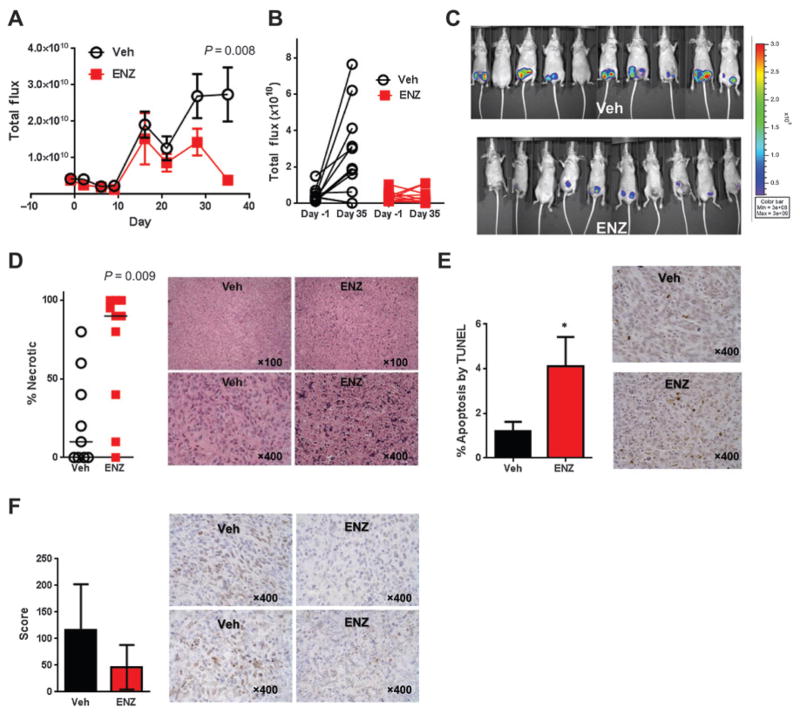
Enzalutamide (ENZ) decreases cellular viability and increases necrosis and apoptosis in SUM159PT xenografts. A, total flux growth curve of SUM159PT nude mice xenografts. Mice were randomized at day −1 and treatment was initiated on day 0. P value represents a 2-tailed t test comparing total flux between groups on day 35 and error bars represent SEM. B, change in total flux between randomization and day 35, by mouse. C, luminescent overlay of Veh and enzalutamide-treated mice. D, percent necrotic tissue by H&E staining. Horizontal bars represent median percentage necrotic tissue. P value represents a 2-tailed t test comparing percent necrosis between groups on day 35. Photomicrographs depict examples of tumor xenograft H&E staining showing viable tumor (Veh) and necrotic tumor (ENZ). E, TUNEL staining for apoptosis. Photomicrographs depict examples of TUNEL staining. F, AR nuclear score (score = intensity range 0 to 3× % positive) by IHC. Photomicrographs depict examples of AR staining in SUM159PT xenografts. *, P < 0.05; error bars, SEM.
Figure 5
Figure 5
AR inhibition decreases migration and invasion of TNBC cells. A, cellular morphology (200×) of BT549 cells transduced with a nontargeting control (shNEG) compared with a shRNA targeting AR (shAR15) in 3D Matrigel culture. Arrow, stellate cellular morphology. B, migration scratch wound assay of TNBC cell lines with AR knockdown under serum-starved conditions. C, scratch wound assay of TNBC AR knockdown cell lines invading through Matrigel. D, changes in cellular morphology of BT549 cells treated with vehicle (Veh) or enzalutamide (ENZ) in 3D Matrigel culture (200×). E, migration (left) and invasion (right) assays of BT549 cells treated with or without enzalutamide. **, P < 0.01; ***, P < 0.001 by the t test at the final time point.
Figure 6
Figure 6
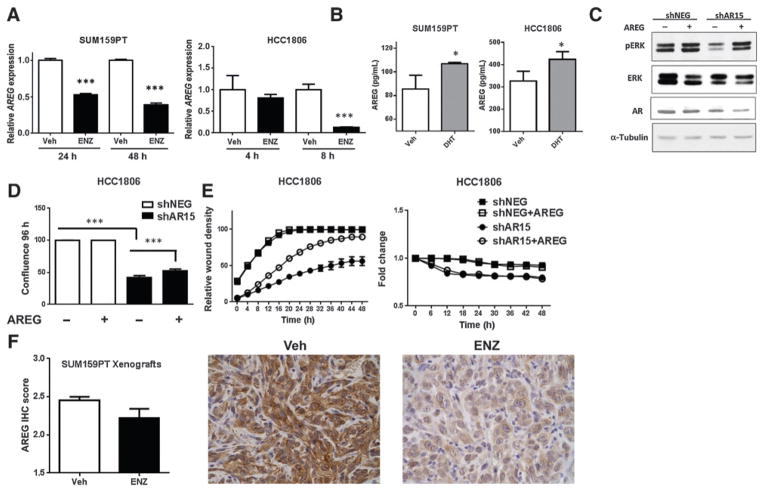
AR regulation of amphiregulin mediates baseline proliferation and migration of TNBC. A, quantitative real-time PCR (qRT-PCR) for amphiregulin (AREG) in SUM159PT cells and HCC1806 cells treated with enzalutamide (ENZ) in full serum. B, ELISA for extracellular AREG in SUM159PT and HCC1806 cell lines treated with vehicle (Veh) or dihydrotestosterone (DHT) for 48 and 72 hours, respectively. C, Western blotting of HCC1806 shNEG and shAR15 cells treated for 30 minutes with exogenous human recombinant AREG. D, proliferation assay of HCC1806 shNEG and shAR15 cells in the absence or presence of exogenous AREG. E, migration (left) and proliferation (right) assays of HCC1806 cells treated with or without exogenous AREG in identical, serum-starved conditions. F, AREG protein expression by IHC in SUM159PT xenografts. P = 0.04 using a 1-tailed t test. Photomicrographs depict representative AREG staining (400×). *, P < 0.05; ***, P < 0.001 by the t test.

References

    1. Dent R, Trudeau M, Pritchard KI, Hanna WM, Kahn HK, Sawka CA, et al. Triple-negative breast cancer: clinical features and patterns of recurrence. Clin Cancer Res. 2007;13:4429–34. - PubMed
    1. Liedtke C, Mazouni C, Hess KR, Andre F, Tordai A, Mejia JA, et al. Response to neoadjuvant therapy and long-term survival in patients with triple-negative breast cancer. J Clin Oncol. 2008;26:1275–81. - PubMed
    1. Cortazar P, Zhang L, Untch M, Mehta K, Costantino JP, Wolmark N, et al. Pathological complete response and long-term clinical benefit in breast cancer: the CTNeoBC pooled analysis. Lancet. 2014;384:164–72. - PubMed
    1. Skor MN, Wonder EL, Kocherginsky M, Goyal A, Hall BA, Cai Y, et al. Glucocorticoid receptor antagonism as a novel therapy for triple-negative breast cancer. Clin Cancer Res. 2013;19:6163–72. - PMC - PubMed
    1. Lonergan PE, Tindall DJ. Androgen receptor signaling in prostate cancer development and progression. J Carcinog. 2011;10:20. - PMC - PubMed

Publication types

MeSH terms