


Intensity and physiological responses to the 6-minute walk test in middle-aged and older adults: a comparison with cardiopulmonary exercise testing
- PMID: 25714888
- PMCID: PMC4418366
- DOI: 10.1590/1414-431X20144235
Intensity and physiological responses to the 6-minute walk test in middle-aged and older adults: a comparison with cardiopulmonary exercise testing
Abstract
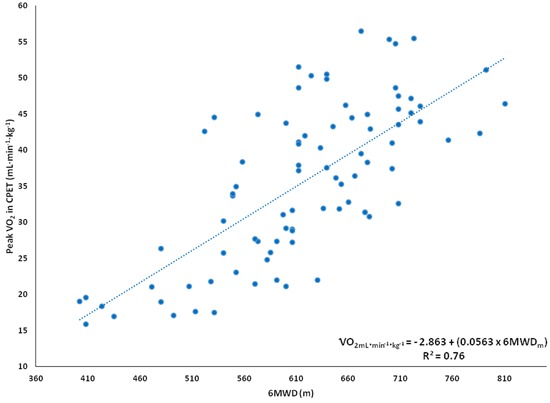
The 6-minute walk test (6MWT) is a simple field test that is widely used in clinical settings to assess functional exercise capacity. However, studies with healthy subjects are scarce. We hypothesized that the 6MWT might be useful to assess exercise capacity in healthy subjects. The purpose of this study was to evaluate 6MWT intensity in middle-aged and older adults, as well as to develop a simple equation to predict oxygen uptake ( V ˙ O 2 ) from the 6-min walk distance (6MWD). Eighty-six participants, 40 men and 46 women, 40-74 years of age and with a mean body mass index of 28±6 kg/m2, performed the 6MWT according to American Thoracic Society guidelines. Physiological responses were evaluated during the 6MWT using a K4b2 Cosmed telemetry gas analyzer. On a different occasion, the subjects performed ramp protocol cardiopulmonary exercise testing (CPET) on a treadmill. Peak V ˙ O 2 in the 6MWT corresponded to 78±13% of the peak V ˙ O 2 during CPET, and the maximum heart rate corresponded to 80±23% of that obtained in CPET. Peak V ˙ O 2 in CPET was adequately predicted by the 6MWD by a linear regression equation: V ˙ O 2 mL·min-1·kg-1 = -2.863 + (0.0563×6MWDm) (R2=0.76). The 6MWT represents a moderate-to-high intensity activity in middle-aged and older adults and proved to be useful for predicting cardiorespiratory fitness in the present study. Our results suggest that the 6MWT may also be useful in asymptomatic individuals, and its use in walk-based conditioning programs should be encouraged.
Figures
References
Publication types
MeSH terms
Substances
LinkOut - more resources
Full Text Sources
Miscellaneous
