


Sleep duration and risk of fatal and nonfatal stroke: a prospective study and meta-analysis
- PMID: 25716357
- PMCID: PMC4371404
- DOI: 10.1212/WNL.0000000000001371
Sleep duration and risk of fatal and nonfatal stroke: a prospective study and meta-analysis
Abstract
Objective: To study the association between sleep duration and stroke incidence in a British population and to synthesize our findings with published results through a meta-analysis.
Methods: The prospective study included 9,692 stroke-free participants aged 42-81 years from the European Prospective Investigation into Cancer-Norfolk cohort. Participants reported sleep duration in 1998-2000 and 2002-2004, and all stroke cases were recorded until March 31, 2009. For the meta-analysis, we searched Ovid Medline, EMBASE, and the Cochrane Library for prospective studies published until May 2014, and pooled effect estimates using a weighted random-effect model.
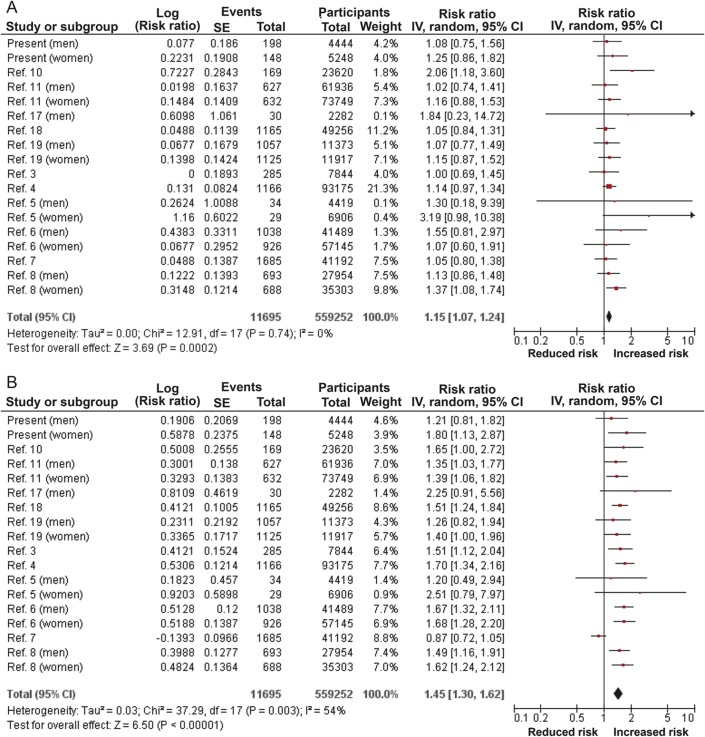
Results: After 9.5 years of follow-up, 346 cases of stroke occurred. Long sleep was significantly associated with an increased risk of stroke (hazard ratio [HR] = 1.46 [95% confidence interval (CI) 1.08, 1.98]) after adjustment for all covariates. The association remained robust among those without preexisting diseases and those who reported sleeping well. The association for short sleep was smaller (and not statistically significant) (HR = 1.18 [95% CI 0.91, 1.53]). There was a higher stroke risk among those who reported persistently long sleep or a substantial increase in sleep duration over time, compared to those reporting persistently average sleep. These were compatible with the pooled HRs from an updated meta-analysis, which were 1.15 (1.07, 1.24) and 1.45 (1.30, 1.62) for short and long sleep duration, respectively.
Conclusions: This prospective study and meta-analysis identified prolonged sleep as a potentially useful marker of increased future stroke risk in an apparently healthy aging population.
© 2015 American Academy of Neurology.
Figures
Comment in
-
Is sleep duration a risk factor for stroke?Neurology. 2015 Mar 17;84(11):1066-7. doi: 10.1212/WNL.0000000000001374. Epub 2015 Feb 25. Neurology. 2015. PMID: 25716359 No abstract available.
References
-
- Cappuccio FP, Cooper D, D'Elia L, Strazzullo P, Miller MA. Sleep duration predicts cardiovascular outcomes: a systematic review and meta-analysis of prospective studies. Eur Heart J 2011;32:1484–1492. - PubMed
-
- Qureshi AI, Giles WH, Croft JB, Bliwise DL. Habitual sleep patterns and risk for stroke and coronary heart disease: a 10-year follow-up from NHANES I. Neurology 1997;48:904–911. - PubMed
Publication types
MeSH terms
Grants and funding
LinkOut - more resources
Full Text Sources
Medical
