


Predictors of kidney tubular dysfunction induced by adefovir treatment for chronic hepatitis B
- PMID: 25717246
- PMCID: PMC4326148
- DOI: 10.3748/wjg.v21.i7.2116
Predictors of kidney tubular dysfunction induced by adefovir treatment for chronic hepatitis B
Abstract
Aim: To investigate the predictors of proximal kidney tubular dysfunction (PKTD) induced by adefovir dipivoxil (ADV) treatment for chronic hepatitis B.
Methods: Seventy-nine patients (age at the evaluation of PKTD: 56.9±10.7 years) with chronic hepatitis B undergoing long-term oral antiviral nucleos(t)ide analogue treatment were consecutively recruited. PKTD was defined by the presence of at least two of the following five abnormalities: phosphate diabetes, nondiabetic glucosuria, metabolic acidosis, β2-microglobulinuria, or renal hypouricemia. The single-nucleotide polymorphisms (SNPs) in the SLC22A6 gene encoding human organic anion transporter 1 (hOAT1) and ABCC2 encoding multidrug resistance protein 2 (MRP2) were analyzed using the TaqMan Allelic Discrimination Demonstration Kit.
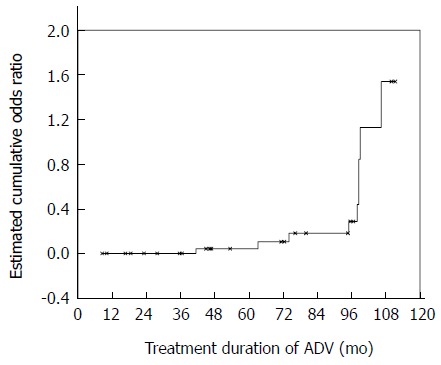
Results: Nine (30.0%) of the 30 ADV-treated patients were diagnosed with PKTD, while no patients without ADV developed PKTD (P<0.001). Three patients with ADV were diagnosed with symptomatic osteomalacia. Among the patients who took ADV, those with PKTD were of higher age at initiation, had significantly longer treatment duration, and had a significantly lower body mass index than those without PKTD. The incidence of PKTD dramatically increased after 96 mo from the start of ADV administration. In contrast, the SNPs were not correlated with PKTD. Logistic regression analysis extracted older age at initiation (OR=5.0, 95%CI: 1.1-23.4; P=0.040) and longer treatment duration (OR=3.2, 95%CI: 1.2-8.6; P=0.020) as significant factors associated with PKTD.
Conclusion: Our results suggest that the tubular function of the kidney of older patients undergoing long-term ADV treatment should be carefully evaluated.
Keywords: Adefovir dipivoxil; Fanconi syndrome; Hepatitis B virus; Proximal kidney tubular dysfunction.
Figures
References
-
- Liaw YF, Chu CM. Hepatitis B virus infection. Lancet. 2009;373:582–592. - PubMed
-
- Lavanchy D. Hepatitis B virus epidemiology, disease burden, treatment, and current and emerging prevention and control measures. J Viral Hepat. 2004;11:97–107. - PubMed
-
- Kashiwagi S, Hayashi J, Ikematsu H, Nomura H, Kusaba T, Shingu T, Hayashida K, Kaji M. An epidemiologic study of hepatitis B virus in Okinawa and Kyushu, Japan. Am J Epidemiol. 1983;118:787–794. - PubMed
-
- Furusyo N, Hayashi J, Sawayama Y, Kawakami Y, Kishihara Y, Kashiwagi S. The elimination of hepatitis B virus infection: changing seroepidemiology of hepatitis A and B virus infection in Okinawa, Japan over a 26-year period. Am J Trop Med Hyg. 1998;59:693–698. - PubMed
-
- Liaw YF. Hepatitis B virus replication and liver disease progression: the impact of antiviral therapy. Antivir Ther. 2006;11:669–679. - PubMed
Publication types
MeSH terms
Substances
LinkOut - more resources
Full Text Sources
Other Literature Sources
Medical
Molecular Biology Databases
