


Verification of Meso-Zeaxanthin in Fish
- PMID: 25717420
- PMCID: PMC4337966
- DOI: 10.4172/2157-7110.1000335
Verification of Meso-Zeaxanthin in Fish
Abstract
Background/objectives: The carotenoids lutein (L), zeaxanthin (Z), and meso-zeaxanthin (MZ) accumulate in the central retina (the macula), where they are collectively known as macular pigment (MP). MP has been shown to enhance visual function in both diseased and non-diseased retinae, and therefore an understanding and confirmation of, the origins of these carotenoids is needed. Studies have shown that L and Z are present in many foodstuffs found in a typical Western diet (e.g. spinach, kale, peppers, yellow corn and eggs). It has been shown that MZ is generated from L in the primate retina and earlier reports suggested that MZ was present in some fish species. Recently, however, one research group reported that MZ is not present in fish and suggested that the earlier reports showing MZ in these marine species were a methodological artefact. The current study was designed to investigate the reason for the contradiction, and test for the presence of MZ in fish and some other foods.
Methods: Raw fruits, vegetables and fish were extracted for carotenoid analysis by high performance liquid chromatography.
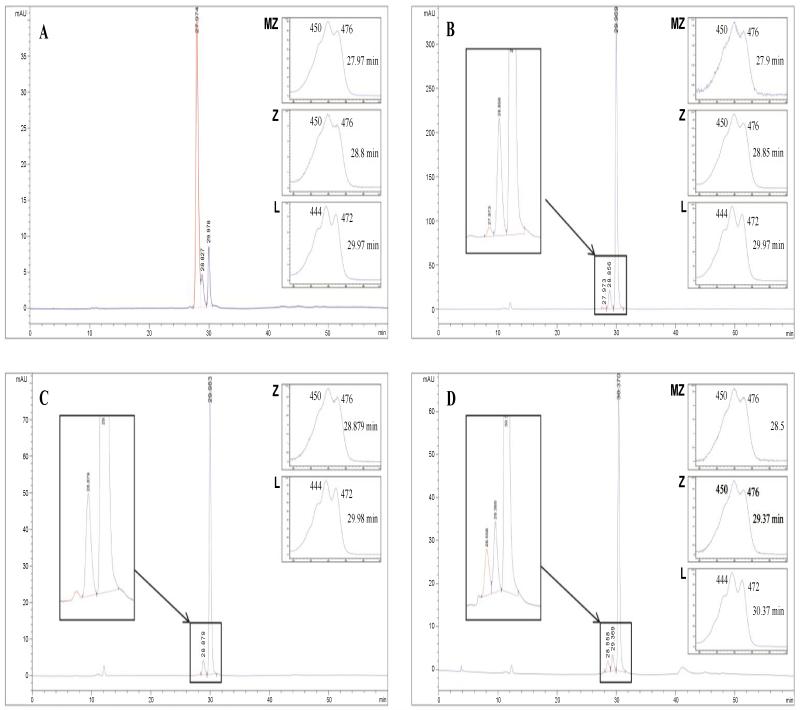
Results: MZ was not detected in any of the fruits or vegetables tested in our study. However, using retention time matching, absorption spectrum comparison, and sample spiking, we verified the presence of MZ in salmon skin, sardine skin, trout skin and trout flesh.
Conclusion: This study confirmed the presence MZ in nature, and in the human food chain.
Keywords: Carotenoids; Fish; Food analysis; Food composition; HPLC; Lutein; Macular pigment; Meso-zeaxanthin; Seafood; Zeaxanthin.
Figures

References
-
- Britton G, Liaaen-Jensen S, Pfander H. Carotenoids: Nutrition and Health. Birkhäuser Basel. 2009
-
- Khachik F, Beecher GR, Goli MB. Separation, identification and quantification of carotenoids in fruits, vegetables and human plasma by high performance liquid chromatography. Pure & Applied Chemistry. 1991;63:71–80.
-
- Khachik F, Beecher GR, Goli MB. Separation and identification of carotenoids and their oxidation products in the extracts of human plasma. Analytical Chemistry. 1992;64:2111–2122. - PubMed
-
- Bone RA, Landrum JT, Tarsis SL. Preliminary identification of the human macular pigment. Vision Res. 1985;25:1531–1535. - PubMed
-
- Bone RA, Landrum JT, Hime GW, Cains A, Zamor J. Stereochemistry of the Human Macular Carotenoids. Invest Ophthalmol Vis Sci. 1993;34:2033–2040. - PubMed
Grants and funding
LinkOut - more resources
Full Text Sources
Other Literature Sources