


Defining the relationship between patient decisions to undergo breast reconstruction and contralateral prophylactic mastectomy
- PMID: 25719688
- PMCID: PMC4822506
- DOI: 10.1097/PRS.0000000000001044
Defining the relationship between patient decisions to undergo breast reconstruction and contralateral prophylactic mastectomy
Abstract
Background: Recent studies suggest that the decisions to undergo breast reconstruction and contralateral prophylactic mastectomy are closely related. In this article, the relationship between method of reconstruction and decision to undergo contralateral prophylactic mastectomy is described. Recent trends in contralateral use in the context of literature questioning its oncologic benefit are also evaluated.
Methods: Female patients with unilateral breast cancer were identified and data extracted from the Surveillance, Epidemiology, and End Results database from 2000 through 2010. Logistic regression analyses were performed to study the relationship between having contralateral prophylactic mastectomy and key demographic, oncologic, and reconstructive factors among women with unilateral breast cancer.
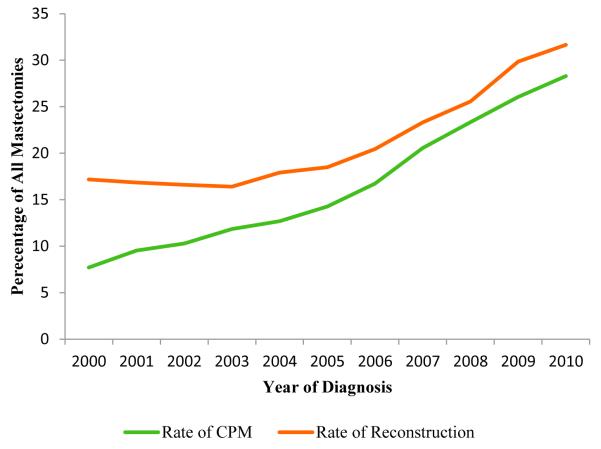
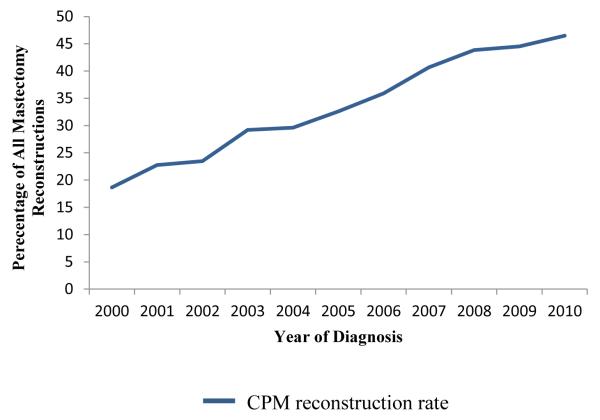
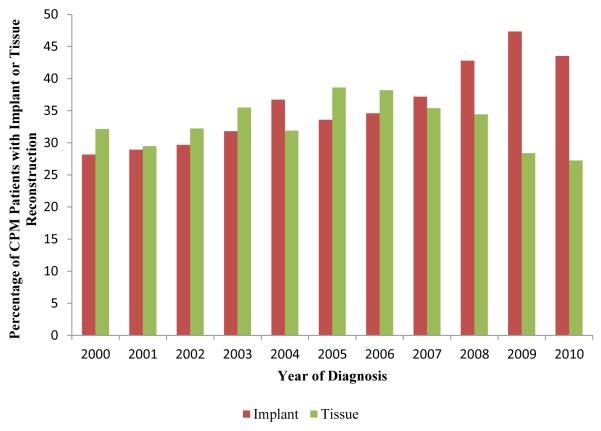
Results: A total of 157,042 patients with unilateral breast cancer were included. The contralateral prophylactic mastectomy rate increased from 7.7 percent to 28.3 percent during the study period, and the proportion of reconstructed patients who underwent contralateral prophylactic mastectomy increased from 19 percent to 46 percent. Reconstruction was associated with higher odds of contralateral prophylactic mastectomy (OR, 2.79; 95 percent CI, 2.70 to 2.88; p < 0.0001). Among women who had reconstruction, implant-based reconstruction was associated with significantly higher odds of contralateral prophylactic mastectomy than autologous tissue reconstruction (OR, 1.38; p < 0.0001).
Conclusions: This study confirms that reconstruction and the decision to undergo contralateral prophylactic mastectomy are closely related, with implant reconstruction dominating in these patients. Given the close relationship between reconstruction and the choice for contralateral prophylactic mastectomy, plastic surgeons should play an active role in educating patients to avoid decisions made based on inaccurate information.
Clinical question/level of evidence: Risk, II.
Figures
References
-
- King TA, Sakr R, Patil S, et al. Clinical management factors contribute to the decision for contralateral prophylactic mastectomy. J Clin Oncol. 2011;29:2158–64. - PubMed
-
- Arrington AK, Jarosek SL, Virnig BA, et al. Patient and surgeon characteristics associated with increased use of contralateral prophylactic mastectomy in patients with breast cancer. Ann Surg Oncol. 2009;16:2697–2704. - PubMed
-
- Jones NB, Wilson J, Kotur L, et al. Contralateral prophylactic mastectomy for unilateral breast cancer: An increasing trend at a single institution. Ann Surg Oncol. 2009;16:2691–2696. - PubMed
-
- Morrow M. Prophylactic mastectomy of the contralateral breast. The Breast. 2011;S3:S108–10. - PubMed
-
- Rosen PP, Groshen S, Kinne DW, Norton L. Factors influencing prognosis in node negative breast carcinoma: analysis of 767 T1N0M0/T2N0M0 patients with long term follow-up. J Clin Oncol. 1993;11:2090–100. - PubMed
Publication types
MeSH terms
Grants and funding
LinkOut - more resources
Full Text Sources
Medical
Research Materials
