


Posttraumatic stress disorder according to DSM-5 and DSM-IV diagnostic criteria: a comparison in a sample of Congolese ex-combatants
- PMID: 25720994
- PMCID: PMC4342502
- DOI: 10.3402/ejpt.v6.24981
Posttraumatic stress disorder according to DSM-5 and DSM-IV diagnostic criteria: a comparison in a sample of Congolese ex-combatants
Abstract
Background: Compared to DSM-IV, the criteria for diagnosing posttraumatic stress disorder (PTSD) have been modified in DSM-5.
Objective: The first aim of this study was to examine how these modifications impact rates of PTSD in a sample of Congolese ex-combatants. The second goal of this study was to investigate whether PTSD symptoms were associated with perpetrator-related acts or victim-related traumatic events.
Method: Ninety-five male ex-combatants in the eastern Democratic Republic of Congo were interviewed. Both the DSM-IV and the DSM-5 PTSD symptom criteria were assessed.
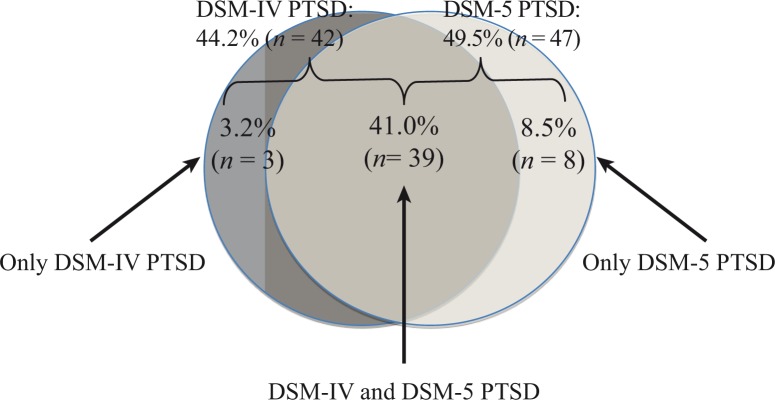
Results: The DSM-5 symptom criteria yielded a PTSD rate of 50% (n=47), whereas the DSM-IV symptom criteria were met by 44% (n=42). If the DSM-5 would be set as the current "gold standard," then DSM-IV would have produced more false negatives (8%) than false positives (3%). A minority of participants (19%, n=18) indicated an event during which they were involved as a perpetrator as their most stressful event. RESULTS of a regression analysis (R (2)=0.40) showed that, after accounting for the number of types of traumatic events, perpetrated violent acts were not associated with the symptom severity of PTSD.
Conclusions: The findings demonstrate that more diagnostic cases were produced with the DSM-5 diagnostic rules than were dropped resulting in an increase in PTSD rates compared to the DSM-IV system. The missing association between PTSD symptoms and perpetrated violent acts might be explained by a potential fascinating and excited perception of these acts.
Keywords: Congo; DSM-5; DSM-IV; PTSD; ex-combatants; violence.
Figures
References
-
- American Psychiatric Association. Diagnostic and statistical manual of mental disorders. 4th ed. Washington, DC: American Psychiatric Association; 2000. Text Rev.
-
- American Psychiatric Association. Diagnostic and statistical manual of mental disorders: DSM-5 . 4th ed. Arlington, VA: American Psychiatric Association; 2013.
-
- Elhai J. D, Miller M. E, Ford J. D, Biehn T. L, Palmieri P. A, Frueh B. Posttraumatic stress disorder in DSM-5: Estimates of prevalence and symptom structure in a nonclinical sample of college students. Journal of Anxiety Disorders. 2012;26(1):58–64. doi: 10.1016/j.janxdis.2011.08.013. - DOI - PubMed
LinkOut - more resources
Full Text Sources
Other Literature Sources
Miscellaneous
