Review
. 2015 May:479-480:600-8.
doi: 10.1016/j.virol.2015.02.007. Epub 2015 Feb 24.

Emerging roles for RNA degradation in viral replication and antiviral defense

Affiliations
Review

Emerging roles for RNA degradation in viral replication and antiviral defense

Emma Abernathy et al. Virology. 2015 May.

Abstract

Viral replication significantly alters the gene expression landscape of infected cells. Many of these changes are driven by viral manipulation of host transcription or translation machinery. Several mammalian viruses encode factors that broadly dampen gene expression by directly targeting messenger RNA (mRNA). Here, we highlight how these factors promote mRNA degradation to globally regulate both host and viral gene expression. Although these viral factors are not homologous and use distinct mechanisms to target mRNA, many of them display striking parallels in their strategies for executing RNA degradation and invoke key features of cellular RNA quality control pathways. In some cases, there is a lack of selectivity for degradation of host versus viral mRNA, indicating that the purposes of virus-induced mRNA degradation extend beyond redirecting cellular resources towards viral gene expression. In addition, several antiviral pathways use RNA degradation as a viral restriction mechanism, and we will summarize new findings related to how these host-encoded ribonucleases target and destroy viral RNA.

Keywords: Endonuclease; Host shutoff; MRNA degradation; Xrn1.


Figures

Fig. 1
Fig. 1
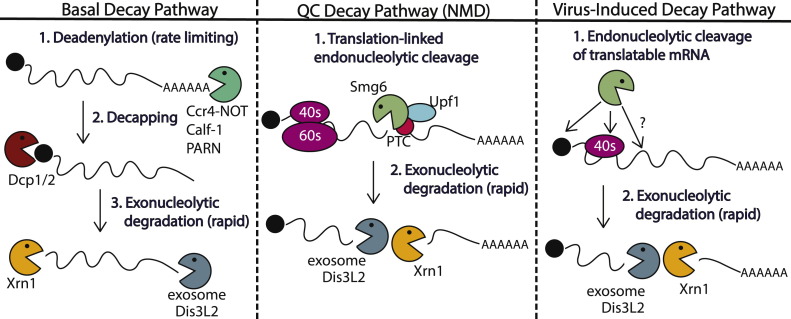
Overview of cellular and viral decay pathways. Basal decay begins with the rate-limiting step of deadenylation, followed by decapping and exonucleolytic degradation of the mRNA body. Quality control decay pathways such as NMD recognize aberrant mRNAs during translation, including the presence of premature termination codons (PTC), and induce endonucleolytic cleavage, whereupon the fragments are degraded by exonucleases. Virus-induced decay also bypass early steps of the basal decay pathway and involves internal cleavage of mRNAs, usually in a translation-linked manner, which is followed by degradation by host exonucleases.
Fig. 2
Fig. 2
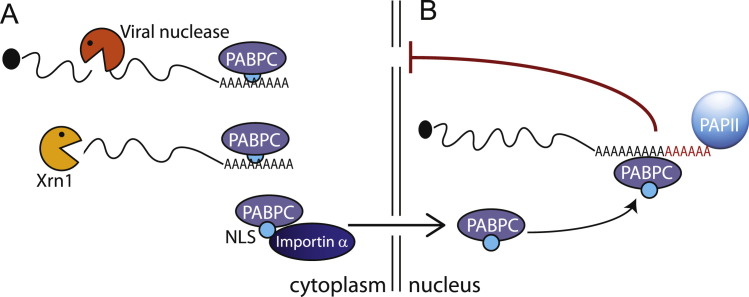
Virus-induced mRNA degradation impacts RNA processing. (A) Widespread mRNA degradation in the cytoplasm leads to release of PABPC from poly(A) tails. This exposes its NLS, which is normally masked during RNA binding, leading to nuclear import via interactions with importin α. (B) Nuclear accumulation of PABPC promotes hyperadenylation of nascent transcripts via PAP II and an mRNA export block.
Fig. 3
Fig. 3
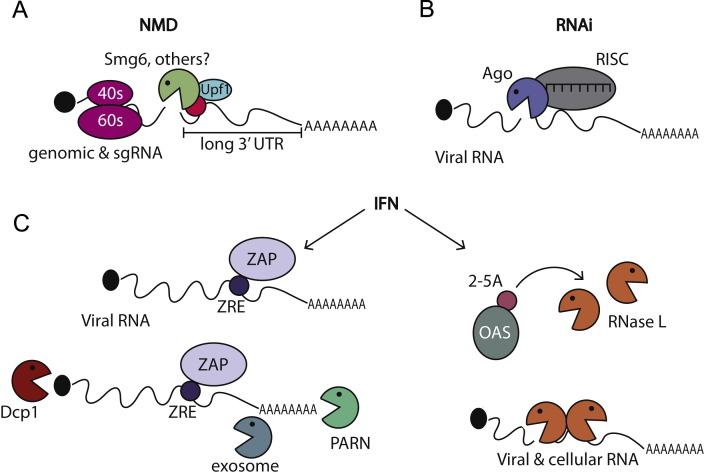
Cellular nucleases with antiviral roles. (A) Viral RNA of (+) RNA viruses can be recognized by cellular QC pathways like NMD, in some cases due to long 3′ UTRs which are inherent to subgenomic RNAs (sgRNA). This leads to their degradation by Smg6 and perhaps other nucleases. (B) RNAi cleaves viral dsRNA, which is loaded into a RNA induced silencing complex (RISC) that targets viral RNA for endonucleolytic cleavage by Ago. (C) IFN-activated mRNA degradation pathways include ZAP and RNase L. ZAP binds viral RNA at specific response elements (ZRE) and recruits cellular decay factors, including deadenylase PARN, de-capping enzyme Dcp1, and the 3′–5′ exosome. IFN also induces 2–5A synthase (OAS) to synthesize the RNase L activator 2–5A, leading to RNase L dimerization and cleavage of viral and cellular RNAs.

References

    1. Abernathy E., Clyde K., Yeasmin R., Krug L.T., Burlingame A., Coscoy L., Glaunsinger B. Gammaherpesviral gene expression and virion composition are broadly controlled by accelerated mRNA degradation. PLoS Pathog. 2014;10:e1003882. - PMC - PubMed
    1. Al-Saif M., Khabar K.S. UU/UA dinucleotide frequency reduction in coding regions results in increased mRNA stability and protein expression. Mol. Ther.the journal of the American Society of Gene Therapy. 2012;20:954–959. - PMC - PubMed
    1. Almeida M.S., Johnson M.A., Herrmann T., Geralt M., Wuthrich K. Novel beta-barrel fold in the nuclear magnetic resonance structure of the replicase nonstructural protein 1 from the severe acute respiratory syndrome coronavirus. J. Virol. 2007;81:3151–3161. - PMC - PubMed
    1. Anderson B.R., Muramatsu H., Jha B.K., Silverman R.H., Weissman D., Kariko K. Nucleoside modifications in RNA limit activation of 2′–5′-oligoadenylate synthetase and increase resistance to cleavage by RNase L. Nucleic Acids Res. 2011;39:9329–9338. - PMC - PubMed
    1. Arias C., Walsh D., Harbell J., Wilson A.C., Mohr I. Activation of host translational control pathways by a viral developmental switch. PLoS Pathog. 2009;5:e1000334. - PMC - PubMed

LinkOut - more resources