


Colorectal cancer deaths attributable to nonuse of screening in the United States
- PMID: 25721748
- PMCID: PMC4554530
- DOI: 10.1016/j.annepidem.2014.11.011
Colorectal cancer deaths attributable to nonuse of screening in the United States
Abstract
Purpose: Screening is a major contributor to colorectal cancer (CRC) mortality reductions in the United States but is underused. We estimated the fraction of CRC deaths attributable to nonuse of screening to demonstrate the potential benefits from targeted interventions.
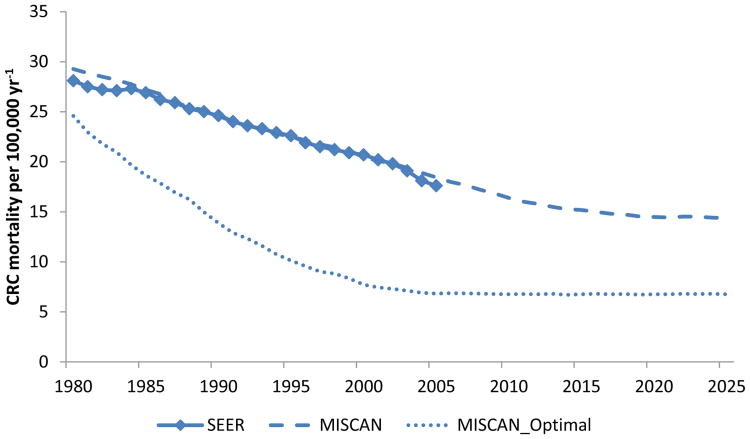
Methods: The established microsimulation screening analysis colon model was used to estimate the population attributable fraction (PAF) in people aged ≥50 years. The model incorporates long-term patterns and effects of screening by age and type of screening test. PAF for 2010 was estimated using currently available data on screening uptake. PAF was also projected assuming constant future screening rates to incorporate lagged effects from past increases in screening uptake. We also computed PAF using Levin's formula to gauge how this simpler approach differs from the model-based approach.
Results: There were an estimated 51,500 CRC deaths in 2010, about 63% (N ∼ 32,200) of which were attributable to nonscreening. The PAF decreases slightly to 58% in 2020. Levin's approach yielded a considerably more conservative PAF of 46% (N ∼ 23,600) for 2010.
Conclusions: Most of the current United States CRC deaths are attributable to nonscreening. This underscores the potential benefits of increasing screening uptake in the population. Traditional methods of estimating PAF underestimated screening effects compared with model-based approaches.
Keywords: Adenomas; Adenomatous polyps; Colorectal neoplasms; Computer simulation; Epidemiology; Screening and early detection; Secondary prevention.
Copyright © 2015 Elsevier Inc. All rights reserved.
Conflict of interest statement
Figures



References
-
- Siegel R, Desantis C, Jemal A. Colorectal cancer statistics, 2014. CA Cancer J Clin. 2014 Mar-Apr;64(2):104–17. - PubMed
-
- Jemal A, Center MM, DeSantis C, Ward EM. Global patterns of cancer incidence and mortality rates and trends. Cancer Epidemiol Biomarkers Prev. 2010 Aug;19(8):1893–907. - PubMed
-
- Yang DX, Gross CP, Soulos PR, Yu JB. Estimating the magnitude of colorectal cancers prevented during the era of screening: 1976 to 2009. Cancer. 2014 Jun 3; - PubMed
-
- Edwards BK, Ward E, Kohler BA, Eheman C, Zauber AG, Anderson RN, et al. Annual report to the nation on the status of cancer, 1975-2006, featuring colorectal cancer trends and impact of interventions (risk factors, screening, and treatment) to reduce future rates. Cancer. 2010 Feb 1;116(3):544–73. - PMC - PubMed
-
- Centres for Disease Control and Prevention. [cited 2014 May, 30];March Is National Colorectal Cancer Awareness Month. 2014 Available from: http://www.cdc.gov/cancer/dcpc/resources/features/colorectalawareness/
Publication types
MeSH terms
Grants and funding
LinkOut - more resources
Full Text Sources
Other Literature Sources
Medical
Miscellaneous
