Review
. 2015:2015:616834.
doi: 10.1155/2015/616834. Epub 2015 Feb 4.

Crosstalk between red blood cells and the immune system and its impact on atherosclerosis

Affiliations
Review

Crosstalk between red blood cells and the immune system and its impact on atherosclerosis

Brigitta Buttari et al. Biomed Res Int. 2015.

Abstract

Atherosclerosis is a chronic multifactorial disease of the arterial wall characterized by inflammation, oxidative stress, and immune system activation. Evidence exists on a pathogenic role of oxidized red blood cells (RBCs) accumulated in the lesion after intraplaque hemorrhage. This review reports current knowledge on the impact of oxidative stress in RBC modifications with the surface appearance of senescent signals characterized by reduced expression of CD47 and glycophorin A and higher externalization of phosphatidylserine. The review summarizes findings indicating that oxidized, senescent, or stored RBCs, due to surface antigen modification and release of prooxidant and proinflammatory molecules, exert an impaired modulatory activity on innate and adaptive immune cells and how this activity contributes to atherosclerotic disease. In particular RBCs from patients with atherosclerosis, unlike those from healthy subjects, fail to control lipopolysaccharide-induced DC maturation and T lymphocyte apoptosis. Stored RBCs, accompanied by shedding of extracellular vesicles, stimulate peripheral blood mononuclear cells to release proinflammatory cytokines, augment mitogen-driven T cell proliferation, and polarize macrophages toward the proinflammatory M1 activation pathway. Collectively, literature data suggest that the crosstalk between RBCs with immune cells represents a novel mechanism by which oxidative stress can contribute to atherosclerotic disease progression and may be exploited for therapeutic interventions.


Figures
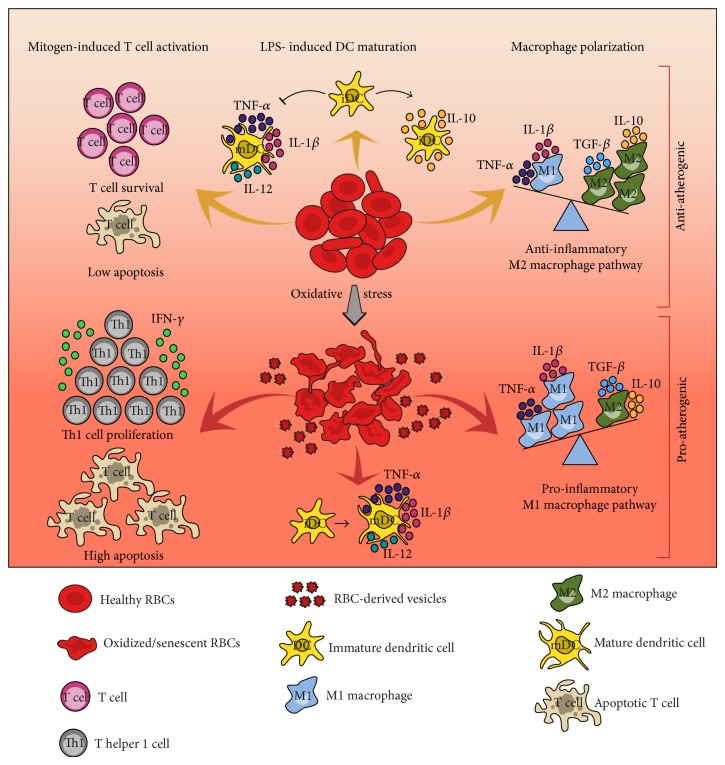
Figure 1
Figure 1
Proposed schematic model showing how the crosstalk between healthy or oxidized/senescent red blood cells (RBCs) and immune cells may exert anti- and proatherogenic effects, respectively. Human healthy RBCs release protein factors with the capacity to sustain T cell survival and to inhibit activation-induced T cell apoptosis. Healthy RBCs are also able to prevent a complete DC maturation in response to LPS, thus inducing phenotypic and functional characteristics typical of immature/tolerogenic DCs characterized by high IL-10 production. Healthy RBCs under noninflammatory conditions might promote a shift toward the anti-inflammatory M2 macrophage pathway. Thus, healthy RBCs may exert an immunomodulatory activity sustaining anti-inflammatory and antiatherogenic mechanisms. Under oxidative stress or store banking conditions, RBCs acquire an oxidized/senescent phenotype resulting in surface antigen modification or release of extracellular vesicles. In this way, oxidized/senescent RBCs or RBC-derived vesicles are capable of augment mitogen-driven T cell proliferation and apoptosis and determine a T helper 1 (Th1) proinflammatory and proatherogenic cytokine response. Oxidized/senescent RBCs, failing to control LPS-induced DC maturation, promote DC maturation toward a DC profile capable of inciting a proinflammatory Th1 cell response. Stored RBCs might polarize macrophages toward the classical M1 macrophage activation pathway associated with proinflammatory cytokine production. We propose that the oxidative injuries on RBCs likely represent dangerous signals for innate and adaptive immune cells, thus contributing or even triggering a damaging process worsening atherosclerotic disease.

References

    1. Arosa F. A., Pereira C. F., Fonseca A. M. Red blood cells as modulators to T cell growth and survival. Current Pharmaceutical Design. 2004;10(2):191–201. doi: 10.2174/1381612043453432. - DOI - PubMed
    1. Schäkel K., von Kietzell M., Hänsel A., et al. Human 6-sulfo LacNAc-expressing dendritic cells are principal producers of early interleukin-12 and are controlled by erythrocytes. Immunity. 2006;24(6):767–777. doi: 10.1016/j.immuni.2006.03.020. - DOI - PubMed
    1. Businaro R., Tagliani A., Buttari B., et al. Cellular and molecular players in the atherosclerotic plaque progression. Annals of the New York Academy of Sciences. 2012;1262(1):134–141. doi: 10.1111/j.1749-6632.2012.06600.x. - DOI - PubMed
    1. Hansson G. K., Hermansson A. The immune system in atherosclerosis. Nature Immunology. 2011;12(3):204–212. doi: 10.1038/ni.2001. - DOI - PubMed
    1. Woollard K. J., Geissmann F. Monocytes in atherosclerosis: subsets and functions. Nature Reviews Cardiology. 2010;7(2):77–86. doi: 10.1038/nrcardio.2009.228. - DOI - PMC - PubMed

MeSH terms
