


Exosome and exosomal microRNA: trafficking, sorting, and function
- PMID: 25724326
- PMCID: PMC4411500
- DOI: 10.1016/j.gpb.2015.02.001
Exosome and exosomal microRNA: trafficking, sorting, and function
Abstract
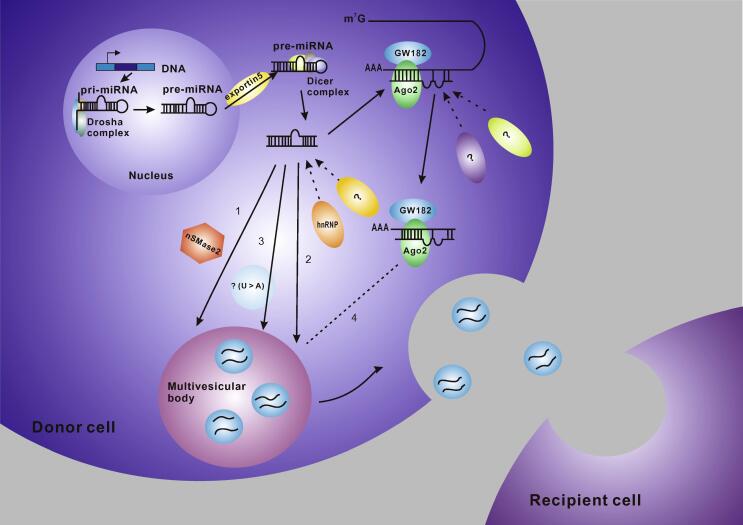
Exosomes are 40-100 nm nano-sized vesicles that are released from many cell types into the extracellular space. Such vesicles are widely distributed in various body fluids. Recently, mRNAs and microRNAs (miRNAs) have been identified in exosomes, which can be taken up by neighboring or distant cells and subsequently modulate recipient cells. This suggests an active sorting mechanism of exosomal miRNAs, since the miRNA profiles of exosomes may differ from those of the parent cells. Exosomal miRNAs play an important role in disease progression, and can stimulate angiogenesis and facilitate metastasis in cancers. In this review, we will introduce the origin and the trafficking of exosomes between cells, display current research on the sorting mechanism of exosomal miRNAs, and briefly describe how exosomes and their miRNAs function in recipient cells. Finally, we will discuss the potential applications of these miRNA-containing vesicles in clinical settings.
Keywords: Cell-to-cell communication; Circulating microRNA; Exosome; Extracellular microRNA; Sorting.
Copyright © 2015 The Authors. Production and hosting by Elsevier Ltd.. All rights reserved.
Figures
References
-
- Simons M., Raposo G. Exosomes – vesicular carriers for intercellular communication. Curr Opin Cell Biol. 2009;21:575–581. - PubMed
-
- Mathivanan S., Ji H., Simpson R.J. Exosomes: extracellular organelles important in intercellular communication. J Proteomics. 2010;73:1907–1920. - PubMed
-
- Gross J.C., Chaudhary V., Bartscherer K., Boutros M. Active Wnt proteins are secreted on exosomes. Nat Cell Biol. 2012;14:1036–1045. - PubMed
-
- Bartel D.P. MicroRNAs: genomics, biogenesis, mechanism, and function. Cell. 2004;116:281–297. - PubMed
Publication types
MeSH terms
Substances
LinkOut - more resources
Full Text Sources
Other Literature Sources
