Review
. 2015 Mar;39(2):184-202.
doi: 10.1093/femsre/fuu012. Epub 2015 Jan 23.

Illumination of growth, division and secretion by metabolic labeling of the bacterial cell surface

Affiliations
Review

Illumination of growth, division and secretion by metabolic labeling of the bacterial cell surface

M Sloan Siegrist et al. FEMS Microbiol Rev. 2015 Mar.

Abstract

The cell surface is the essential interface between a bacterium and its surroundings. Composed primarily of molecules that are not directly genetically encoded, this highly dynamic structure accommodates the basic cellular processes of growth and division as well as the transport of molecules between the cytoplasm and the extracellular milieu. In this review, we describe aspects of bacterial growth, division and secretion that have recently been uncovered by metabolic labeling of the cell envelope. Metabolite derivatives can be used to label a variety of macromolecules, from proteins to non-genetically-encoded glycans and lipids. The embedded metabolite enables precise tracking in time and space, and the versatility of newer chemoselective detection methods offers the ability to execute multiple experiments concurrently. In addition to reviewing the discoveries enabled by metabolic labeling of the bacterial cell envelope, we also discuss the potential of these techniques for translational applications. Finally, we offer some guidelines for implementing this emerging technology.

Keywords: bioorthogonal; click chemistry; glycolipid; metabolic labeling; peptidoglycan; protein secretion.


Figures

None
We review aspects of bacterial growth, division and secretion that have recently been uncovered by metabolic labeling of the cell surface.
Figure 1.
Figure 1.
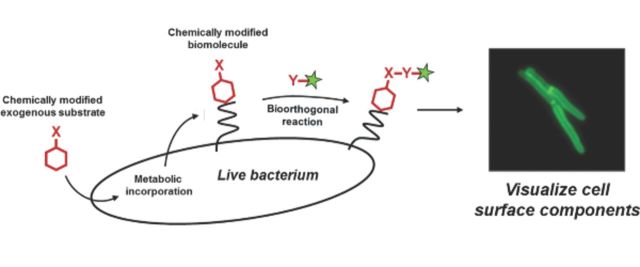
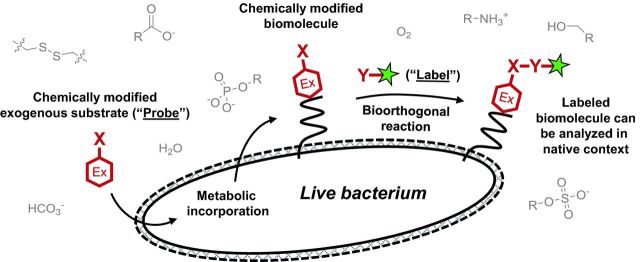
General scheme for metabolic labeling followed by bioorthogonal chemical detection. Chemical or chemoenzymatic synthesis is used to prepare the probe, which is a substrate (red hexagon) modified with a small chemical reporter group X. The endogenous metabolic machinery of the bacterium incorporates the exogenously added probe into the macromolecule of interest. The presence of X is detected by incubating the cell surface of intact (and often live) bacteria with a reaction partner Y containing the label (green star), which is a detectable group such as a fluorophore. X and Y form a covalent bond, thus embedding the label in the macromolecule. Selective, non-toxic reactions that occur in the presence of other cellular biomolecules (gray) are termed ‘bioorthogonal’ and are summarized in Table 1.
Figure 2.
Figure 2.
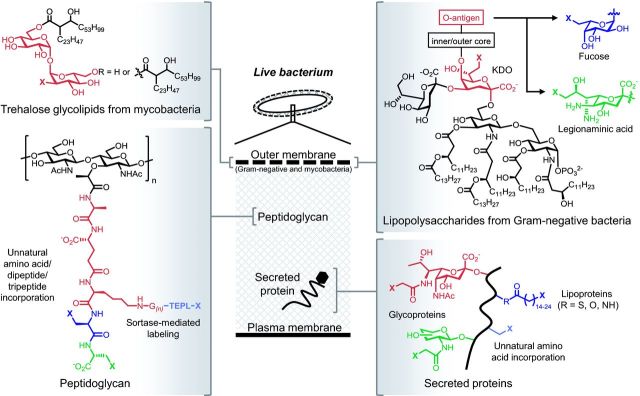
Structure and location of cell envelope macromolecules covered in this review. The embedded metabolic labels (various colors) contain chemical reporters denoted as X. See Table 2 for representative publications and more detailed information regarding metabolic incorporation.
Figure 3.
Figure 3.
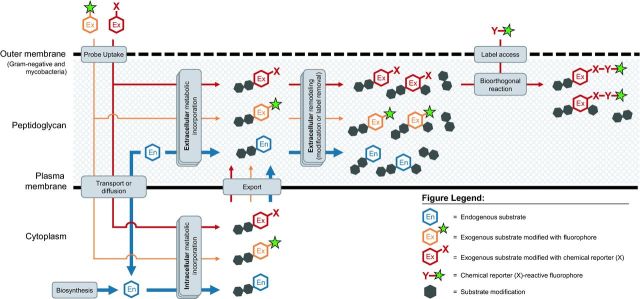
Labeling the bacterial cell surface by hijacking endogenous metabolic pathways (blue) with exogenous substrates via one-step (orange) and two-step (red) approaches. Thickness of arrows indicates probable relative processing efficiency of substrates by the cell's metabolic machinery.

References

    1. Abe R, Caaveiro JM, Kozuka-Hata H, et al. Mapping ultra-weak protein–protein interactions between heme transporters of Staphylococcus aureus. J Biol Chem. 2012;287:16477–87. - PMC - PubMed
    1. Agard NJ, Prescher JA, Bertozzi CR. A strain-promoted [3 + 2] azide-alkyne cycloaddition for covalent modification of biomolecules in living systems. J Am Chem Soc. 2004;126:15046–7. - PubMed
    1. Aldridge BB, Fernandez-Suarez M, Heller D, et al. Asymmetry and aging of mycobacterial cells lead to variable growth and antibiotic susceptibility. Science. 2012;335:100–4. - PMC - PubMed
    1. Ali MM, Kang DK, Tsang K, et al. Cell-surface sensors: lighting the cellular environment. Wiley Interdiscip Rev Nanomed Nanobiotechnol. 2012;4:547–61. - PMC - PubMed
    1. Alvarez L, Espaillat A, Hermoso JA, et al. Peptidoglycan remodeling by the coordinated action of multispecific enzymes. Microb Drug Resist. 2014;20:190–8. - PMC - PubMed

Publication types

MeSH terms