


Enteropathogenic Escherichia coli: foe or innocent bystander?
- PMID: 25726041
- PMCID: PMC4497942
- DOI: 10.1016/j.cmi.2015.01.015
Enteropathogenic Escherichia coli: foe or innocent bystander?
Abstract
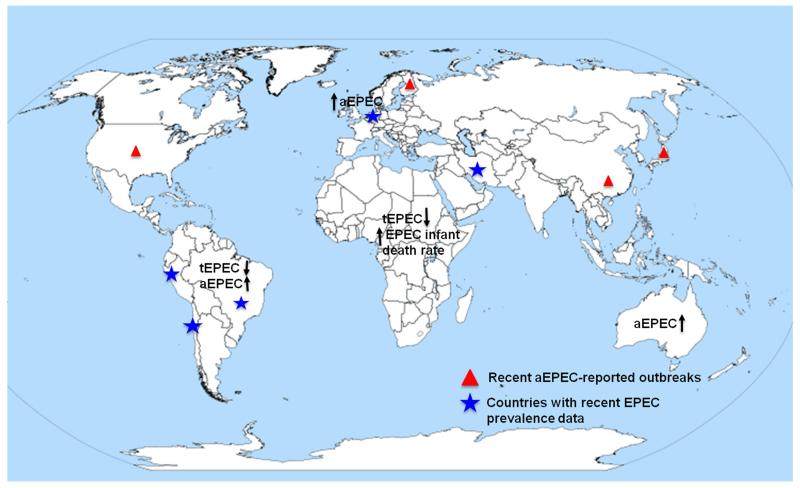
Enteropathogenic Escherichia coli (EPEC) remain one the most important pathogens infecting children and they are one of the main causes of persistent diarrhoea worldwide. Historically, typical EPEC (tEPEC), defined as those isolates with the attaching and effacement (A/E) genotype (eae(+)), which possess bfpA(+) and lack the stx(-) genes are found strongly associated with diarrhoeal cases. However, occurrence of atypical EPEC (aEPEC; eae(+)bfpA(-)stx(-)) in diarrhoeal and asymptomatic hosts has made investigators question the role of these pathogens in human disease. Current epidemiological data are helping to answer the question of whether EPEC is mainly a foe or an innocent bystander during infection.
Keywords: Asymptomatic pathogenic Escherichia coli; atypical EPEC; diarrhoea; enteropathogenic Escherichia coli; epidemiology.
Copyright © 2015 European Society of Clinical Microbiology and Infectious Diseases. Published by Elsevier Ltd. All rights reserved.
Figures
References
-
- Liu L, Johnson HL, Cousens S, Perin J, Scott S, Lawn JE, et al. Global, regional, and national causes of child mortality: an updated systematic analysis for 2010 with time trends since 2000. Lancet. 2012;379:2151–61. - PubMed
-
- Bhutta ZA, Das JK. Global burden of childhood diarrhea and pneumonia: what can and should be done? Pediatrics. 2013;131:634–6. - PubMed
-
- Neter E, Westphal O, Luderitz O, Gino RM, Gorzynski EA. Demonstration of antibodies against enteropathogenic Escherichia coli in sera of children of various ages. Pediatrics. 1955;16:801–8. - PubMed
Publication types
MeSH terms
Substances
Grants and funding
LinkOut - more resources
Full Text Sources
Other Literature Sources
Medical
