


Binocular iPad treatment for amblyopia in preschool children
- PMID: 25727578
- PMCID: PMC4346708
- DOI: 10.1016/j.jaapos.2014.09.009
Binocular iPad treatment for amblyopia in preschool children
Abstract
Background: Recent experimental evidence supports a role for binocular visual experience in the treatment of amblyopia. The purpose of this study was to determine whether repeated binocular visual experience with dichoptic iPad games could effectively treat amblyopia in preschool children.
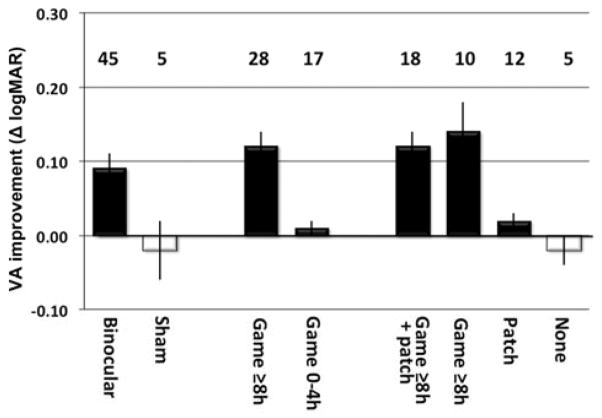
Methods: A total of 50 consecutive amblyopic preschool children 3-6.9 years of age were assigned to play sham iPad games (first 5 children) or binocular iPad games (n = 45) for at least 4 hours per week for 4 weeks. Thirty (67%) children in the binocular iPad group and 4 (80%) in the sham iPad group were also treated with patching at a different time of day. Visual acuity and stereoacuity were assessed at baseline, at 4 weeks, and at 3 months after the cessation of game play.
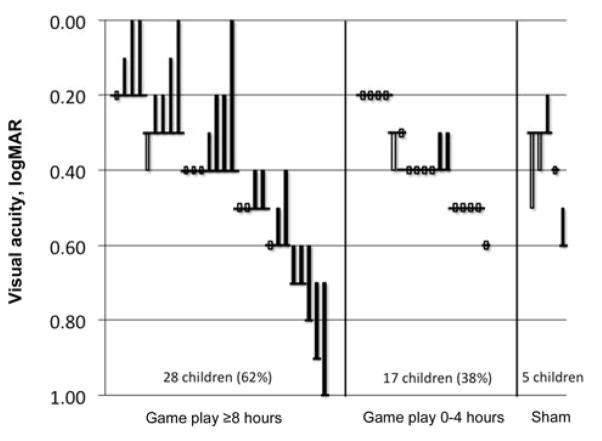
Results: The sham iPad group had no significant improvement in visual acuity (t4 = 0.34, P = 0.75). In the binocular iPad group, mean visual acuity (plus or minus standard error) improved from 0.43 ± 0.03 at baseline to 0.34 ± 0.03 logMAR at 4 weeks (n = 45; paired t44 = 4.93; P < 0.0001). Stereoacuity did not significantly improve (t44 = 1.35, P = 0.18). Children who played the binocular iPad games for ≥8 hours (≥50% compliance) had significantly more visual acuity improvement than children who played 0-4 hours (t43 = 4.21, P = 0.0001).
Conclusions: Repeated binocular experience, provided by dichoptic iPad game play, was more effective than sham iPad game play as a treatment for amblyopia in preschool children.
Copyright © 2015 American Association for Pediatric Ophthalmology and Strabismus. Published by Elsevier Inc. All rights reserved.
Figures
Comment in
-
Treatment of amblyopia: the "eye pad," or the iPad?J AAPOS. 2015 Feb;19(1):1-2. doi: 10.1016/j.jaapos.2015.01.003. J AAPOS. 2015. PMID: 25727576 No abstract available.
References
-
- Birch EE, Stager DR., Sr Long-term motor and sensory outcomes after early surgery for infantile esotropia. J AAPOS. 2006;10:409–13. - PubMed
-
- Birch EE, Stager DR, Sr, Berry P, Leffler J. Stereopsis and long-term stability of alignment in esotropia. J AAPOS. 2004;8:146–50. - PubMed
-
- Repka MX, Beck RW, Holmes JM, et al. Pediatric Eye Disease Investigator Group. A randomized trial of patching regimens for treatment of moderate amblyopia in children. Arch Ophthalmol. 2003;12:603–11. - PubMed
-
- Repka MX, Cotter SA, Beck RW, et al. Pediatric Eye Disease Investigator Group. A randomized trial of atropine regimens for treatment of moderate amblyopia in children. Ophthalmology. 2004;111:2076–85. - PubMed
-
- Repka MX, Wallace DK, Beck RW, et al. Pediatric Eye Disease Investigator Group. Two-year follow-up of a 6-month randomized trial of atropine vs patching for treatment of moderate amblyopia in children. Arch Ophthalmol. 2005;123:149–57. - PubMed
Publication types
MeSH terms
Grants and funding
LinkOut - more resources
Full Text Sources
Other Literature Sources
Medical
