


Non-invasive prenatal diagnosis of achondroplasia and thanatophoric dysplasia: next-generation sequencing allows for a safer, more accurate, and comprehensive approach
- PMID: 25728633
- PMCID: PMC4657458
- DOI: 10.1002/pd.4583
Non-invasive prenatal diagnosis of achondroplasia and thanatophoric dysplasia: next-generation sequencing allows for a safer, more accurate, and comprehensive approach
Abstract
Objective: Accurate prenatal diagnosis of genetic conditions can be challenging and usually requires invasive testing. Here, we demonstrate the potential of next-generation sequencing (NGS) for the analysis of cell-free DNA in maternal blood to transform prenatal diagnosis of monogenic disorders.
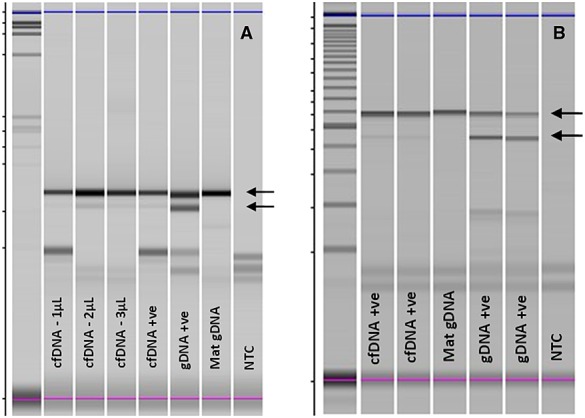
Methods: Analysis of cell-free DNA using a PCR and restriction enzyme digest (PCR-RED) was compared with a novel NGS assay in pregnancies at risk of achondroplasia and thanatophoric dysplasia.
Results: PCR-RED was performed in 72 cases and was correct in 88.6%, inconclusive in 7% with one false negative. NGS was performed in 47 cases and was accurate in 96.2% with no inconclusives. Both approaches were used in 27 cases, with NGS giving the correct result in the two cases inconclusive with PCR-RED.
Conclusion: NGS provides an accurate, flexible approach to non-invasive prenatal diagnosis of de novo and paternally inherited mutations. It is more sensitive than PCR-RED and is ideal when screening a gene with multiple potential pathogenic mutations. These findings highlight the value of NGS in the development of non-invasive prenatal diagnosis for other monogenic disorders.
© 2015 John Wiley & Sons, Ltd.
Figures
References
-
- Tabor A, Alfirevic Z. Update on procedure-related risks for prenatal diagnosis techniques. Fetal Diagn Ther. 2010;271:1–7. - PubMed
-
- Lo YM, Corbetta N, Chamberlain PF, et al. Presence of fetal DNA in maternal plasma and serum. Lancet. 1997;350:485–7. - PubMed
-
- Chitty LS, Bianchi DW. Non-invasive prenatal testing: the paradigm is shifting rapidly. Prenat Diagn. 2013;33:511–3. - PubMed
-
- Boon EM, Faas BH. Benefits and limitations of whole genome versus targeted approaches for non-invasive prenatal testing for fetal aneuploidies. Prenat Diagn. 2013;33:563–8. - PubMed
Publication types
MeSH terms
Substances
Grants and funding
LinkOut - more resources
Full Text Sources
Other Literature Sources
Medical
