doi: 10.1210/en.2015-1097.
Epub 2015 Mar 2.
The forgotten lactogenic activity of growth hormone: important implications for rodent studies
Affiliations
- PMID: 25730109
- PMCID: PMC4398757
- DOI: 10.1210/en.2015-1097
Item in Clipboard
The forgotten lactogenic activity of growth hormone: important implications for rodent studies
Endocrinology.
2015 May.
Abstract
Studies of the effects of GH and the mechanisms of its actions frequently use rats or mice and various recombinant human GH preparations. Authors of many of these studies appear unaware of the fact that, in rodents, human GH signals through both GH and prolactin (PRL) receptors; thus, treatment with human GH is equivalent to a combined treatment with GH and PRL. GH receptors and PRL receptors are present in multiple cell types. Importantly, PRL exerts major effects on brain neuroendocrine action, female and male reproduction, metabolism, body composition, immune responses, and a host of other functions; thus, treatment of rodents with recombinant human GH could affect these important physiological parameters.
Figures
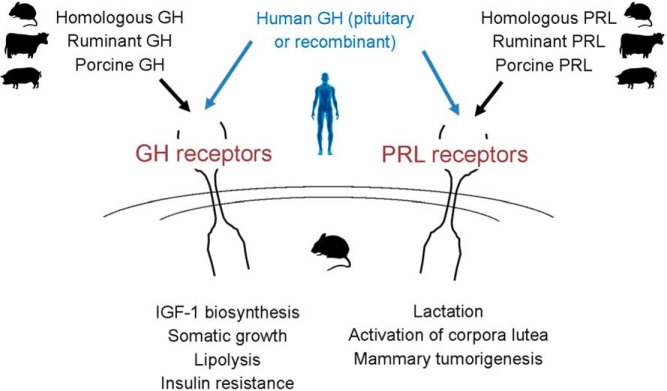
Actions of homologous (mouse, rat), ruminant (bovine, ovine), porcine or human GH in rodents.
References
-
- Forsyth IA, Folley SJ, Chadwick A. Lactogenic and pigeon crop-stimulating activities of human pituitary growth hormone preparation. J Endocrinol. 1965;31:115–126. - PubMed
-
- Hartree AS, Kovacic N, Thomas M. Growth-promoting and luteotrophic activities of human growth hormone. J Endocrinol. 1965;33:249–258. - PubMed
-
- Friesen HG. The discovery of human prolactin: a very personal account. Clin Invest Med. 1995;18:66–72. - PubMed
-
- Gala RR. Prolactin production by the human anterior pituitary cultured in vitro. J Endocrinol. 1971;50:637–642. - PubMed
-
- Lewis UJ, Singh RN, Seavey BK. Human prolactin: Isolation and some properties. Biochem Biophys Res Commun. 1971;44:1169–1176. - PubMed
Publication types
MeSH terms
Substances
Grants and funding
LinkOut - more resources
Full Text Sources
Other Literature Sources