Review
. 2015 Apr;29(4):490-501.
doi: 10.1210/me.2015-1033. Epub 2015 Mar 2.

Minireview: translocator protein (TSPO) and steroidogenesis: a reappraisal

Affiliations
Review

Minireview: translocator protein (TSPO) and steroidogenesis: a reappraisal

Vimal Selvaraj et al. Mol Endocrinol. 2015 Apr.

Abstract

The 18-kDa translocator protein (TSPO), also known as the peripheral benzodiazepine receptor, is a transmembrane protein in the outer mitochondrial membrane. TSPO has long been described as being indispensable for mitochondrial cholesterol import that is essential for steroid hormone production. In contrast to this initial proposition, recent experiments reexamining TSPO function have demonstrated that it is not involved in steroidogenesis. This fundamental change has forced a reexamination of the functional interpretations made for TSPO that broadly impacts both basic and clinical research across multiple fields. In this minireview, we recapitulate the key studies from 25 years of TSPO research and concurrently examine their limitations that perhaps led towards the incorrect association of TSPO and steroid hormone production. Although this shift in understanding raises new questions regarding the molecular function of TSPO, these recent developments are poised to have a significant positive impact for research progress in steroid endocrinology.


Figures
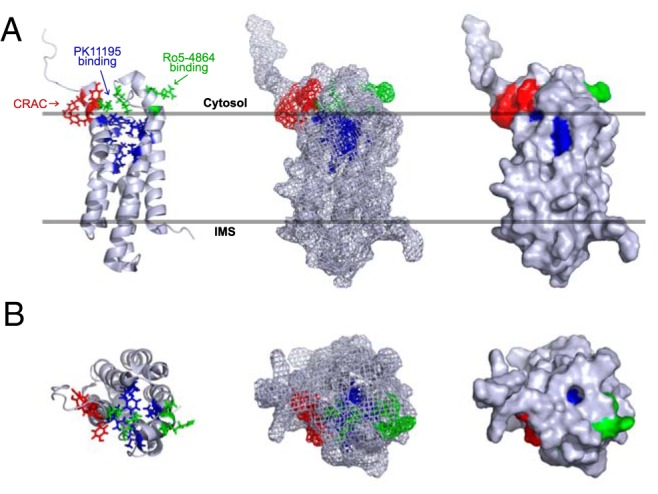
Figure 1.
Figure 1.
Structure of TSPO in OMM. A, Side view. TSPO has a 5 α-helix transmembrane structure. The CRAC motif (in red) is at the C- terminus (residues 147–159). Side chains of Tyr152, Tyr153, and Arg156, essential for cholesterol binding are located on the outside of the TSPO structure and point toward the membrane environment. PK11195-binding pocket (in purple) is formed by residues Ala23, Val26, Leu49, Ala50, Ile52, Trp107, Ala110, Leu114, Ala147, and Leu150, which do not involve side chains of CRAC motif amino acids. Binding site for Ro5-4864 (in green) is distinct from that of PK11195 and was identified to include residues Glu29, Arg32, Lys39, and Val154 (82). B, Top view. Cholesterol-binding side chains of the CRAC motif pointing outside of the TSPO structure and do not interfere with internal PK11195-binding site. From high-resolution NMR structure PDB ID, 2MGY (83).
Figure 2.
Figure 2.
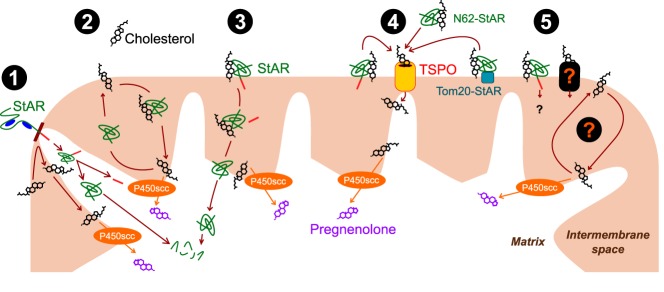
Evolution of mitochondrial cholesterol import models. Cholesterol transport to the IMM and its conversion to pregnenolone by P450scc are essential steps for all steroid hormone production. The first generation of models indicated that StAR could independently accomplish cholesterol import to the IMM: 1) StAR was carried by chaperones and entered mitochondria creating “contact sites” between the outer and IMMs. Cholesterol is able to cross from the outer to the IMM at these contact sites. On entering the matrix, StAR is assembled, cleaved, and subsequently degraded. 2) StAR worked at the level of the mitochondrial intermembrane space shuttling cholesterol from the outer to the IMM. 3) StAR could bind and carry cholesterol in one direction across to the IMM, then enters the matrix to be cleaved and subsequently degraded. The second generation of models appeared after TSPO was introduced as a functional partner for StAR action: 4) StAR resided in the OMM and delivered cholesterol to TSPO that acted as a cholesterol channel to directly transport it to the IMM through contact sites between the 2 membranes. This could explain why N-terminal StAR truncation (N62-StAR) that disrupts its mitochondrial targeting and the Tom20-StAR fusion protein that resides in the OMM could still mediate cholesterol import. Given the new information on TSPO and its high-resolution structure, these elements need to be modified. In addition, recent information suggests that movement of StAR and cleavage/degradation in the mitochondrial matrix might be a terminal event that occurs after its function is completed. Therefore, existing questions are: 5) Is there a channel at the level of the OMM that is essential for cholesterol import? Is there a mechanism that shuttles cholesterol across the intermembrane space? Do we completely understand the mechanism of StAR action? These are topics that will require investigation.

References

    1. Braestrup C, Albrechtsen R, Squires RF. High densities of benzodiazepine receptors in human cortical areas. Nature. 1977;269:702–704. - PubMed
    1. Braestrup C, Squires RF. Specific benzodiazepine receptors in rat brain characterized by high-affinity (3H)diazepam binding. Proc Natl Acad Sci USA. 1977;74:3805–3809. - PMC - PubMed
    1. Regan JW, Yamamura HI, Yamada S, Roeske WR. High affinity [3H]flunitrazepam binding: characterization, localization, and alteration in hypertension. Life Sci. 1981;28:991–998. - PubMed
    1. Davies LP, Huston V. Peripheral benzodiazepine binding sites in heart and their interaction with dipyridamole. Eur J Pharmacol. 1981;73:209–211. - PubMed
    1. Takahashi H, Nagashima A, Koshino C. Effect of γ-aminobutyryl-choline upon the electrical activity of the cerebral cortex. Nature. 1958;182:1443–1444. - PubMed

Publication types