


Baseline caries risk assessment as a predictor of caries incidence
- PMID: 25731155
- PMCID: PMC4417378
- DOI: 10.1016/j.jdent.2015.02.013
Baseline caries risk assessment as a predictor of caries incidence
Abstract
Few studies have evaluated clinical outcomes following caries risk assessment in large datasets that reflect risk assessments performed during routine practice.
Objectives: From clinical records, compare 18-month caries incidence according to baseline caries risk designation.
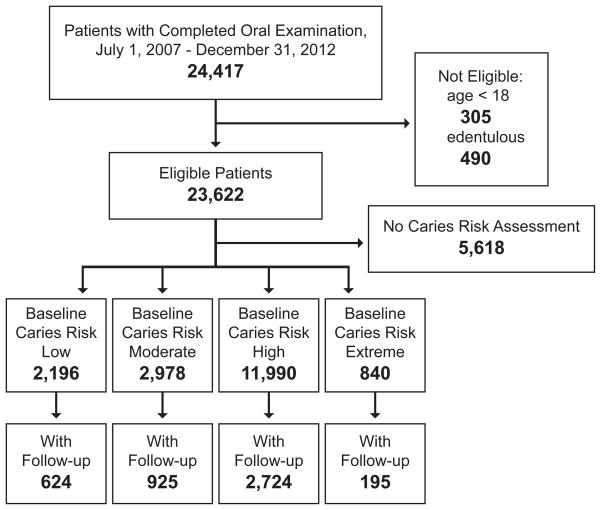
Methods: For this retrospective cohort study, data were collected from electronic records of non-edentulous adult patients who completed an oral examination and caries risk assessment (CRA) at a university instructional clinic from 2007 to 2012 (N=18,004 baseline patients). The primary outcome was the number of new decayed/restored teeth from the initial CRA to the ensuing oral examination, through June 30, 2013 (N=4468 patients with follow-up). We obtained doubly-robust estimates for 18-month caries increment by baseline CRA category (low, moderate, high, extreme), adjusted for patient characteristics (age, sex, payer type, race/ethnicity, number of teeth), provider type, and calendar year.
Results: Adjusted mean decayed, restored tooth (DFT) increment from baseline to follow-up was greater with each rising category of baseline caries risk, from low (0.94), moderate (1.26), high (1.79), to extreme (3.26). The percentage of patients with any newly affected teeth (DFT increment>0) was similar among low-risk and moderate-risk patients (cumulative incidence ratio, RR: 1.01; 95% confidence interval, CI: 0.83, 1.23), but was increased relative to low-risk patients among high-risk (RR: 1.28; 95% CI: 1.10, 1.52), and extreme-risk patients (RR: 1.52; 95% CI: 1.23, 1.87).
Conclusions: These results lend evidence that baseline caries risk predicts future caries in this setting, supporting the use of caries risk assessment to identify candidate patients for more intensive preventive therapy.
Clinical significance: Identification of patients at greater risk for future caries helps clinicians to plan appropriate personalized care. In this study, a multifactorial approach to caries risk assessment effectively stratified patients into groups of higher or lower caries propensity. Dentists can apply risk assessment in practice antecedent to patient-tailored caries management.
Keywords: Caries management; Caries risk assessment; Dental caries; Epidemiology; Longitudinal studies.
Copyright © 2015 Elsevier Ltd. All rights reserved.
Conflict of interest statement
The authors declare that they have no conflicts of interest related to this research.
Figures
Comment in
-
Baseline Caries Risk Assessment Using CAMBRA May Predict Caries Only in High and Extreme Caries Risk Groups.J Evid Based Dent Pract. 2015 Dec;15(4):197-9. doi: 10.1016/j.jebdp.2015.10.008. Epub 2015 Oct 28. J Evid Based Dent Pract. 2015. PMID: 26698010
References
-
- Fontana M, Young DA, Wolff MS. Evidence-based caries, risk assessment, and treatment. Dental Clinics of North America. 2009;53:149–161. - PubMed
-
- Hallett KB. The application of caries risk assessment in minimum intervention dentistry. Australian Dental Journal. 2013;58 (Suppl 1):26–34. - PubMed
-
- Lallam C, Decup F. Minimal intervention dentistry II: part 2. Management of caries and periodontal risks in general dental practice. British Dental Journal. 2014;216:179–85. - PubMed
-
- Tellez M, Gomez J, Pretty I, Ellwood R, Ismail A. Evidence on existing caries risk assessment systems: are they predictive of future caries? Community Dentistry and Oral Epidemiology. 2013;41:67–78. - PubMed
Publication types
MeSH terms
Grants and funding
LinkOut - more resources
Full Text Sources
Other Literature Sources
Medical
