


Review
doi: 10.1016/j.tig.2015.02.001.
Epub 2015 Feb 27.
Concepts in solid tumor evolution
Affiliations
- PMID: 25733351
- PMCID: PMC4380537
- DOI: 10.1016/j.tig.2015.02.001
Item in Clipboard
Review
Concepts in solid tumor evolution
Trends Genet.
2015 Apr.
Abstract
Evolutionary mechanisms in cancer progression give tumors their individuality. Cancer evolution is different from organismal evolution, however, and we discuss where concepts from evolutionary genetics are useful or limited in facilitating an understanding of cancer. Based on these concepts we construct and apply the simplest plausible model of tumor growth and progression. Simulations using this simple model illustrate the importance of stochastic events early in tumorigenesis, highlight the dominance of exponential growth over linear growth and differentiation, and explain the clonal substructure of tumors.
Copyright © 2015 Elsevier Ltd. All rights reserved.
Figures
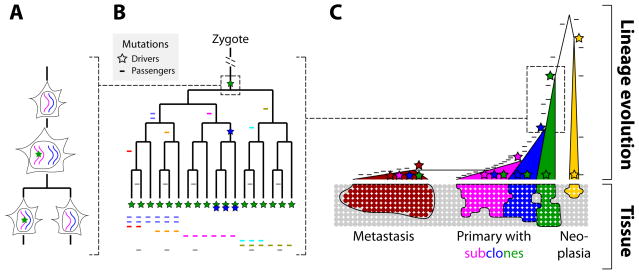
Passenger mutations serve as lineage markers, and driver mutations lead to subclones whose size is a function of strength and timing of the driver. A. Mutations (star) that arise during DNA replication will be passed on in heterozygous state to one of the daughter cells. Mutations that arise during interphase (not shown), such as incorrectly repaired DNA damage, will likely be passed on to both daughter cells. B. Mutations serve as lineage markers because they are passed on to only their progeny and are not horizontally transferred. C. Drivers initiate proliferation and then increase the growth rate, which leads to subclones (or metastases) that are marked by ever increasing numbers of mutations. When the ancestor is old, as in slowly-growing neoplasias such as columnar cell lesions in breast, the number of mutations that are shared by all cells of the neoplasia is comparatively lower than the number of mutations in a fast-growing tumor whose ancestral cell is more recent. Note that, in the primary tumor, the subclones (blue and magenta) have to grow sufficiently more quickly to be detectable compared to the already existing and still-expanding original clone (green).
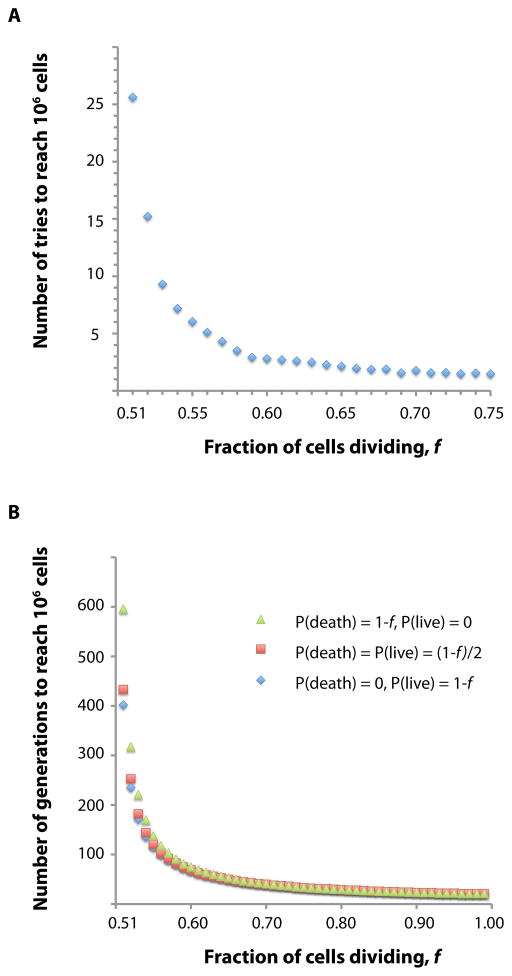
Simulations of tumor growth based on a simple model of proliferation. A. Stochasticity in the initial phase of tumor growth, illustrated by the number of tries it takes (Y axis) for a clone to grow to one million cells (as opposed to going extinct), as a function of the strength of the initial driver mutation (X axis). B. Results from a simulation exploring the effect of the balance between cell death and ‘terminal differentiation’ of nondividing cells. Only when drivers are weak (X axis) is there an appreciable difference in the number of generations it takes to reach one million cells.
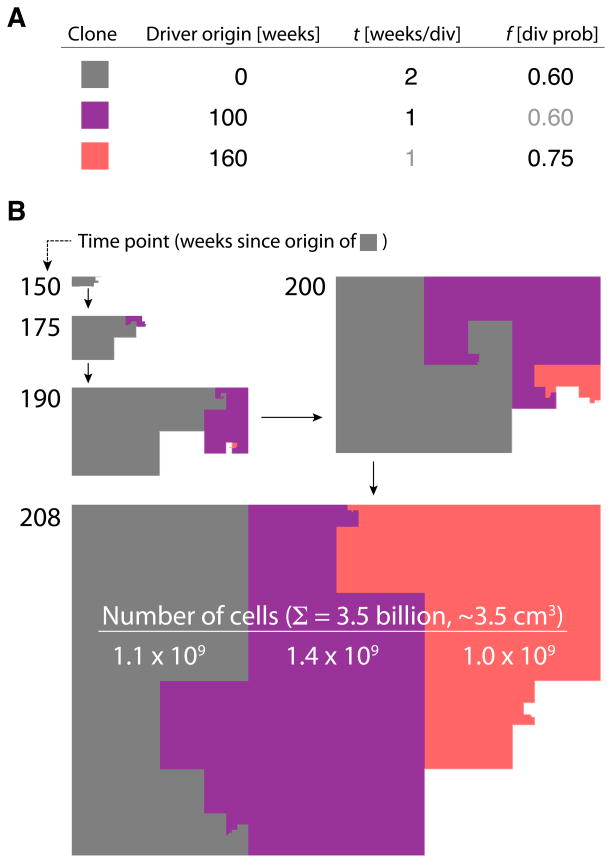
Visual representation of evolution and resulting clonal heterogeneity in a tumor that grows to 3.5 billion cells over the course of three driver mutations that occur within four years. A. Parameters of the simulation. The grey clone originates with the first driver mutation that sets f = 0.60, and t = 2 weeks. 100 weeks later the purple clone originates due to a driver that decreases t to 1 week (f does not change). A further 60 weeks later, the orange clone arises by a driver that sets f to 0.75. B. Five time points of this tumor’s evolution. Area sizes are proportional to the number of cells in each clone. After four years (208 weeks), each clone is approximately the same size, 1 billion cells each, comprising a solid tumor of about 3.5 cubic centimeters.
References
-
- Zuckerkandl E, Pauling LB. Molecular disease, evolution, and genic heterogeneity. In: Kasha M, Pullman B, editors. Horizons in Biochemistry. Academic Press; New York: 1962. pp. 189–225.
-
- Dobzhansky T. Nothing in biology makes sense except in the light of evolution. The American Biology Teacher. 1973;35:125–129.
Publication types
MeSH terms
Grants and funding
LinkOut - more resources
Full Text Sources
Other Literature Sources
