Investigating the relationship between quality of primary care and premature mortality in England: a spatial whole-population study
- PMID: 25733592
- PMCID: PMC4353289
- DOI: 10.1136/bmj.h904
Investigating the relationship between quality of primary care and premature mortality in England: a spatial whole-population study
Abstract
Objectives: To quantify the relationship between a national primary care pay-for-performance programme, the UK's Quality and Outcomes Framework (QOF), and all-cause and cause-specific premature mortality linked closely with conditions included in the framework.
Design: Longitudinal spatial study, at the level of the "lower layer super output area" (LSOA).
Setting: 32482 LSOAs (neighbourhoods of 1500 people on average), covering the whole population of England (approximately 53.5 million), from 2007 to 2012.
Participants: 8647 English general practices participating in the QOF for at least one year of the study period, including over 99% of patients registered with primary care.
Intervention: National pay-for-performance programme incentivising performance on over 100 quality-of-care indicators.
Main outcome measures: All-cause and cause-specific mortality rates for six chronic conditions: diabetes, heart failure, hypertension, ischaemic heart disease, stroke, and chronic kidney disease. We used multiple linear regressions to investigate the relationship between spatially estimated recorded quality of care and mortality.
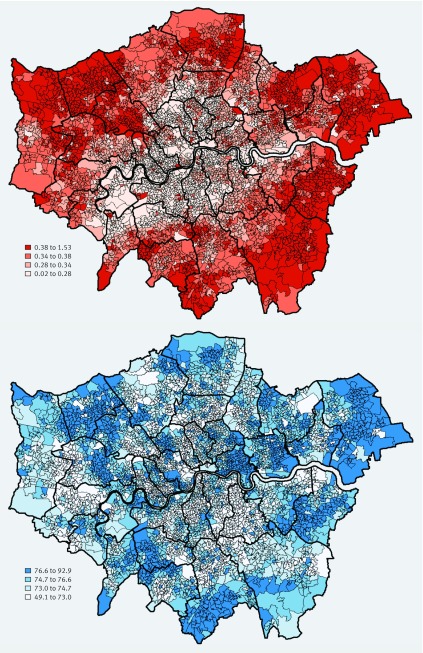
Results: All-cause and cause-specific mortality rates declined over the study period. Higher mortality was associated with greater area deprivation, urban location, and higher proportion of a non-white population. In general, there was no significant relationship between practice performance on quality indicators included in the QOF and all-cause or cause-specific mortality rates in the practice locality.
Conclusions: Higher reported achievement of activities incentivised under a major, nationwide pay-for-performance programme did not seem to result in reduced incidence of premature death in the population.
© Kontopantelis et al 2015.
Conflict of interest statement
Competing interests: All authors have completed the Unified Competing Interest form at
Figures



Comment in
-
Whether QOF has reduced premature death rates is still unclear.BMJ. 2015 Mar 30;350:h1677. doi: 10.1136/bmj.h1677. BMJ. 2015. PMID: 25825071 No abstract available.
-
Authors' reply to Honeyford and colleagues and Roland.BMJ. 2015 Mar 30;350:h1681. doi: 10.1136/bmj.h1681. BMJ. 2015. PMID: 25825414 No abstract available.
-
Study may not be the best approach to assessing link between QOF and premature death.BMJ. 2015 Mar 30;350:h1675. doi: 10.1136/bmj.h1675. BMJ. 2015. PMID: 25825417 No abstract available.
-
The mortality rate in England between 2007 and 2012 was not associated with the quality of primary care in an established pay for performance programme.Evid Based Med. 2015 Aug;20(4):149. doi: 10.1136/ebmed-2015-110205. Epub 2015 Jun 16. Evid Based Med. 2015. PMID: 26081806 No abstract available.
References
-
- Bellamy D, Smith J. Role of primary care in early diagnosis and effective management of COPD. Int J Clin Pract 2007;61:1380-9. - PubMed
-
- Engstrom S, Foldevi M, Borgquist L. Is general practice effective? A systematic literature review. Scand J Prim Health 2001;19:131-44. - PubMed
-
- McGlynn EA, Asch SM, Adams J, Keesey J, Hicks J, DeCristofaro A, et al. The quality of health care delivered to adults in the United States. N Engl J Med 2003;348:2635-45. - PubMed
MeSH terms
Grants and funding
LinkOut - more resources
Full Text Sources
Other Literature Sources
Medical