


Prepregnancy body mass and weight gain during pregnancy in India and sub-Saharan Africa
- PMID: 25733859
- PMCID: PMC4371959
- DOI: 10.1073/pnas.1416964112
Prepregnancy body mass and weight gain during pregnancy in India and sub-Saharan Africa
Abstract
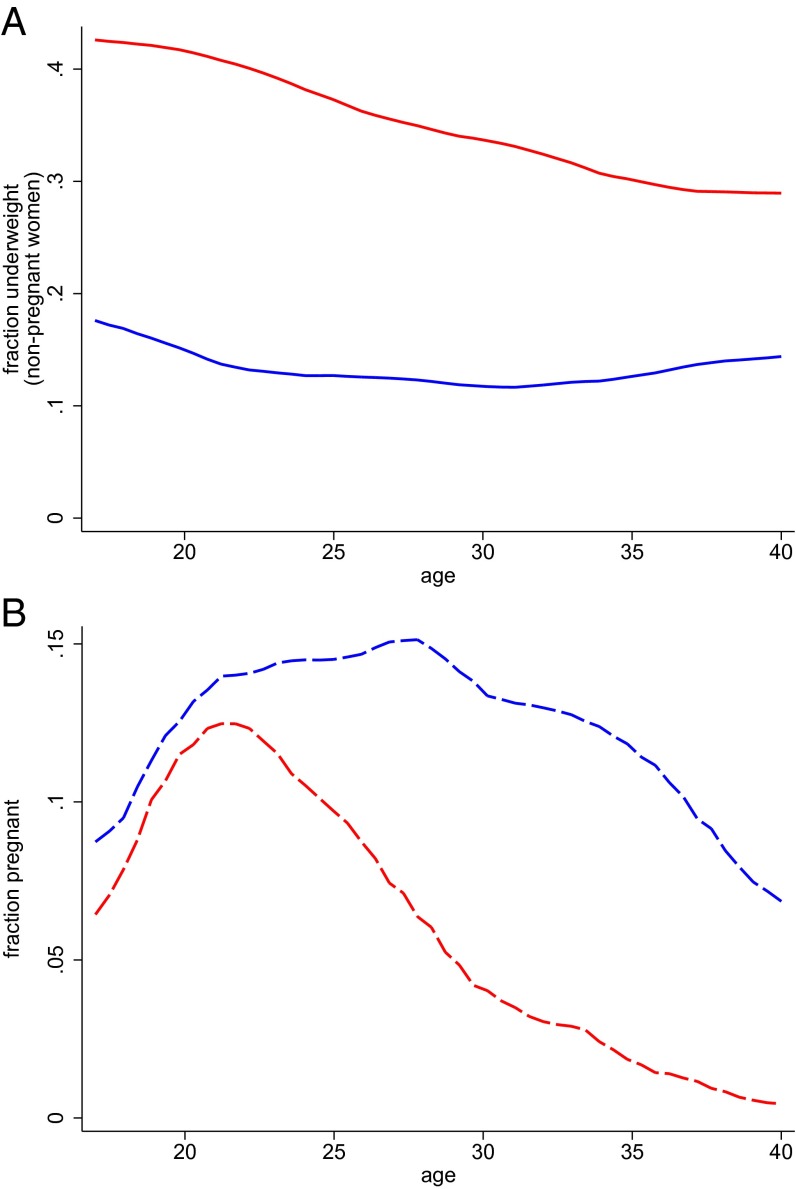
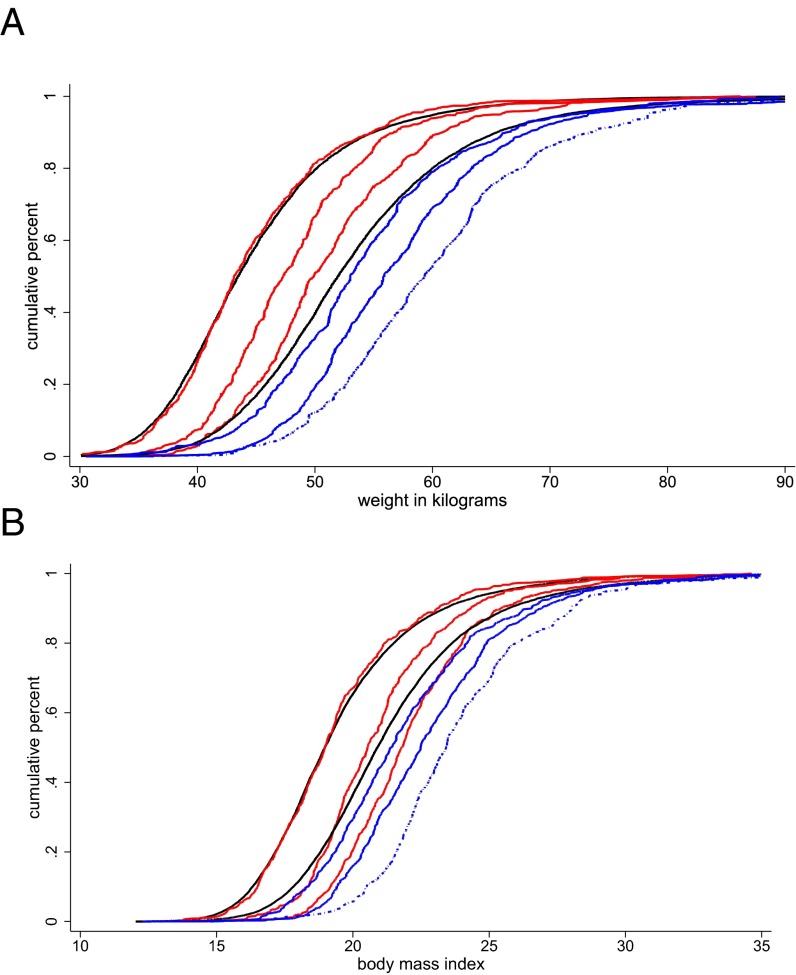
Despite being wealthier, Indian children are significantly shorter and smaller than African children. These differences begin very early in life, suggesting that they may in part reflect differences in maternal health. By applying reweighting estimation strategies to the Demographic and Health Surveys, this paper reports, to my knowledge, the first representative estimates of prepregnancy body mass index and weight gain during pregnancy for India and sub-Saharan Africa. I find that 42.2% of prepregnant women in India are underweight compared with 16.5% of prepregnant women in sub-Saharan Africa. Levels of prepregnancy underweight for India are almost seven percentage points higher than the average fraction underweight among women 15-49 y old. This difference in part reflects a previously unquantified relationship among age, fertility, and underweight; childbearing is concentrated in the narrow age range in which Indian women are most likely to be underweight. Further, because weight gain during pregnancy is low, averaging about 7 kg for a full-term pregnancy in both regions, the average woman in India ends pregnancy weighing less than the average woman in sub-Saharan Africa begins pregnancy. Poor maternal health among Indian women is of global significance because India is home to one fifth of the world's births.
Keywords: India; maternal health; nutrition; sub-Saharan Africa.
Conflict of interest statement
The author declares no conflict of interest.
Figures
Comment in
-
Two fifths of pregnant women in India are underweight.BMJ. 2015 Mar 6;350:h1241. doi: 10.1136/bmj.h1241. BMJ. 2015. PMID: 25747202 No abstract available.
References
-
- Nubé M. The Asian enigma: Predisposition for low adult BMI among people of South Asian descent. Public Health Nutr. 2009;12(4):507–516. - PubMed
-
- Underwood BA. Health and nutrition in women, infants, and children: Overview of the global situation and the Asian enigma. Nutr Rev. 2002;60(5 Pt 2):S7–S13. - PubMed
-
- Coffey D, Deaton A, Drèze J, Spears D, Tarozzi A. Stunting among children: Facts and implications. Econ Polit Wkly. 2013;XLVIII(34):68–70.
Publication types
MeSH terms
Grants and funding
LinkOut - more resources
Full Text Sources
Other Literature Sources
