


Structure of superhard tungsten tetraboride: a missing link between MB2 and MB12 higher borides
- PMID: 25733870
- PMCID: PMC4371990
- DOI: 10.1073/pnas.1415018112
Structure of superhard tungsten tetraboride: a missing link between MB2 and MB12 higher borides
Abstract
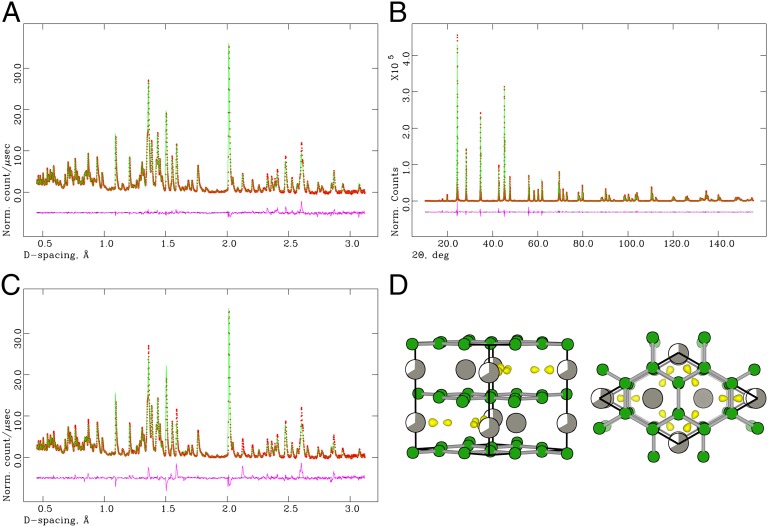
Superhard metals are of interest as possible replacements with enhanced properties over the metal carbides commonly used in cutting, drilling, and wear-resistant tooling. Of the superhard metals, the highest boride of tungsten--often referred to as WB4 and sometimes as W(1-x)B3--is one of the most promising candidates. The structure of this boride, however, has never been fully resolved, despite the fact that it was discovered in 1961--a fact that severely limits our understanding of its structure-property relationships and has generated increasing controversy in the literature. Here, we present a new crystallographic model of this compound based on refinement against time-of-flight neutron diffraction data. Contrary to previous X-ray-only structural refinements, there is strong evidence for the presence of interstitial arrangements of boron atoms and polyhedral bonding. The formation of these polyhedral--slightly distorted boron cuboctahedra--appears to be dependent upon the defective nature of the tungsten-deficient metal sublattice. This previously unidentified structure type has an intermediary relationship between MB2 and MB12 type boride polymorphs. Manipulation of the fractionally occupied metal and boron sites may provide insight for the rational design of new superhard metals.
Keywords: Rietveld refinement; borides; neutron diffraction; superhard; tungsten tetraboride.
Conflict of interest statement
The authors declare no conflict of interest.
Figures




References
-
- Cumberland RW, et al. Osmium diboride, an ultra-incompressible, hard material. J Am Chem Soc. 2005;127(20):7264–7265. - PubMed
-
- Chung H-Y, et al. Synthesis of ultra-incompressible superhard rhenium diboride at ambient pressure. Science. 2007;316(5823):436–439. - PubMed
-
- Kaner RB, Gilman JJ, Tolbert SH. Materials science. Designing superhard materials. Science. 2005;308(5726):1268–1269. - PubMed
-
- Levine JB, Tolbert SH, Kaner RB. Advancements in the search for superhard ultra-incompressible metal borides. Adv Funct Mater. 2009;19(22):3519–3533.
-
- Komanduri R, Shaw MC. Wear of synthetic diamond when grinding ferrous metals. Nature. 1975;255(5505):211–213.
Publication types
LinkOut - more resources
Full Text Sources
Other Literature Sources
