


A cyclopean neural mechanism compensating for optical differences between the eyes
- PMID: 25734264
- PMCID: PMC4354679
- DOI: 10.1016/j.cub.2015.01.027
A cyclopean neural mechanism compensating for optical differences between the eyes
Abstract
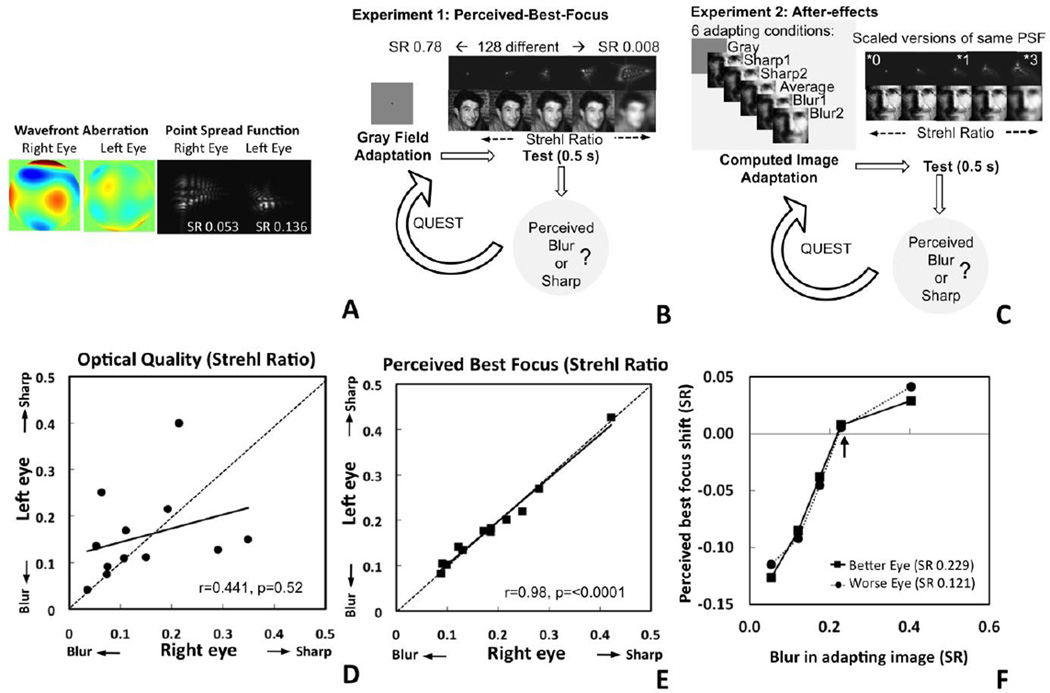
The two eyes of an individual routinely differ in their optical and neural properties, yet percepts through either eye remain more similar than predicted by these differences. Little is known as to how the brain resolves this conflicting information. Differences in visual inputs from the two eyes have been studied extensively in the context of binocular vision and rivalry [1], but it remains unknown how the visual system calibrates and corrects for normal variability in image quality between the eyes, and whether this correction is applied to each eye separately or after their signals have converged. To test this, we used adaptive optics to control and manipulate the blur projected on each retina, and then compared judgments of image focus through either eye and how these judgments were biased by adapting to different levels of blur. Despite significant interocular differences in the magnitude of optical blur, the blur level that appeared best focused was the same through both eyes, and corresponded to the ocular blur of the less aberrated eye. Moreover, for both eyes, blur aftereffects depended on whether the adapting blur was stronger or weaker than the native blur of the better eye, with no aftereffect when the blur equaled the aberrations of the better eye. Our results indicate that the neural calibration for the perception of image focus reflects a single 'cyclopean' site that is set monocularly by the eye with better optical quality. Consequently, what people regard as 'best-focused' matches the blur encountered through the eye with better optics, even when judging the world through the eye with poorer optics.
Copyright © 2015 Elsevier Ltd. All rights reserved.
Figures
References
-
- Marcos S, Sawides L, Gambra E, Dorronsoro C. Influence of adaptive-optics ocular aberration correction on visual acuity at different luminances and contrast polarities. J. Vis. 2008;8:1–12. - PubMed
-
- Artal P, Chen L, Fernandez EJ, Singer B, Manzanera S, Williams DR. Neural compensation for the eye's optical aberrations. J. Vis. 2004;4:281–287. - PubMed
-
- Webster MA, Georgeson MA, Webster SM. Neural adjustments to image blur. Nat. Neurosci. 2002;5:839–840. - PubMed
Publication types
MeSH terms
Grants and funding
LinkOut - more resources
Full Text Sources
Other Literature Sources
