Diagnostic Precursors to Bipolar Disorder in Offspring of Parents With Bipolar Disorder: A Longitudinal Study
- PMID: 25734353
- PMCID: PMC4489996
- DOI: 10.1176/appi.ajp.2014.14010035
Diagnostic Precursors to Bipolar Disorder in Offspring of Parents With Bipolar Disorder: A Longitudinal Study
Abstract
Objective: The authors sought to identify diagnostic risk factors of manic, mixed, or hypomanic episodes in the offspring of parents with bipolar disorder ("high-risk offspring").
Method: High-risk offspring 6-18 years old (N=391) and demographically matched offspring (N=248) of community parents without bipolar disorder were assessed longitudinally with standardized diagnostic instruments by staff blind to parental diagnoses. Follow-up assessments were completed in 91% of the offspring (mean follow-up interval, 2.5 years; mean follow-up duration, 6.8 years).
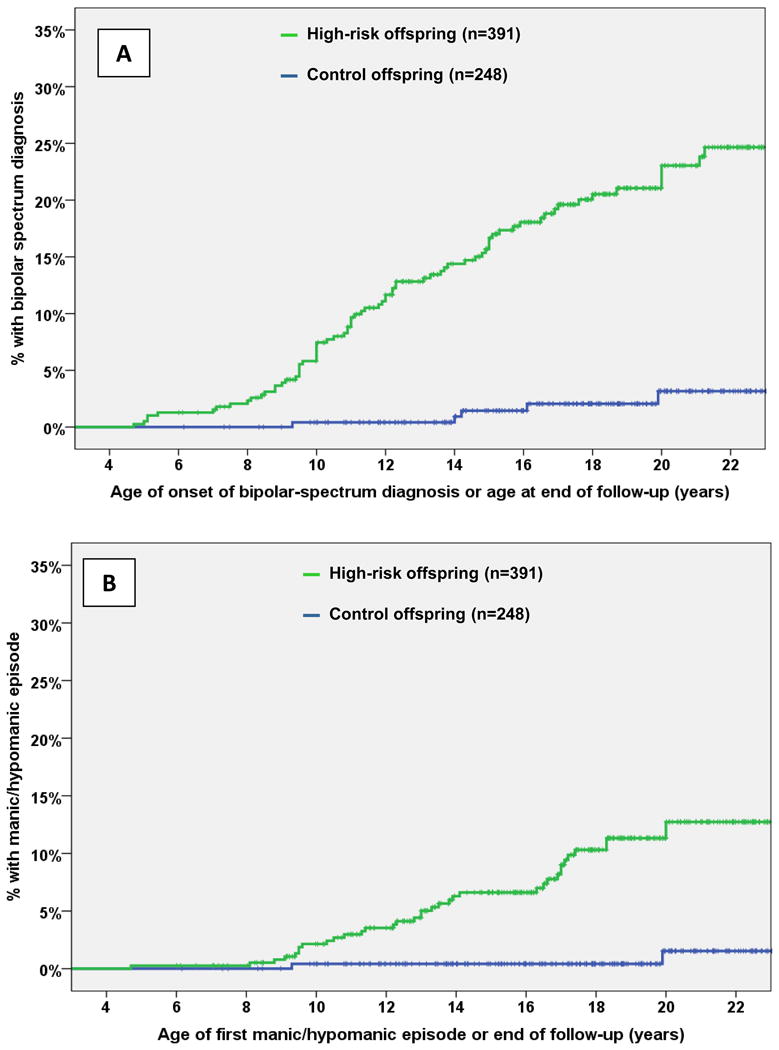
Results: Compared with community offspring, high-risk offspring had significantly higher rates of subthreshold mania or hypomania (13.3% compared with 1.2%), manic, mixed, or hypomanic episodes (9.2% compared with 0.8%), and major depressive episodes (32.0% compared with 14.9%). They also had higher rates of attention deficit hyperactivity disorder (30.7% compared with 18.1%), disruptive behavior disorders (27.4% compared with 15.3%), anxiety disorders (39.9% compared with 21.8%), and substance use disorders (19.9% compared with 10.1%), but not unipolar major depressive disorder (major depression with no bipolarity; 18.9% compared with 13.7%). Multivariate Cox regressions showed that in the high-risk offspring, subthreshold manic or hypomanic episodes (hazard ratio=2.29), major depressive episodes (hazard ratio=1.99), and disruptive behavior disorders (hazard ratio=2.12) were associated with subsequent manic, mixed, or hypomanic episodes. Only subthreshold manic or hypomanic episodes (hazard ratio=7.57) were associated when analyses were restricted to prospective data.
Conclusions: Subthreshold manic or hypomanic episodes were a diagnostic risk factor for the development of manic, mixed, or hypomanic episodes in the offspring of parents with bipolar disorder and should be a target for clinical assessment and treatment research. Major depressive episodes and disruptive behavior disorders are also indications for close clinical monitoring of emergent bipolarity in high-risk offspring.
Figures
Comment in
-
The Long and Winding Road to Bipolar Disorder.Am J Psychiatry. 2015 Jul;172(7):599-600. doi: 10.1176/appi.ajp.2015.15040432. Am J Psychiatry. 2015. PMID: 26130197 Free PMC article. No abstract available.
-
Monitoring Children's Mood and Behavior.Am J Psychiatry. 2015 Sep 1;172(9):909. doi: 10.1176/appi.ajp.2015.15040427. Am J Psychiatry. 2015. PMID: 26324304 No abstract available.
References
-
- Lish JD, Dime-Meehan S, Whybrow PC, Price RA, Hirschfeld RM. The National Depressive and Manic-Depressive Association (DMDA) Survey of Bipolar Members. Journal of Affective Disorders. 1994;31(4):281–94. - PubMed
-
- Chengappa KN, Kupfer DJ, Frank E, Houck PR, Grochocinski VJ, Cluss PA, et al. Relationship of birth cohort and early age at onset of illness in a bipolar disorder case registry. American Journal of Psychiatry. 2003;160(9):1636–42. - PubMed
-
- Leverich G, Post RM, Keck PE, Altshuler L, Frye MA, Kupka R. The poor prognosis of childhood-onset bipolar disorder. Journal of Pediatrics. 2007;150:485–90. - PubMed
-
- Goodwin FK, Jamison KR. Manic-depressive illness: Bipolar Disorders and Recurrent Depression. 2nd. New York: Oxford University Press; 2007.
MeSH terms
Grants and funding
LinkOut - more resources
Full Text Sources
Other Literature Sources
Medical