


Maternal Blood Manganese and Early Neurodevelopment: The Mothers and Children's Environmental Health (MOCEH) Study
- PMID: 25734517
- PMCID: PMC4492260
- DOI: 10.1289/ehp.1307865
Maternal Blood Manganese and Early Neurodevelopment: The Mothers and Children's Environmental Health (MOCEH) Study
Abstract
Background: Manganese is an essential trace element and common component of water, soil, and air. Prenatal manganese exposure may affect fetal and infantile neurodevelopment, but reports on in utero manganese exposure and infant neurodevelopment are rare.
Objective: This study was conducted to investigate a relationship between maternal blood manganese level and neurodevelopment of infants at 6 months of age.
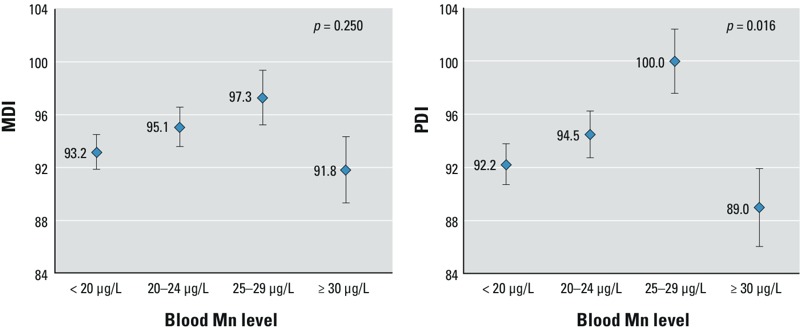
Methods: Data were obtained from the Mothers and Children's Environmental Health (MOCEH) birth cohort study. The study population included 232 pairs of pregnant women and their infants at 6 months of age. Maternal blood manganese was measured at term, just before delivery. Mental and psychomotor development in infancy was assessed at 6 months of age using the Bayley Scales of Infant Development. The relationship between maternal blood manganese level and the mental and psychomotor development indexes (MDI and PDI) was estimated for manganese modeled as a linear and as a categorical variable and using penalized splines for nonlinear modeling.
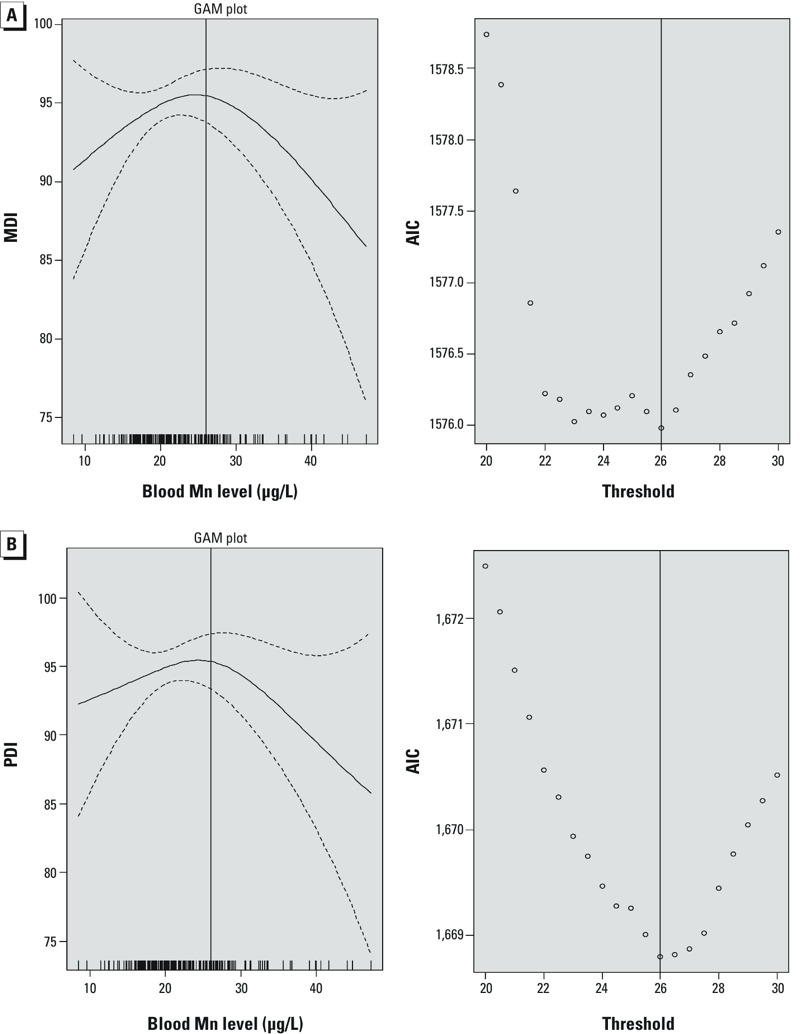
Results: Mean ± SD maternal blood manganese concentration was 22.5 ± 6.5 μg/L. After adjustment for potential confounders, blood manganese was used as a continuous variable in a linear and nonlinear model. Associations between maternal blood manganese and MDI and PDI scores followed an inverted U-shape dose-response curve after adjustment for potential confounders, with lower scores associated with both low and high blood concentrations [MDI: likelihood-ratio test (LRT) p = 0.075, PDI: LRT p = 0.038]. Associations of both outcomes with increasing blood manganese shifted from positive to negative at concentrations of 24-28 μg/L in this cohort of term, normal birth weight children.
Conclusion: Although no cut-off point has been established to define manganese toxicity, both high and low blood manganese levels may be associated with neurobehavioral function in infants.
Conflict of interest statement
The authors declare they have no actual or potential competing financial interests.
Figures
References
-
- Agency for Toxic Substances and Disease Registry. Toxicological Profile for Manganese. 2012. Available: http://www.atsdr.cdc.gov/toxprofiles/tp151.pdf [accessed 7 November 2013] - PubMed
-
- American Educational Research Association, American Psychological Association, National Council on Measurement in Education. Washington, DC: American Educational Research Association; 1999. The Standards for Educational and Psychological Testing.
-
- Bayley N. San Antonio, TX: Psychological Corporation; 1993. Bayley Scales of Infant Development, 2nd ed.
Publication types
MeSH terms
Substances
LinkOut - more resources
Full Text Sources
Other Literature Sources
Medical