


Involvement of astrocyte metabolic coupling in Tourette syndrome pathogenesis
- PMID: 25735483
- PMCID: PMC4613465
- DOI: 10.1038/ejhg.2015.22
Involvement of astrocyte metabolic coupling in Tourette syndrome pathogenesis
Abstract
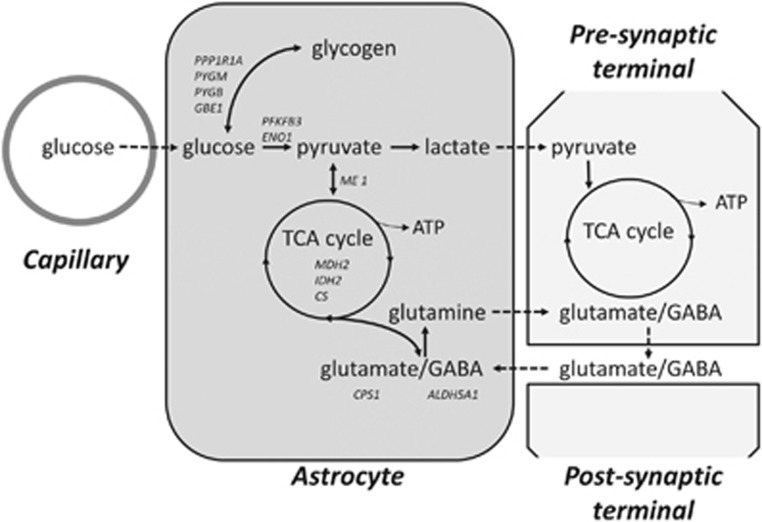
Tourette syndrome is a heritable neurodevelopmental disorder whose pathophysiology remains unknown. Recent genome-wide association studies suggest that it is a polygenic disorder influenced by many genes of small effect. We tested whether these genes cluster in cellular function by applying gene-set analysis using expert curated sets of brain-expressed genes in the current largest available Tourette syndrome genome-wide association data set, involving 1285 cases and 4964 controls. The gene sets included specific synaptic, astrocytic, oligodendrocyte and microglial functions. We report association of Tourette syndrome with a set of genes involved in astrocyte function, specifically in astrocyte carbohydrate metabolism. This association is driven primarily by a subset of 33 genes involved in glycolysis and glutamate metabolism through which astrocytes support synaptic function. Our results indicate for the first time that the process of astrocyte-neuron metabolic coupling may be an important contributor to Tourette syndrome pathogenesis.
Conflict of interest statement
Drs Scharf and Mathews have received research support from the NIH and the Tourette Syndrome Association (TSA) on behalf of the TSA International Consortium for Genetics (TSAICG). Drs Scharf and Mathews have received honoraria and travel support from the TSA and are members of the TSA Medical Advisory Board (CAM) and Scientific Advisory Board (JMS).
None of the funding agencies for this project (NINDS, NIMH, the Tourette Syndrome Association and the David Judah Fund) had any influence or played any role in (a) the design or conduct of the study; (b) management, analysis or interpretation of the data; (c) preparation, review or approval of the manuscript. The remaining authors declare no conflict of interest.
Figures
References
-
- 2Deng H, Gao K, Jankovic J: The genetics of Tourette syndrome. Nat Rev Neurol 2012; 8: 203–213. - PubMed
Publication types
MeSH terms
Substances
Grants and funding
- U01 HG004438/HG/NHGRI NIH HHS/United States
- U01 HG004446/HG/NHGRI NIH HHS/United States
- K23 MH085057/MH/NIMH NIH HHS/United States
- NS037484/NS/NINDS NIH HHS/United States
- P01 CA089392/CA/NCI NIH HHS/United States
- U01 NS040024/NS/NINDS NIH HHS/United States
- NS40024/NS/NINDS NIH HHS/United States
- R01 NS016648/NS/NINDS NIH HHS/United States
- MH085057/MH/NIMH NIH HHS/United States
- HHSN268200782096C/HG/NHGRI NIH HHS/United States
- U01 HG004422/HG/NHGRI NIH HHS/United States
- R01 DA013423/DA/NIDA NIH HHS/United States
- R01 NS040024/NS/NINDS NIH HHS/United States
- U24 MH068457/MH/NIMH NIH HHS/United States
- R01 MH092293/MH/NIMH NIH HHS/United States
- U10 AA008401/AA/NIAAA NIH HHS/United States
- R01 NS037484/NS/NINDS NIH HHS/United States
- U54 RR020278/RR/NCRR NIH HHS/United States
- NS16648/NS/NINDS NIH HHS/United States
LinkOut - more resources
Full Text Sources
Other Literature Sources
Medical
