


Processing of Spontaneous Emotional Responses in Adolescents and Adults with Autism Spectrum Disorders: Effect of Stimulus Type
- PMID: 25735657
- PMCID: PMC4964927
- DOI: 10.1002/aur.1468
Processing of Spontaneous Emotional Responses in Adolescents and Adults with Autism Spectrum Disorders: Effect of Stimulus Type
Abstract
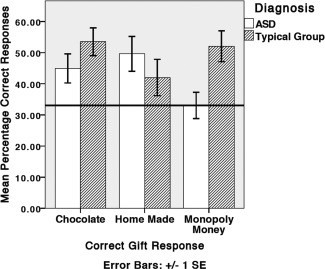
Recent research has shown that adults with autism spectrum disorders (ASD) have difficulty interpreting others' emotional responses, in order to work out what actually happened to them. It is unclear what underlies this difficulty; important cues may be missed from fast paced dynamic stimuli, or spontaneous emotional responses may be too complex for those with ASD to successfully recognise. To explore these possibilities, 17 adolescents and adults with ASD and 17 neurotypical controls viewed 21 videos and pictures of peoples' emotional responses to gifts (chocolate, a handmade novelty or Monopoly money), then inferred what gift the person received and the emotion expressed by the person while eye movements were measured. Participants with ASD were significantly more accurate at distinguishing who received a chocolate or homemade gift from static (compared to dynamic) stimuli, but significantly less accurate when inferring who received Monopoly money from static (compared to dynamic) stimuli. Both groups made similar emotion attributions to each gift in both conditions (positive for chocolate, feigned positive for homemade and confused for Monopoly money). Participants with ASD only made marginally significantly fewer fixations to the eyes of the face, and face of the person than typical controls in both conditions. Results suggest adolescents and adults with ASD can distinguish subtle emotion cues for certain emotions (genuine from feigned positive) when given sufficient processing time, however, dynamic cues are informative for recognising emotion blends (e.g., smiling in confusion). This indicates difficulties processing complex emotion responses in ASD.
Keywords: autism spectrum disorders; eye tracking; face perception; multi-modal processing; retrodictive mindreading; social cognition; spontaneous emotion recognition; visual auditory integration.
© 2015 The Authors Autism Research published by Wiley Periodicals, Inc. on behalf of International Society for Autism Research.
Figures

References
-
- Adolphs, R. , Sears, L. , & Piven, J. (2001). Abnormal processing of social information from faces in autism. Journal of Cognitive Neuroscience, 13, 232–240. - PubMed
-
- American Psychiatric Association . (1994). Diagnostic and statistical manual of mental disorders (4th edition). Washington, DC: American Psychiatric Association.
-
- American Psychiatric Association . (2013). Diagnostic and statistical manual of mental disorders, (DSM‐5®). American Psychiatric Pub.
-
- Baron‐Cohen, S. , Wheelwright, S. , Skinner, R. , Martin, J. , & Clubley, E. (2001). The Autism Spectrum Quotient (AQ): Evidence from Asperger syndrome/ high functioning autism, males and females, scientists and mathematicians. Journal of Autism and Developmental Disorders, 31, 5–17. - PubMed
-
- Bebko, J.M. , Schroeder, J.H. , & Weiss, J.A. (2014). The McGurk effect in children with autism and Asperger syndrome. Autism Research, 7(1), 50–59. - PubMed
MeSH terms
LinkOut - more resources
Full Text Sources
Other Literature Sources
Medical
