


The medial prefrontal cortex: coordinator of autonomic, neuroendocrine and behavioural responses to stress
- PMID: 25737097
- PMCID: PMC4580281
- DOI: 10.1111/jne.12272
The medial prefrontal cortex: coordinator of autonomic, neuroendocrine and behavioural responses to stress
Abstract
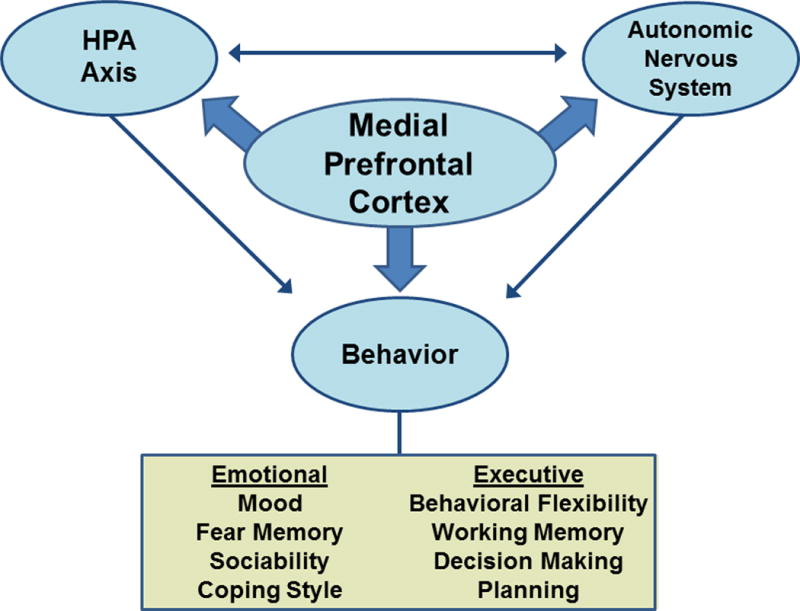
Responding to real or potential threats in the environment requires the coordination of autonomic, neuroendocrine and behavioural processes to promote adaptation and survival. These diverging systems necessitate input from the limbic forebrain to integrate and modulate functional output in accordance with contextual demand. In the present review, we discuss the potential role of the medial prefrontal cortex (mPFC) as a coordinator of behavioural and physiological stress responses across multiple temporal and contextual domains. Furthermore, we highlight converging evidence from rodent and human research indicating the necessity of the mPFC for modulating physiological energetic systems to mobilise or limit energetic resources as needed to ultimately promote behavioural adaptation in the face of stress. We review the literature indicating that glucocorticoids act as one of the primary messengers in the reallocation of energetic resources having profound effects locally within the mPFC, as well as shaping how the mPFC acts within a network of brain structures to modulate responses to stress. Finally, we discuss how both rodent and human studies point toward a critical role of the mPFC in the coordination of anticipatory responses to stress and why this distinction is an important one to make in stress neurobiology.
Keywords: autonomic nervous system; executive function; glucocorticoids; hypothalamic-pituitary-adrenocortical axis; prefrontal cortex; stress.
© 2015 British Society for Neuroendocrinology.
Figures
References
-
- Benarroch EE. Central Autonomic Control. In: Robertson D, Biaggioni I, Burnstock G, Low PS, Paton JFR, editors. Primer on the Autonomic Nervous System. 3rd. San Diego, CA: Academic Press Inc; 2012. pp. 9–12.
-
- Vale W, Spiess J, Rivier C, Rivier J. Characterization of a 41-residue ovine hypothalamic peptide that stimulates secretion of corticotropin and beta-endorphin. Science. 1981;213(4514):1394–1397. - PubMed
Publication types
MeSH terms
Grants and funding
LinkOut - more resources
Full Text Sources
Other Literature Sources
Medical
