Anti-inflammatory activity of roots of Cichorium intybus due to its inhibitory effect on various cytokines and antioxidant activity
- PMID: 25737610
- PMCID: PMC4342649
- DOI: 10.4103/0257-7941.150780
Anti-inflammatory activity of roots of Cichorium intybus due to its inhibitory effect on various cytokines and antioxidant activity
Abstract
Background: Cichorium intybus L. commonly known as chicory is one of the important medicinal plants commonly used in Ayurvedic system of medicine. It is commonly used for the treatment of diseases involving a khapa and pitta doshas. Traditionally, C. intybus is used for the treatment of inflammatory conditions, but there are only few in vitro studies reporting the anti-inflammatory activity of roots of chicory.
Objective: Evaluation of anti-inflammatory activity of roots of chicory and mechanisms involved in it using in vivo models of inflammation.
Materials and methods: Albino Wistar rats of either sex weighing 150-200 g were used. Ethanolic and aqueous extracts of roots of chicory were prepared with the help of Soxhlet's apparatus. The anti-inflammatory activity was studied using carrageenan-induced paw edema method and cotton pellet granuloma method. Levels of cytokines such as tumor necrosis factor alpha (TNF-α), interleukin 6 (IL-6), and IL-1 and activity of antioxidant enzymes such as catalase (CAT) and glutathione peroxidase (GPx) were estimated.
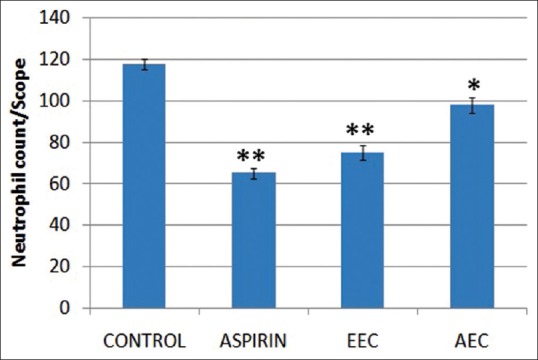
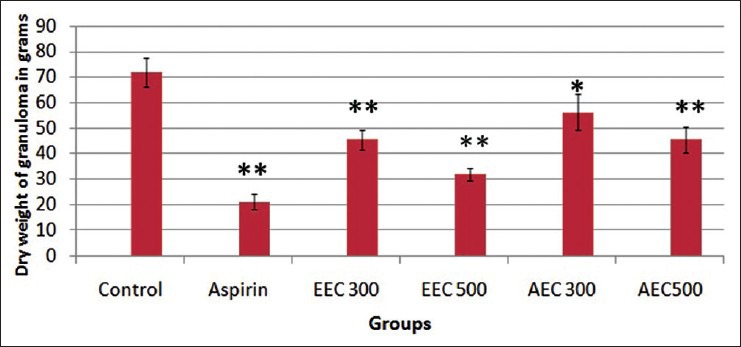
Results: Chicory roots demonstrated significant dose-dependent decrease in paw edema in carrageenan-induced paw edema method. Chicory roots diminished the serum TNF-α, IL-6, and IL-1 levels. They also significantly attenuated the malonylaldehyde levels and increased the activities of CAT and GPx in paw tissue. Similarly, chicory roots demonstrated a significant decrease in granuloma formation in cotton pellet induced granuloma method.
Conclusion: Chicory roots possess anti-inflammatory activity, and this might be due to the inhibition of various cytokines, antioxidant effects, and their free radical scavenging activity.
Keywords: Anti-inflammatory; Cichorium intybus; antioxidant activity; carrageenan; cytokines.
Conflict of interest statement
Figures

References
-
- Zafar R, Mujahid Ali S. Anti-hepatotoxic effects of root and root callus extracts of Cichorium intybus L. J Ethnopharmacol. 1998;63:227–31. - PubMed
-
- Pazola Z. The chemistry of chicory and chicory-product beverages. In: Clarke RJ, Macrae R, editors. Coffee. Related Beverages. New York: Elsevier Applied Science Publishers; 1987. pp. 19–57.
-
- Kapoor LD. United States, Florida: CRC Press; 1989. CRC Handbook of Ayurvedic Medicinal Plants; pp. 114–5.
-
- Panda H. Handbook on Medicinal Herbs with Uses. New Delhi: National Institute of Industrial Research; 2002. Chicorium intybus; pp. 334–5.
-
- Roberfroid MB, Van Loo JA, Gibson GR. The bifidogenic nature of chicory inulin and its hydrolysis products. J Nutr. 1998;128:11–9. - PubMed
LinkOut - more resources
Full Text Sources
Other Literature Sources
Miscellaneous