


Gout and the risk of Alzheimer's disease: a population-based, BMI-matched cohort study
- PMID: 25739830
- PMCID: PMC4560667
- DOI: 10.1136/annrheumdis-2014-206917
Gout and the risk of Alzheimer's disease: a population-based, BMI-matched cohort study
Abstract
Objective: While gout is associated with cardiovascular (CV)-metabolic comorbidities and their sequelae, the antioxidant effects of uric acid may have neuroprotective benefits. We evaluated the potential impact of incident gout on the risk of developing Alzheimer's disease (AD) in a general population context.
Methods: We conducted an age-matched, sex-matched, entry-time-matched and body mass index (BMI)-matched cohort study using data from The Health Improvement Network, an electronic medical record database representative of the UK general population, from 1 January 1995 to 31 December 2013. Up to five non-gout individuals were matched to each case of incident gout by age, sex, year of enrolment and BMI. We compared incidence rates of AD between the gout and comparison cohorts, excluding individuals with prevalent gout or dementia at baseline. Multivariate hazard ratios (HRs) were calculated, while adjusting for smoking, alcohol use, physician visits, social deprivation index, comorbidities and medication use. We repeated the same analysis among patients with incident osteoarthritis (OA) as a negative control exposure.
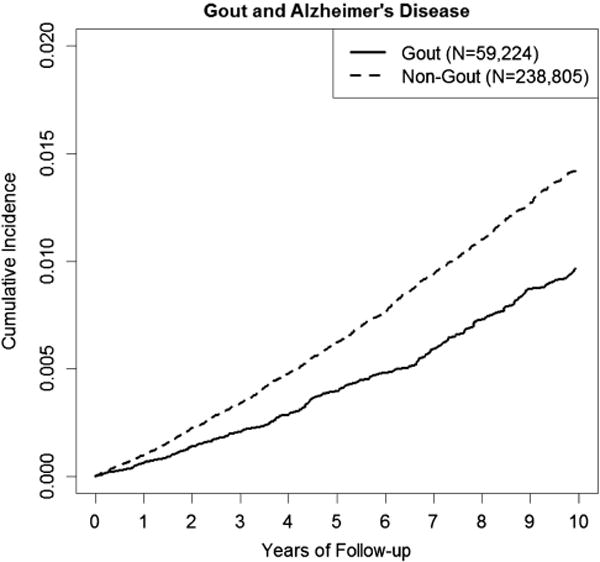
Results: We identified 309 new cases of AD among 59 224 patients with gout (29% female, mean age 65 years) and 1942 cases among 238 805 in the comparison cohort over a 5-year median follow up (1.0 vs 1.5 per 1000 person-years, respectively). Univariate (age-matched, sex-matched, entry-time-matched and BMI-matched) and multivariate HRs for AD among patients with gout were 0.71 (95% CI 0.62 to 0.80) and 0.76 (95% CI 0.66 to 0.87), respectively. The inverse association persisted among subgroups stratified by sex, age group (<75 and ≥75 years), social deprivation index and history of CV disease. The association between incident OA and the risk of incident AD was null.
Conclusions: These findings provide the first general population-based evidence that gout is inversely associated with the risk of developing AD, supporting the purported potential neuroprotective role of uric acid.
Keywords: Arthritis; Epidemiology; Gout.
Published by the BMJ Publishing Group Limited. For permission to use (where not already granted under a licence) please go to http://www.bmj.com/company/products-services/rights-and-licensing/
Conflict of interest statement
Figures
References
-
- Zhu Y, Pandya BJ, Choi HK. Comorbidities of gout and hyperuricemia in the US general population: NHANES 2007–2008. Am J Med. 2012;125:679–687 e1. - PubMed
-
- Abbott RD, Brand FN, Kannel WB, et al. Gout and coronary heart disease: the Framingham Study. J Clin Epidemiol. 1988;41:237–42. - PubMed
-
- Krishnan E, Baker JF, Furst DE, et al. Gout and the risk of acute myocardial infarction. Arthritis Rheum. 2006;54:2688–96. - PubMed
-
- Krishnan E, Svendsen K, Neaton JD, et al. Long-term cardiovascular mortality among middle-aged men with gout. Arch Intern Med. 2008;168:1104–10. - PubMed
-
- Choi HK, Curhan G. Independent impact of gout on mortality and risk for coronary heart disease. Circulation. 2007;116:894–900. - PubMed
Publication types
MeSH terms
Grants and funding
LinkOut - more resources
Full Text Sources
Other Literature Sources
Medical
