. 2015 Mar 5:5:8771.
doi: 10.1038/srep08771.

New compound sets identified from high throughput phenotypic screening against three kinetoplastid parasites: an open resource

Affiliations

New compound sets identified from high throughput phenotypic screening against three kinetoplastid parasites: an open resource

Imanol Peña et al. Sci Rep. .

Abstract

Using whole-cell phenotypic assays, the GlaxoSmithKline high-throughput screening (HTS) diversity set of 1.8 million compounds was screened against the three kinetoplastids most relevant to human disease, i.e. Leishmania donovani, Trypanosoma cruzi and Trypanosoma brucei. Secondary confirmatory and orthogonal intracellular anti-parasiticidal assays were conducted, and the potential for non-specific cytotoxicity determined. Hit compounds were chemically clustered and triaged for desirable physicochemical properties. The hypothetical biological target space covered by these diversity sets was investigated through bioinformatics methodologies. Consequently, three anti-kinetoplastid chemical boxes of ~200 compounds each were assembled. Functional analyses of these compounds suggest a wide array of potential modes of action against kinetoplastid kinases, proteases and cytochromes as well as potential host-pathogen targets. This is the first published parallel high throughput screening of a pharma compound collection against kinetoplastids. The compound sets are provided as an open resource for future lead discovery programs, and to address important research questions.


Figures
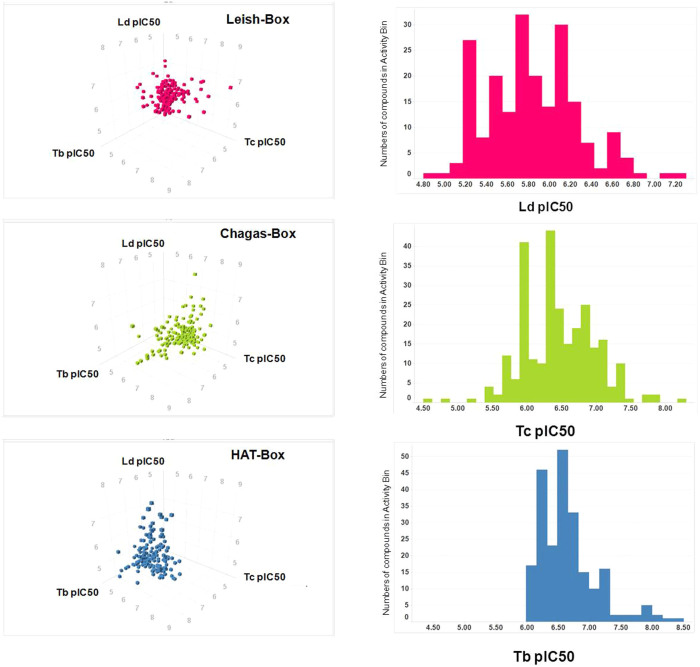
Figure 1
Figure 1. Distribution of potency by chemical box (Leishmania donovani in pink, Trypanosoma brucei in blue and T. cruzi in green) and parasite.
Left panels: 3D scatter plot of pIC50 values for each compound against L. donovani (Ld pIC50, as inhibition of amastigotes per macrophage readout from imaging assay), T. cruzi (Tc pIC50, as inhibition of amastigotes per cell readout from imaging assay) and T. brucei (Tb pIC50, as inhibition of FLINT from fluorescent assay). Right panels: Distribution of potency for all compounds of each of the three chemical boxes (~200 compounds distributed into 40 potency bins).
Figure 2
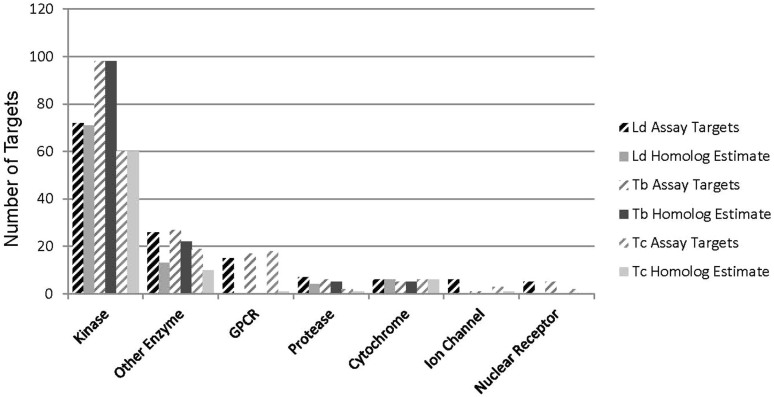
Figure 2. Histogram of assignment of positive compounds based on historical assay data and homology of human protein targets to kinetoplastid genomes.
Histograms are clustered by assays for Leishmania donovani (Ld), Trypanosoma brucei (Tb) and T. cruzi (Tc). The threshold above which compound efficacy against specific human targets was considered significant was defined as pIC50 ≥ 5 for inhibition or antagonist assays, and pEC50 ≥ 5 for agonist, activation or modulator assays (i.e. overall pXC50 ≥ 5). Kinetoplastid homologs to human proteins were assigned based on BLASTP E-values ≤ 1.0e–05. Some compounds met the criteria for multiple human proteins (cross-hatched bars) while some kinetoplastid proteins had homology to multiple human proteins (solid bars).
Figure 3
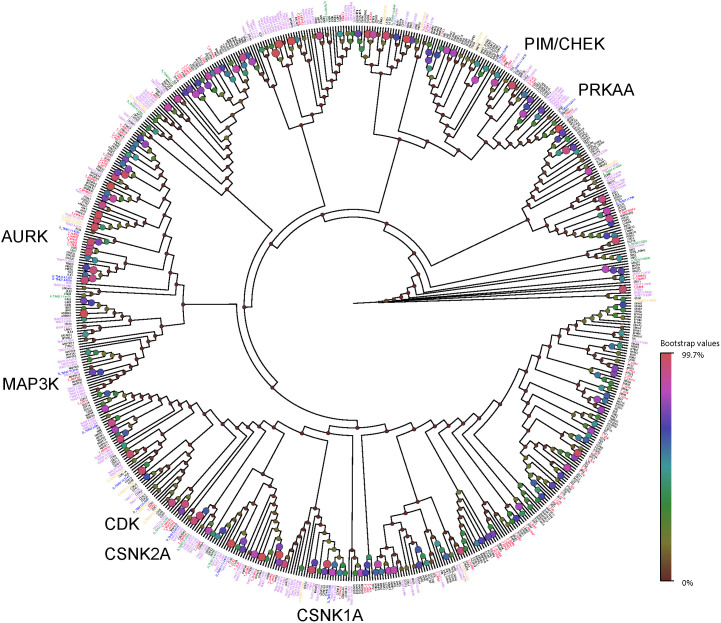
Figure 3. Neighbor-joining phylogenetic tree of combined human and Trypanosoma brucei str. 927 kinomes.
Human kinase targets with putative compounds are colored and prefixed (T_red); all human kinases are colored black. T. brucei kinases are colored and prefixed for the RNAi phenotypes death (D_blue), arrest (A_dark green) or slow (S_orange) according to Table 1 in Jones et al.. All other T. brucei kinases are colored violet. A few key clusters of human target and essential T. brucei kinases are labeled. The size and color of circles on the nodes represent support in 1000 bootstrap replicates.
Figure 4
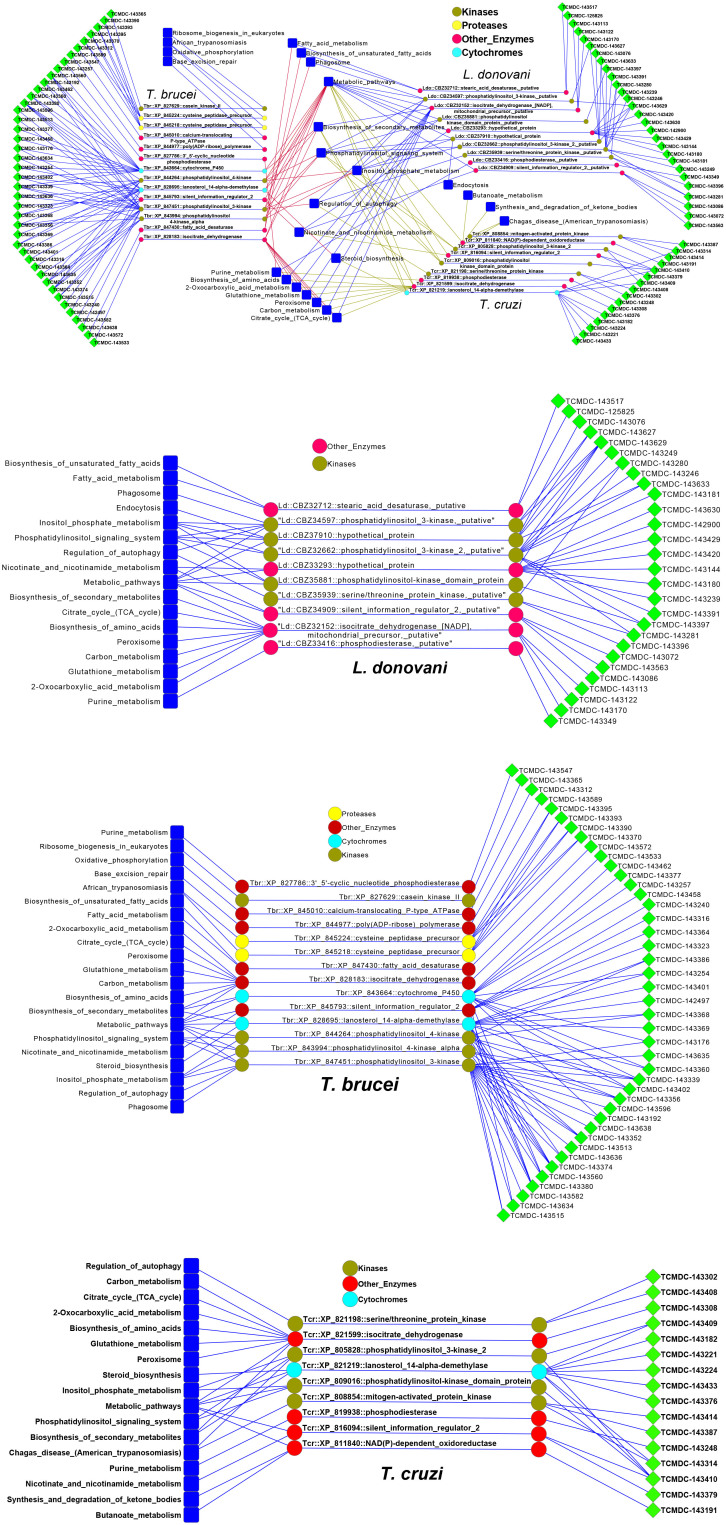
Figure 4. Pathway network analysis of combined and individual kinetoplastid target hypotheses.
Pathways were assigned using KEGG and visualized using Cytoscape. Proteins of three species are grouped and colored according to general functional groups (kinases, proteases, other enzymes and cytochromes).

Comment in

References

    1. Stuart K. et al. Kinetoplastids: related protozoan pathogens, different diseases. J. Clin. Inv. 118, 1301–1310 (2008). - PMC - PubMed
    1. Pedrique B. et al. The drug and vaccine landscape for neglected diseases (2000–2011): a systematic assessment. Lancet Glob. Health 1, e371–e379 (2013). - PubMed
    1. World Health Organization. Working to overcome the global impact of neglected tropical diseases – first WHO report on neglected tropical diseases. http://whqlibdoc.who.int/publications/2010/9789241564090_eng.pdf (2010) (Date of access: 20th November 2014).
    1. Aslett M. et al. TriTrypDB: a functional genomic resource for the Trypanosomatidae. Nucleic Acids Res. 38, D457–462 (2010). - PMC - PubMed
    1. Parsons M., Worthey E. A., Ward P. N. & Mottram J. C. Comparative analysis of the kinomes of three pathogenic trypanosomatids: Leishmania major, Trypanosoma brucei and Trypanosoma cruzi. BMC Genomics 6, 127 (2005). - PMC - PubMed

Publication types

Substances