


Low circulating 25-hydroxyvitamin D concentrations are associated with defects in insulin action and insulin secretion in persons with prediabetes
- PMID: 25740907
- PMCID: PMC4381771
- DOI: 10.3945/jn.114.209171
Low circulating 25-hydroxyvitamin D concentrations are associated with defects in insulin action and insulin secretion in persons with prediabetes
Abstract
Background: Individuals with prediabetes mellitus (PreDM) and low circulating 25-hydroxyvitamin D [25(OH)D] are at increased risk of type 2 diabetes mellitus (T2DM).
Objective: We aimed to determine whether low 25(OH)D concentrations are associated with defects in insulin action and insulin secretion in persons with PreDM.
Methods: In this cross-sectional study, we stratified 488 nondiabetic subjects as having PreDM or normal fasting glucose (NFG) and a 25(OH)D concentration ≤20 ng/mL (deficient) or >20 ng/mL (sufficient). We determined insulin resistance by steady state plasma glucose (SSPG) concentration and homeostasis model assessment of insulin resistance (HOMA-IR) and insulin secretion by homeostasis model assessment of β-cell function (HOMA-β). We compared insulin resistance and secretion measures in PreDM and NFG groups; 25(OH)D-deficient and 25(OH)D-sufficient groups; and PreDM-deficient, PreDM-sufficient, NFG-deficient, and NFG-sufficient subgroups, adjusting for age, sex, race, body mass index, multivitamin use, and season.
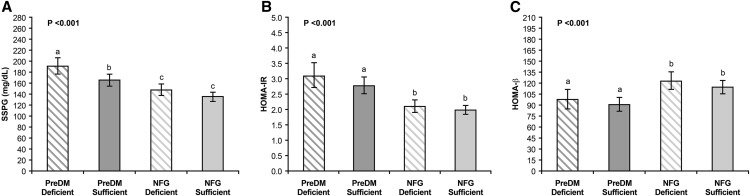
Results: In the PreDM group, mean SSPG concentration and HOMA-IR were higher and mean HOMA-β was lower than in the NFG group (P < 0.001 for all comparisons). In the 25(OH)D-deficient group, mean SSPG concentration was higher (P < 0.001), but neither mean HOMA-IR nor HOMA-β was significantly different from that in the 25(OH)D-sufficient group. In the PreDM-deficient subgroup, mean (95% CI) SSPG concentration was higher (P < 0.01) than in the PreDM-sufficient, NFG-deficient, and NFG-sufficient subgroups [192 (177-207) mg/dL vs. 166 (155-177) mg/dL, 148 (138-159) mg/dL, and 136 (127-144) mg/dL, respectively]. Despite greater insulin resistance, mean HOMA-β was not significantly higher in the PreDM-deficient subgroup than in the PreDM-sufficient, NFG-deficient, and NFG-sufficient subgroups [98 (85-112) vs. 91 (82-101), 123 (112-136), and 115 (106-124), respectively].
Conclusion: Subjects with PreDM and low circulating 25(OH)D concentrations are the subgroup of nondiabetic individuals who are the most insulin resistant and have impaired β-cell function, attributes that put them at enhanced risk of T2DM.
Keywords: 25-hydroxyvitamin D; HOMA-IR; HOMA-β; insulin resistance; insulin secretion; prediabetes.
© 2015 American Society for Nutrition.
Conflict of interest statement
Author disclosures: F Abbasi, C Blasey, D Feldman, and GM Reaven, no conflicts of interest. MP Caulfield and FM Hantash are employees of Quest Diagnostics and own stock in the company.
Figures
References
-
- Pittas AG, Nelson J, Mitri J, Hillmann W, Garganta C, Nathan DM, Hu FB, Dawson-Hughes B; Diabetes Prevention Program Research Group. Plasma 25-hydroxyvitamin D and progression to diabetes in patients at risk for diabetes: an ancillary analysis in the Diabetes Prevention Program. Diabetes Care 2012;35:565–73. - PMC - PubMed
-
- Deleskog A, Hilding A, Brismar K, Hamsten A, Efendic S, Ostenson CG. Low serum 25-hydroxyvitamin D level predicts progression to type 2 diabetes in individuals with prediabetes but not with normal glucose tolerance. Diabetologia 2012;55:1668–78. - PubMed
-
- Tuomilehto J, Lindstrom J, Eriksson JG, Valle TT, Hamalainen H, Ilanne-Parikka P, Keinanen-Kiukaanniemi S, Laakso M, Louheranta A, Rastas M, et al. Prevention of type 2 diabetes mellitus by changes in lifestyle among subjects with impaired glucose tolerance. N Engl J Med 2001;344:1343–50. - PubMed
Publication types
MeSH terms
Substances
Grants and funding
LinkOut - more resources
Full Text Sources
Other Literature Sources
Medical
