. 2015 Apr;66(7):2067-77.
doi: 10.1093/jxb/erv018. Epub 2015 Mar 4.

An Arabidopsis soluble chloroplast proteomic analysis reveals the participation of the Executer pathway in response to increased light conditions

Affiliations

An Arabidopsis soluble chloroplast proteomic analysis reveals the participation of the Executer pathway in response to increased light conditions

Estefanía Uberegui et al. J Exp Bot. 2015 Apr.

Abstract

The Executer1 and Executer2 proteins have a fundamental role in the signalling pathway mediated by singlet oxygen in chloroplast; nonetheless, not much is known yet about their specific activity and features. Herein, we have followed a differential-expression proteomics approach to analyse the impact of Executer on the soluble chloroplast protein abundance in Arabidopsis. Because singlet oxygen plays a significant role in signalling the oxidative response of plants to light, our analysis also included the soluble chloroplast proteome of plants exposed to a moderate light intensity in the time frame of hours. A number of light- and genotype-responsive proteins were detected, and mass-spectrometry identification showed changes in abundance of several photosynthesis- and carbon metabolism-related proteins as well as proteins involved in plastid mRNA processing. Our results support the participation of the Executer proteins in signalling and control of chloroplast metabolism, and in the regulation of plant response to environmental changes.

Keywords: Abiotic stress; DIGE; ROS.; acclimation response; chloroplast metabolism; light; retrograde signalling.


Figures

Fig. 1.
Fig. 1.
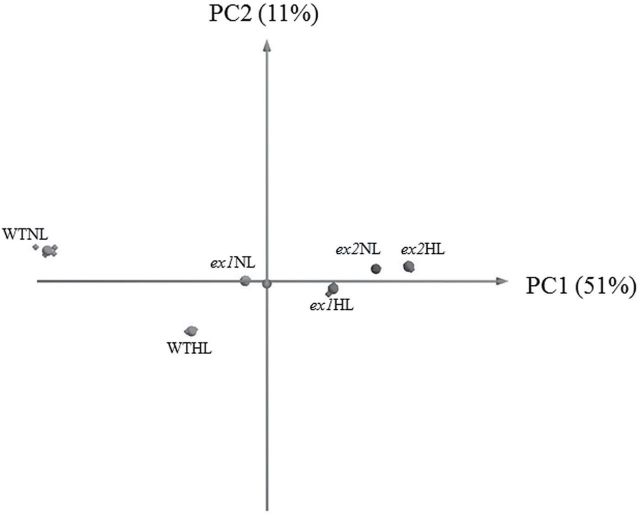
A principal component analysis (PCA) biplot for the complete data set demonstrated a distinct clustering of WT from the executer mutants (ex1 and ex2) in the two light treatments (NL and HL). Principal components 1 (PC1) and 2 (PC2)—where PC1 indicates the direction of the highest variability followed by PC2 with diminishing variability orthogonal to PC1—accounted for 51% and 11% of the study variance, respectively. PCA suggested a modification of the soluble chloroplast proteome in Arabidopsis upon light treatment. The genotype caused a large shift in the PC1 dimension to more positive values and significantly reduced the differences between NL and HL samples in PC2.
Fig. 2.
Fig. 2.
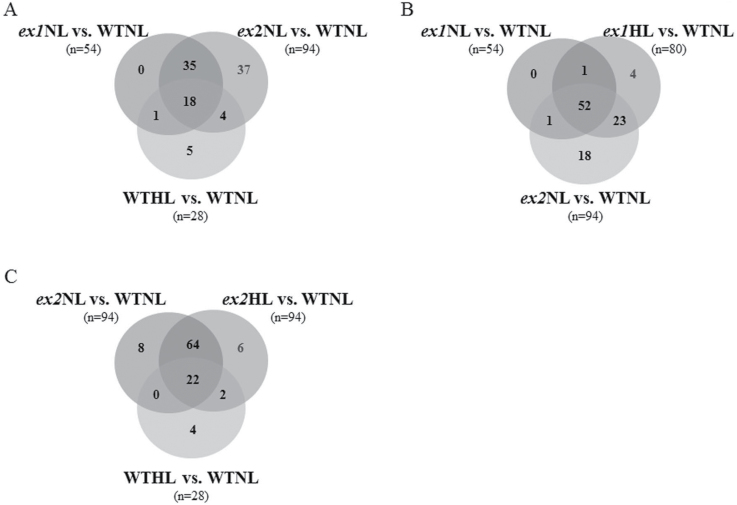
Venn diagram analyses showing common and differential distribution of protein spots detected by DIGE in stromal preparations of Arabidopsis plants in response to light and genotype, using as reference WT in normal growth light conditions (WTNL). (A) Overlay of the responsive proteins in WT upon light treatment (WTHL), and the two executer mutants in normal growth light conditions (ex1NL and ex2NL, respectively); (B) Overlay of the responsive proteins in ex1 plants upon light treatment (ex2HL) and the two executer mutants in normal growth light conditions (ex1NL and ex2NL, respectively); (C) Overlay of the responsive proteins in WT upon light treatment (WTHL) and the ex2 mutants both in normal light (ex2NL) and high light (ex2HL) conditions.
Fig. 3.
Fig. 3.
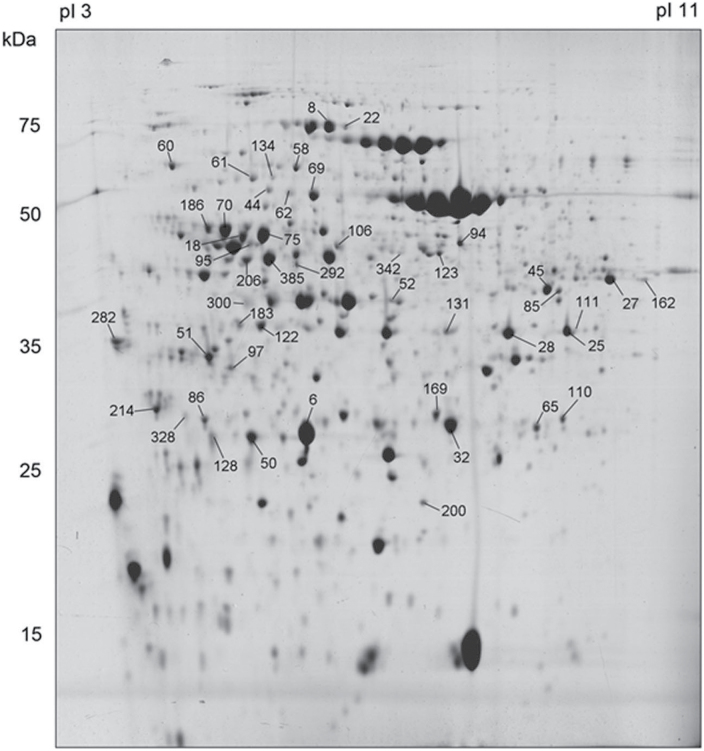
Preparative CBB-stained 2D gel of the soluble chloroplast proteome of Arabidopsis. The positions and numbers of the 47 identified protein spots are indicated according to the numbering in Table 3.
Fig. 4.
Fig. 4.
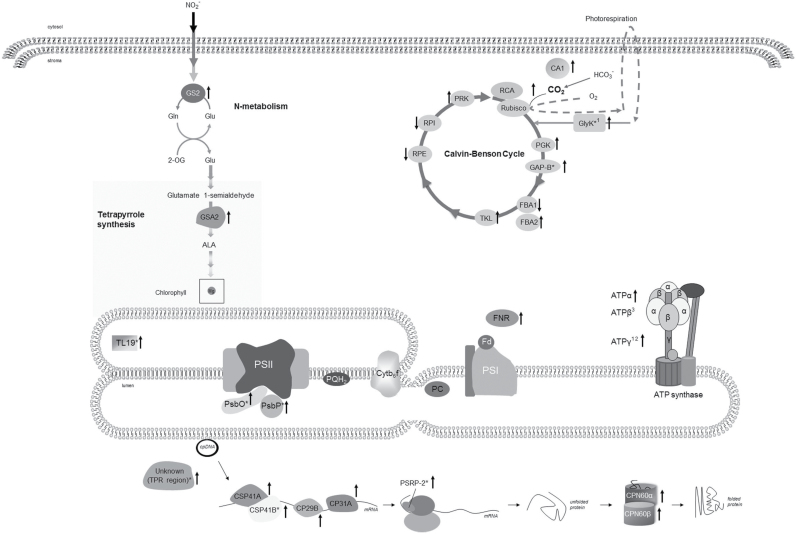
Schematic presentation of chloroplast proteins affected in executer mutants and WT plants after light treatment compared to WT plants under normal or growth light conditions, as shown in Table 3. Arrows indicate increased or decreased abundance compared to WTNL. An asterisk indicates that the protein is not differentially expressed in WTHL; 1protein is not differentially expressed in ex1NL, 2protein is not differentially expressed in ex2NL; 3multi-expression pattern. Abbreviations: ALA, 5-aminolevulinic acid; ATPα, ATPβ and ATPγ, ATPase alpha, beta and gamma subunits, respectively; CA1, carbonic anhydrase 1; CP29B’, chloroplast ribonucleoprotein 29kDa; CP31A, 31 kDA RNA-binding protein; CPN60α and CPN60β, chaperonin 60 alpha and beta subunits, respectively; CSP41A and CSP41B, chloroplast stem-loop binding protein of 41kDa A and B subunits, respectively; Cytb6f, cytochrome b6f complex; FBA1 and FBA2, ructose-bisphosphate aldolase subunits 1 and 2, respectively; Fd, ferredoxin; FNR2, ferredoxin-NADP(+)-oxidoreductase 2; GAPB, glyceraldehyde 3-phosphate dehydrogenase B subunit; Glu, glutamate; Gln, glutamine; GlyK, D-glycerate 3-kinase; GS2, glutamine synthetase-2; GSA2, glutamate-1-semialdehyde 2 1-aminomutase); PC, plastocyanin; PGK, phosphoglycerate kinase; PQH2, plastoquinol; PRK, phosphoribulokinase; PsbO and PsbP, photosystem II subunits O and P, respectively; PSI, photosystem I; PSII, photosystem II; PSRP-2, plastid-specific ribosomal protein 2; RCA, rubisco activase; RPE, ribulose-phosphate-3-epimerase; RPI, ribose 5-phosphate isomerase; TKL, transketolase; TL19, thylakoid lumen 19kDa; 2-OG, 2-oxoglutarate.

References

    1. Alonso JM, Stepanova AN, Leisse TJ, et al. 2003. Genome-wide insertional mutagenesis of Arabidopsis thaliana . Science 301, 653–657. - PubMed
    1. Apel K. 2004. Reactive oxygen species: metabolism, oxidative stress, and signal transduction. Annual Review of Plant Biology 55, 373–399. - PubMed
    1. Asada K. 2006. Production and scavenging of reactive oxygen species in chloroplasts and their functions. Plant Physiology 141, 391–396. - PMC - PubMed
    1. Barajas-López JdD, Blanco NE, Strand Å. 2013. Plastid-to-nucleus communication, signals controlling the running of the plant cell. Biochimica et Biophysica Acta (BBA) – Molecular Cell Research 1833, 425–437. - PubMed
    1. Baruah A, Šimková K, Apel K, Laloi C. 2009. Arabidopsis mutants reveal multiple singlet oxygen signaling pathways involved in stress response and development. Plant Molecular Biology 70, 547–563. - PubMed

Publication types