. 2015 Mar 5;11(3):e1004698.
doi: 10.1371/journal.ppat.1004698. eCollection 2015 Mar.

Subgingival microbial communities in Leukocyte Adhesion Deficiency and their relationship with local immunopathology

Affiliations

Subgingival microbial communities in Leukocyte Adhesion Deficiency and their relationship with local immunopathology

Niki M Moutsopoulos et al. PLoS Pathog. .

Erratum in

Abstract

Leukocyte Adhesion Deficiency I (LAD-I) is a primary immunodeficiency caused by single gene mutations in the CD18 subunit of β2 integrins which result in defective transmigration of neutrophils into the tissues. Affected patients suffer from recurrent life threatening infections and severe oral disease (periodontitis). Microbial communities in the local environment (subgingival plaque) are thought to be the triggers for inflammatory periodontitis, yet little is known regarding the microbial communities associated with LAD-I periodontitis. Here we present the first comprehensive characterization of the subgingival communities in LAD-I, using a 16S rRNA gene-based microarray, and investigate the relationship of this tooth adherent microbiome to the local immunopathology of periodontitis. We show that the LAD subgingival microbiome is distinct from that of health and Localized Aggressive Periodontitits. Select periodontitis-associated species in the LAD microbiome included Parvimonas micra, Porphyromonas endodontalis, Eubacterium brachy and Treponema species. Pseudomonas aeruginosa, a bacterium not typically found in subgingival plaque is detected in LAD-I. We suggest that microbial products from LAD-associated communities may have a role in stimulating the local inflammatory response. We demonstrate that bacterial LPS translocates into the lesions of LAD-periodontitis potentially triggering immunopathology. We also show in in vitro assays with human macrophages and in vivo in animal models that microbial products from LAD-associated subgingival plaque trigger IL-23-related immune responses, which have been shown to dominate in patient lesions. In conclusion, our current study characterizes the subgingival microbial communities in LAD-periodontitis and supports their role as triggers of disease pathogenesis.


Conflict of interest statement

The authors have declared that no competing interests exist.

Figures
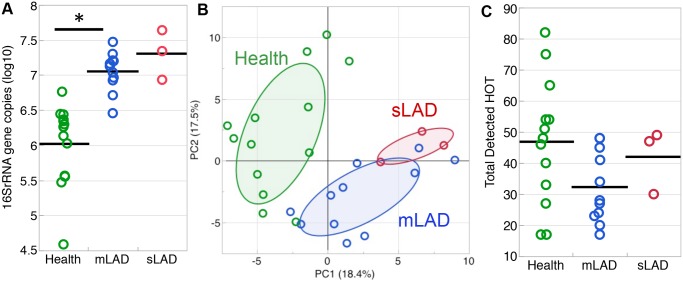
Fig 1
Fig 1. Microbial load and diversity of LAD-1 subgingival communities.
(A) Total bacterial load (quantified with real-time PCR for 16S rRNA) shown in health (green), mild/moderate LAD (mLAD, blue) and severe LAD (sLAD, red). Bacterial load values are expressed as log (10) of 16S rRNA gene copy number and each circle represents a site. Mean values are indicated with a line. * indicates p<0.05. (B) Principal component analysis based on detection levels for bacterial taxa in the HOMIM microarray. Principal component 1 (PC1, x-axis, 18.4%) vs. principal component 2 (PC2, y-axis, 17.5%) account for 35.9% of the total data variability. Microbial communities from health (green circles) cluster away from LAD-I communities (mLAD, blue circles and sLAD, red circles). Ellipse is drawn around 50% of the data within the group. (C) Total number of HOT detected per group in health (green), mild/moderate LAD (blue) and severe LAD (red). Each circle represents a site. Mean values are indicated with a line. Multiple sites from the same patient were first averaged to obtain one value per patient prior to calculating mean values both for (A) and (C).
Fig 2
Fig 2. Detection levels of subgingival microbes in health and LAD.
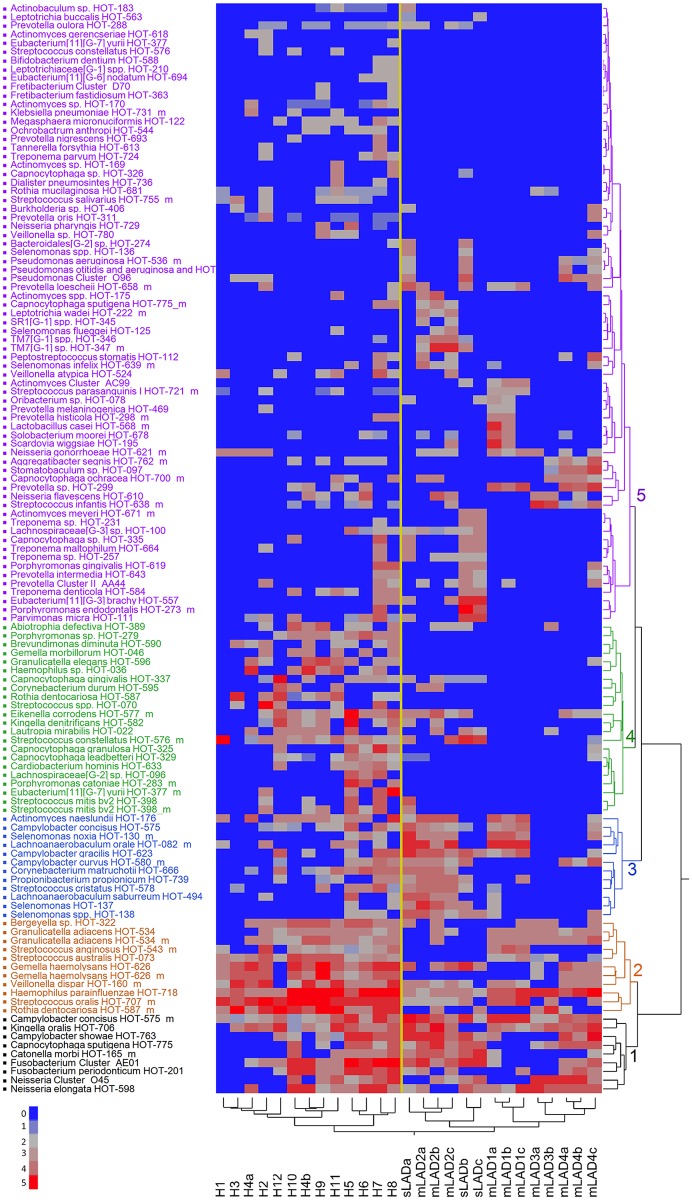
Two way hierarchical cluster analysis with Ward’s distance measure applied to the normalized fluorescence intensity signal from the microarray data, on a 0 to 5 scale where 0 is not present (blue) and 5 is present in high levels (red) (scale 0–5 on the bottom left of Figure). The diagram represents 125 species (HOT) in 27 samples. The patients samples grouped in two distinct clusters: Health (H1 to H12) and LAD (both moderate and severe). Separation is shown by a yellow super-imposed line. Bacterial species grouped in 5 distinct clusters (1–5, black, brown, blue, green and purple).
Fig 3
Fig 3. Unique bacterial taxa detected in health, severe and moderate LAD.
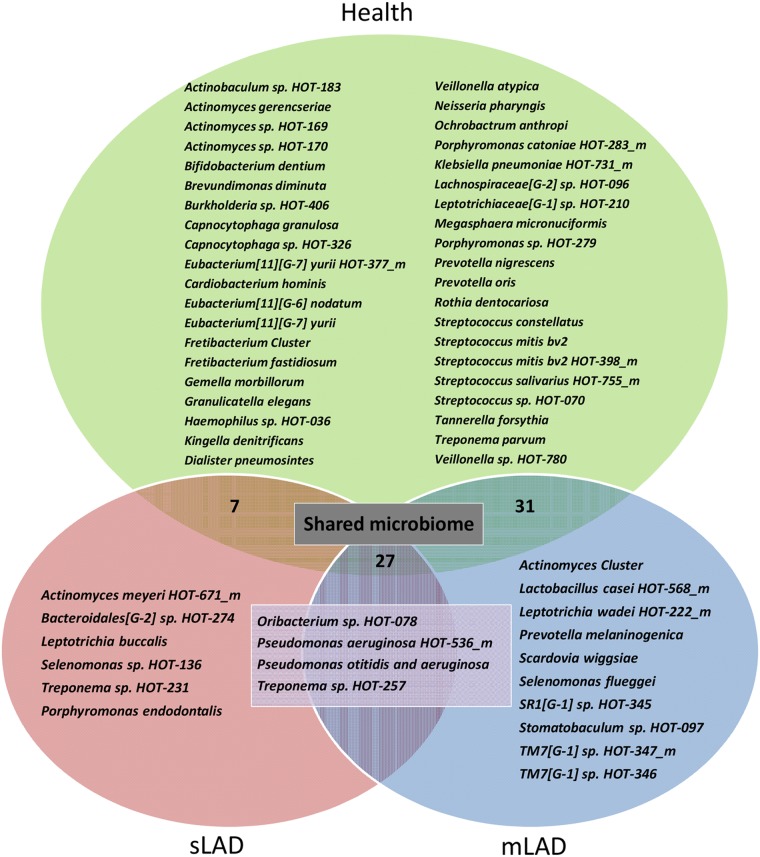
Venn Diagram showing unique taxa detected in Health (n = 40, green), mLAD (n = 10, blue), sLAD (n = 6, red) and all LAD patients (n = 4, purple). Taxa (species) shared between mLAD and Health (n = 31), sLAD and Health (n = 7) or detected in all groups (n = 27) are termed a “shared microbiome” and not listed in the figure.
Fig 4
Fig 4. Bacterial taxa differentially represented in LAD and health.
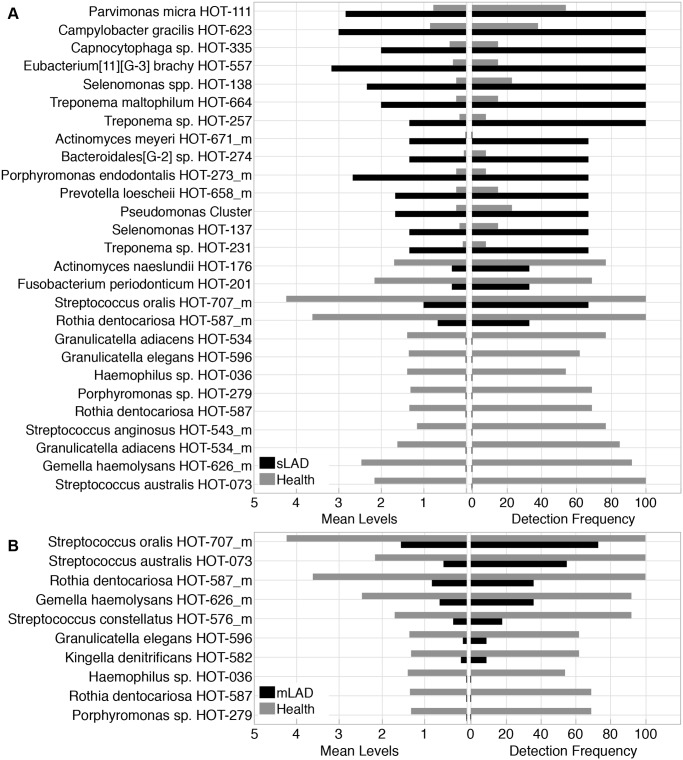
(A) Species with a 2 fold change or greater in severe LAD (sLAD) versus health samples. Left panel shows mean detection levels of 27 bacterial taxa that were differentially represented in severe LAD compared to health. Right panel shows detection frequency across samples of those 27 species. Percent present for each group is the number of sites that were positive for the specific species. (B) Species with a 2 fold or greater difference between mild/moderate LAD (mLAD) and health microbial communities. Left panel shows mean detection levels for 10 species that were differentially found compared to health. Right panel shows percent presence across samples for the same 10 species.
Fig 5
Fig 5. Immunostimulatory potential of LAD- associated dental plaque.
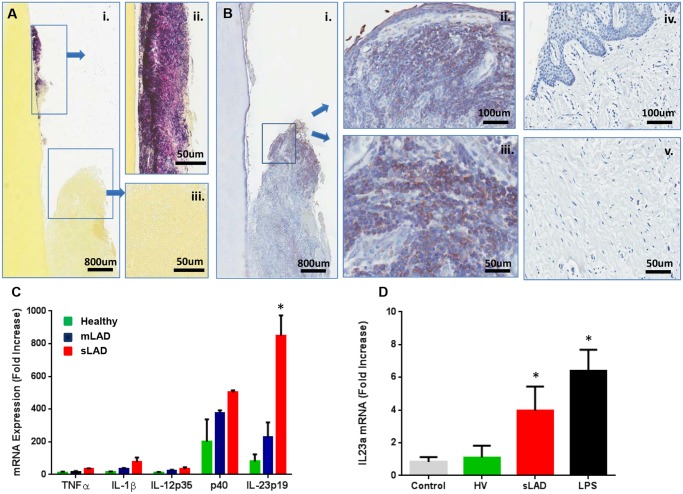
(A) Gram staining (Brown and Brenn method) of extracted tooth and adjacent soft tissues: (i) Gram positive (violet) and negative (pink) staining on the root surface (ii) and surrounding tissues (iii)(scale bars shown). Representative of 3 LAD patients with tooth extractions. (B) Immunohistochemistry for bacterial lipopolysaccharide (LPS) on extracted LAD tooth (i) and surrounding tissues (ii, iii) as well as in healthy gingiva (iv, v). Positive staining is brown and indicated by arrows (scale bars shown). Representative of 3 LAD patients. (C) Exposure of human macrophages to LAD microbial plaque. Human macrophages (at a concentration of 3x10⁶/ml) were left untreated (medium control) or treated with standardized amounts of inactivated subgingival plaque (equivalent of 1x10⁶ 16S rRNA gene copy number) from healthy, mLAD and LAD donors (n = 3, each) for 4 hours and processed for RNA to evaluate cytokine gene transcription. Results are shown as fold induction of mRNA expression relative to the untreated control, p<0.05 between health and LAD. (D) In vivo inoculation of murine oral mucosa with inactivated subgingival plaque from healthy volunteer (HV) and sLAD donors or purified LPS (2 μg/μl). Mice received oral injections with HV or sLAD plaque or LPS and oral tissues were harvested at 4h for evaluation IL23a at the mRNA level (n = 3). Results are shown as fold increase over untreated control, * = p<0.05, significant increase over treatment with HV plaque.

References

    1. Rosenzweig SD, Holland SM (2004) Phagocyte immunodeficiencies and their infections. J Allergy Clin Immunol 113: 620–626. - PubMed
    1. Hanna S, Etzioni A (2011) New host defense mechanisms against Candida species clarify the basis of clinical phenotypes. J Allergy Clin Immunol 127: 1433–1437. 10.1016/j.jaci.2011.03.026 - DOI - PubMed
    1. Gerald L. Mandell JEB, and Raphael Dolin (2009) Mandell, Douglas, and Bennett’s Principles and Practice of Infectious Diseases In: Gerald L. Mandell JEB, and Raphael Dolin, editor. Mandell, Douglas, and Bennett’s Principles and Practice of Infectious Diseases Philadelphia: Elsevier; 10.1056/NEJMoa1304839.Two - DOI
    1. Uzel G, Tng E, Rosenzweig SD, Hsu AP, Shaw JM, et al. (2008) Reversion mutations in patients with leukocyte adhesion deficiency type-1 (LAD-1). Blood 111: 209–218. - PMC - PubMed
    1. Hanna S, Etzioni A (2012) Leukocyte adhesion deficiencies. Ann N Y Acad Sci 1250: 50–55. 10.1111/j.1749-6632.2011.06389.x - DOI - PubMed

Publication types

MeSH terms

LinkOut - more resources