


Common behavioral clusters and subcortical anatomy in stroke
- PMID: 25741721
- PMCID: PMC4646844
- DOI: 10.1016/j.neuron.2015.02.027
Common behavioral clusters and subcortical anatomy in stroke
Abstract
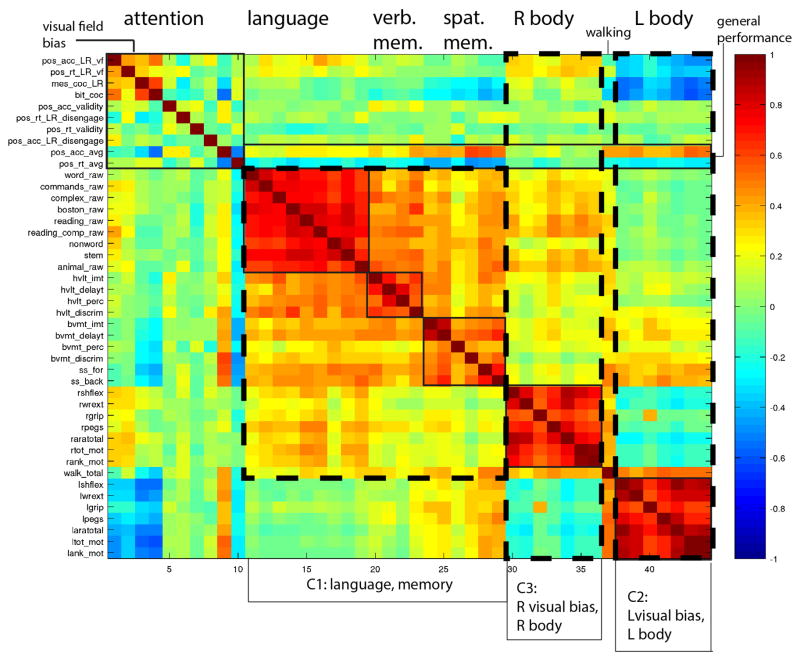
A long-held view is that stroke causes many distinct neurological syndromes due to damage of specialized cortical and subcortical centers. However, it is unknown if a syndrome-based description is helpful in characterizing behavioral deficits across a large number of patients. We studied a large prospective sample of first-time stroke patients with heterogeneous lesions at 1-2 weeks post-stroke. We measured behavior over multiple domains and lesion anatomy with structural MRI and a probabilistic atlas of white matter pathways. Multivariate methods estimated the percentage of behavioral variance explained by structural damage. A few clusters of behavioral deficits spanning multiple functions explained neurological impairment. Stroke topography was predominantly subcortical, and disconnection of white matter tracts critically contributed to behavioral deficits and their correlation. The locus of damage explained more variance for motor and language than memory or attention deficits. Our findings highlight the need for better models of white matter damage on cognition.
Copyright © 2015 Elsevier Inc. All rights reserved.
Conflict of interest statement
They declare that they have no competing interests.
Figures




Comment in
-
Structure-function correlations in stroke.Neuron. 2015 Mar 4;85(5):887-9. doi: 10.1016/j.neuron.2015.02.031. Neuron. 2015. PMID: 25741715
References
Publication types
MeSH terms
Grants and funding
LinkOut - more resources
Full Text Sources
Other Literature Sources
Medical
