


Determining the prevalence of McArdle disease from gene frequency by analysis of next-generation sequencing data
- PMID: 25741863
- PMCID: PMC4561039
- DOI: 10.1038/gim.2015.9
Determining the prevalence of McArdle disease from gene frequency by analysis of next-generation sequencing data
Abstract
Purpose: McArdle disease is one of the most common glycogen storage disorders. Although the exact prevalence is not known, it has been estimated to be 1 in 100,000 patients in the United States. More than 100 mutations in PYGM have been associated with this disorder. McArdle disease has significant clinical variability: Some patients present with severe muscle pain and weakness; others have only mild, exercise-related symptoms.
Methods: Next-generation sequencing data allow estimation of disease prevalence with minimal ascertainment bias. We analyzed gene frequencies in two cohorts of patients based on exome sequencing results. We categorized variants into three groups: a curated set of published mutations, variants of uncertain significance, and likely benign variants.
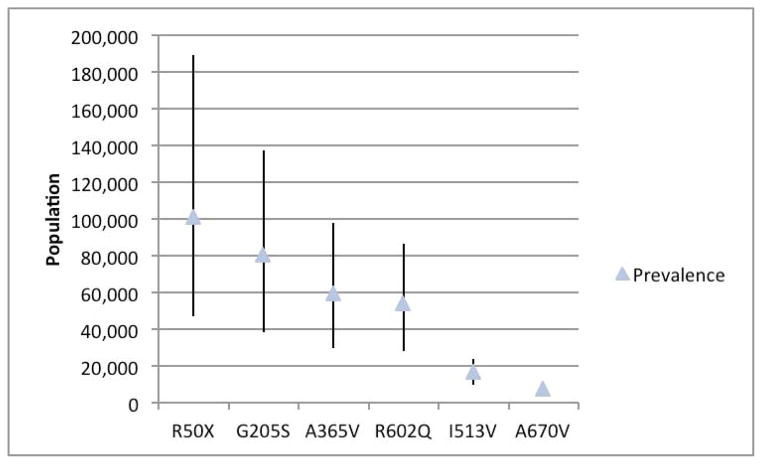
Results: An initial estimate based on the frequency of six common mutations predicts a disease prevalence of 1/7,650 (95% confidence interval (CI) 1/5,362-1/11,108), which greatly deviates from published estimates. A second method using the two most common mutations predicts a prevalence of 1/42,355 (95% CI 1/24,536-1/76,310) in Caucasians.
Conclusions: These results suggest that the currently accepted prevalence of McArdle disease is an underestimate and that some of the currently considered pathogenic variants are likely benign.
Figures
References
-
- el-Schahawi M, Tsujino S, Shanske S, DiMauro S. Diagnosis of McArdle’s disease by molecular genetic analysis of blood. Neurology. 1996;47:579–580. - PubMed
-
- Wolfe GI, Baker NS, Haller RG, Burns DK, Barohn RJ. McArdle’s disease presenting with asymmetric, late-onset arm weakness. Muscle Nerve. 2000;23:641–64. - PubMed
-
- Di Mauro S, Hartlage PL. Fatal infantile form of muscle phosphorylase deficiency. Neurology. 1978;28:1124–1129. - PubMed
-
- Garcia-Consuegra I, Rubio JC, Nogales-Gadea G, et al. Novel mutations in patients with McArdle disease by analysis of skeletal muscle mRNA. J Med Genet. 2009;46:198–202. - PubMed
-
- de Luna N, Brull A, Lucia A, et al. PYGM expression analysis in white blood cells: A complementary tool for diagnosis McArdle disease? Neuromuscul Disord. 2014;24:1079–86. - PubMed
MeSH terms
Grants and funding
LinkOut - more resources
Full Text Sources
Other Literature Sources
