


The Role of Surfactant in Lung Disease and Host Defense against Pulmonary Infections
- PMID: 25742123
- PMCID: PMC4418337
- DOI: 10.1513/AnnalsATS.201411-507FR
The Role of Surfactant in Lung Disease and Host Defense against Pulmonary Infections
Abstract
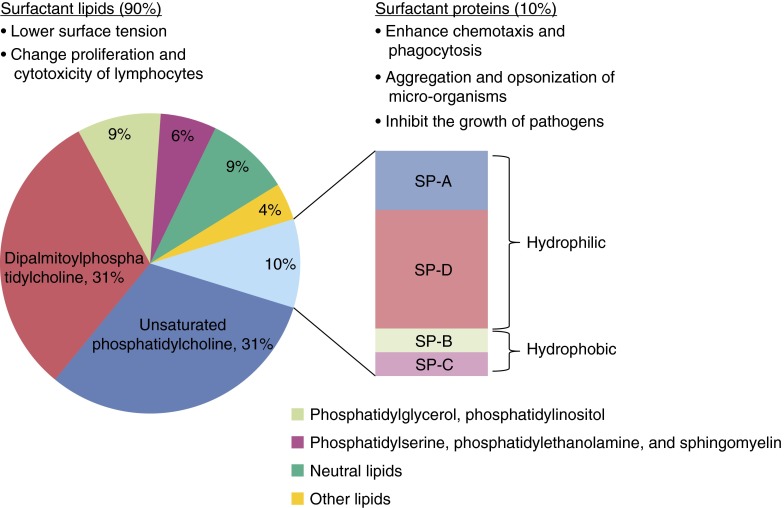
Pulmonary surfactant is essential for life as it lines the alveoli to lower surface tension, thereby preventing atelectasis during breathing. Surfactant is enriched with a relatively unique phospholipid, termed dipalmitoylphosphatidylcholine, and four surfactant-associated proteins, SP-A, SP-B, SP-C, and SP-D. The hydrophobic proteins, SP-B and SP-C, together with dipalmitoylphosphatidylcholine, confer surface tension-lowering properties to the material. The more hydrophilic surfactant components, SP-A and SP-D, participate in pulmonary host defense and modify immune responses. Specifically, SP-A and SP-D bind and partake in the clearance of a variety of bacterial, fungal, and viral pathogens and can dampen antigen-induced immune function of effector cells. Emerging data also show immunosuppressive actions of some surfactant-associated lipids, such as phosphatidylglycerol. Conversely, microbial pathogens in preclinical models impair surfactant synthesis and secretion, and microbial proteinases degrade surfactant-associated proteins. Deficiencies of surfactant components are classically observed in the neonatal respiratory distress syndrome, where surfactant replacement therapies have been the mainstay of treatment. However, functional or compositional deficiencies of surfactant are also observed in a variety of acute and chronic lung disorders. Increased surfactant is seen in pulmonary alveolar proteinosis, a disorder characterized by a functional deficiency of the granulocyte-macrophage colony-stimulating factor receptor or development of granulocyte-macrophage colony-stimulating factor antibodies. Genetic polymorphisms of some surfactant proteins such as SP-C are linked to interstitial pulmonary fibrosis. Here, we briefly review the composition, antimicrobial properties, and relevance of pulmonary surfactant to lung disorders and present its therapeutic implications.
Keywords: immune responses; infection; pulmonary host defense; surfactant.
Figures
References
-
- Neergaard K. Neue Auffassungen über einen Grundbegriff der Atemmechanik. Z Ges Exp Med. 1929;66:373–394.
-
- Pattle RE. Properties, function and origin of the alveolar lining layer. Nature. 1955;175:1125–1126. - PubMed
-
- Clements JA. Surface tension of lung extracts. Proc Soc Exp Biol Med. 1957;95:170–172. - PubMed
-
- Avery ME, Said S. Surface phenomena in lungs in health and disease. Medicine (Baltimore) 1965;44:503–526. - PubMed
-
- Wright JR, Clements JA. Metabolism and turnover of lung surfactant. Am Rev Respir Dis. 1987;136:426–444. - PubMed
Publication types
MeSH terms
Substances
Grants and funding
LinkOut - more resources
Full Text Sources
Other Literature Sources
Medical
