


Partition and poliomyelitis: an investigation of the polio disparity affecting Muslims during India's eradication program
- PMID: 25742622
- PMCID: PMC4350996
- DOI: 10.1371/journal.pone.0115628
Partition and poliomyelitis: an investigation of the polio disparity affecting Muslims during India's eradication program
Abstract
Background: Significant disparities in the incidence of polio existed during its eradication campaign in India. In 2006, Muslims, who comprise 16% of the population in affected states, comprised 70% of paralytic polio cases. This disparity was initially blamed on the Muslims and a rumor that the vaccination program was a plot to sterilize their children. Using the framework of structural violence, this paper describes how the socio-political and historical context of Muslim populations in India shaped the polio disparity.
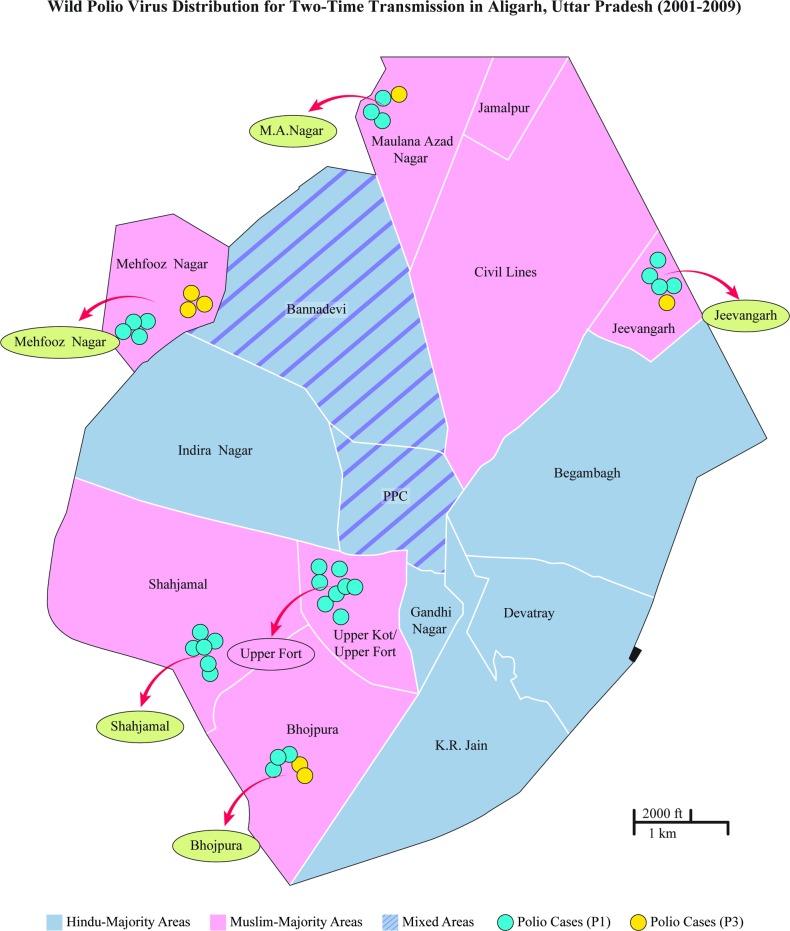
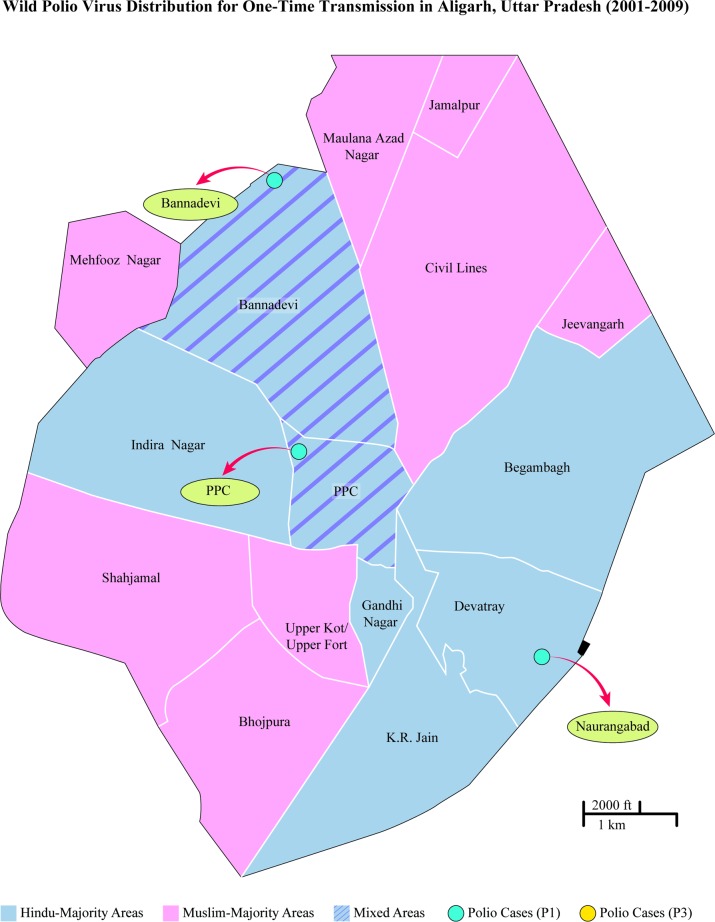
Methods and findings: A qualitative study utilizing methods of rapid ethnography was conducted from May-August 2009 in Aligarh, Uttar Pradesh, India. Field methods included participant observation of vaccination teams, historical document research, and 107 interviews with both Global Polio Eradication Initiative (GPEI) stakeholders and families with vaccine-eligible children. Almost all respondents agreed that Aligarh was a highly segregated city, mostly due to riots after Partition and during the 1990s. Since the formation of segregated neighborhoods, most respondents described that "Muslim areas" had been underdeveloped compared to "Hindu areas," facilitating the physical transmission of poliovirus. Distrust of the government and resistance to vaccination were linked to this disparate development and fears of sterilization influenced by the "Family Planning Program" from 1976-1977.
Conclusions: Ethnic violence and social marginalization since the Partition and during the rise of Hindu nationalism led to distrust of the government, the formation of segregated slums, and has made Muslims victims of structural violence. This led to the creation of disease-spreading physical environments, lowered vaccine efficacy, and disproportionately higher levels of resistance to vaccination. The causes of the polio disparity found in this study elucidate the nature of possible other health disparities affecting minorities in India.
Limitations: This study is limited by the manual coding of the transcribed data, size, and some dialectal difficulties in translation.
Conflict of interest statement
Figures
References
-
- Kew OM, Sutter RW, de Gourville EM, Dowdle WR, Pallansch MA (2005) Vaccine-derived Polioviruses and the Endgame Strategy for Global Polio Eradication. Annual Review of Microbiology 59: 587–635. - PubMed
-
- The World Health Organization and the Government of India (2009) National Polio Surveillance Project-Aligarh Regional Office Dataset (2001–2009). 29 p.
-
- Pallansch MA, Sandhu HS (2006) The Eradication of Polio—Progress and Challenges. New England Journal of Medicine 355(24): 2508–2511. - PubMed
-
- GOI-Ministry of Home Affairs (2001) Population by Religious Communities. Available: http://censusindia.gov.in/Census_Data_2001/Census_data_finder/C_Series/P.... Accessed 2010 April 15.
-
- Allen K (2003) India tackles child Polio BBC World News: Health; Available: http://news.bbc.co.uk/2/hi/health/2741767.stm. Accessed 2014 May 18.
Publication types
MeSH terms
Substances
LinkOut - more resources
Full Text Sources
Other Literature Sources
Medical
