


Honey as a topical treatment for wounds
- PMID: 25742878
- PMCID: PMC9719456
- DOI: 10.1002/14651858.CD005083.pub4
Honey as a topical treatment for wounds
Abstract
Background: Honey is a viscous, supersaturated sugar solution derived from nectar gathered and modified by the honeybee, Apis mellifera. Honey has been used since ancient times as a remedy in wound care. Evidence from animal studies and some trials has suggested that honey may accelerate wound healing.
Objectives: The objective of this review was to assess the effects of honey compared with alternative wound dressings and topical treatments on the of healing of acute (e.g. burns, lacerations) and/or chronic (e.g. venous ulcers) wounds.
Search methods: For this update of the review we searched the Cochrane Wounds Group Specialised Register (searched 15 October 2014); The Cochrane Central Register of Controlled Trials (CENTRAL) (The Cochrane Library 2014, Issue 9); Ovid MEDLINE (1946 to October Week 1 2014); Ovid MEDLINE (In-Process & Other Non-Indexed Citations 13 October 2014); Ovid EMBASE (1974 to 13 October 2014); and EBSCO CINAHL (1982 to 15 October 2014).
Selection criteria: Randomised and quasi-randomised trials that evaluated honey as a treatment for any sort of acute or chronic wound were sought. There was no restriction in terms of source, date of publication or language. Wound healing was the primary endpoint.
Data collection and analysis: Data from eligible trials were extracted and summarised by one review author, using a data extraction sheet, and independently verified by a second review author. All data have been subsequently checked by two more authors.
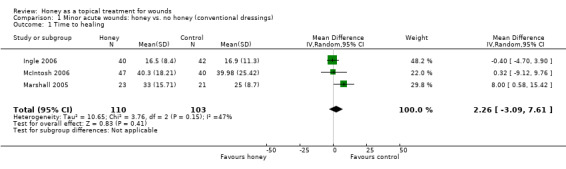
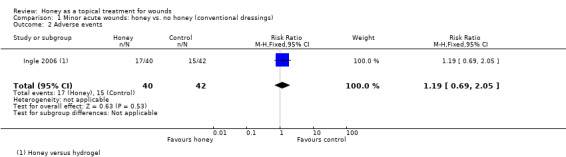
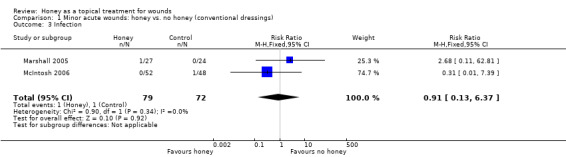
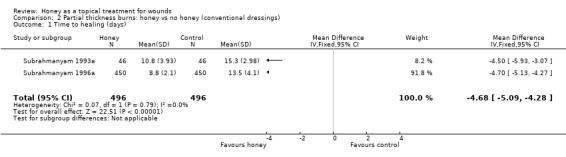
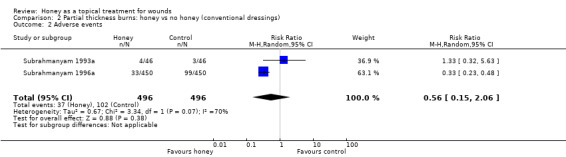
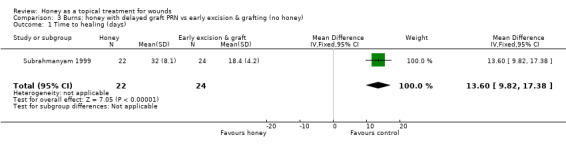
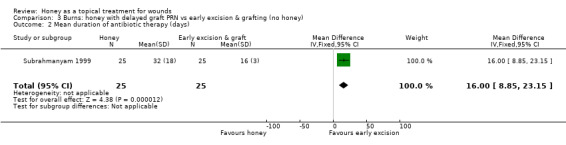
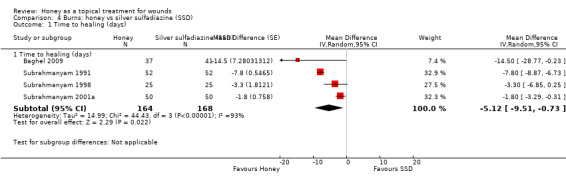
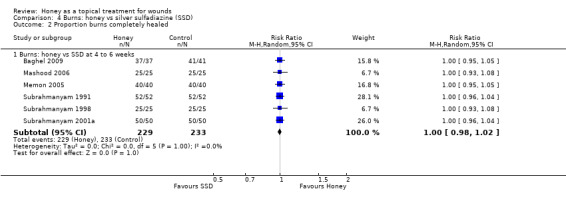
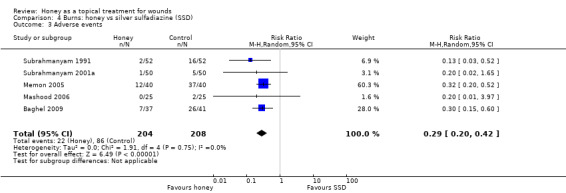
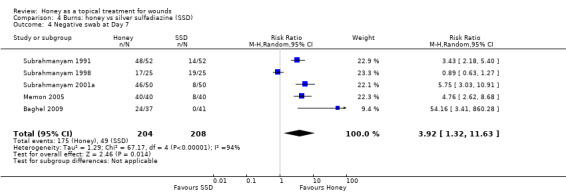
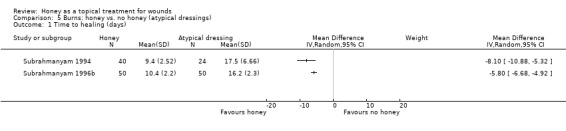
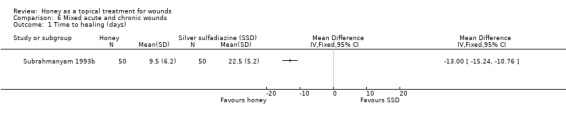
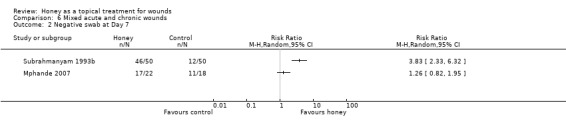
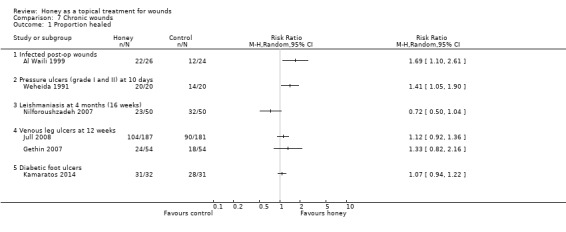
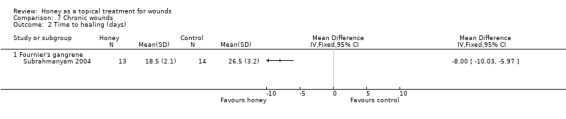
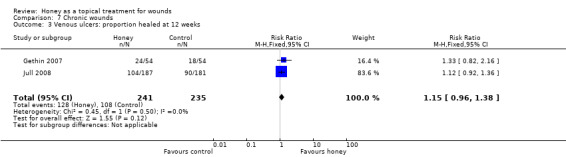
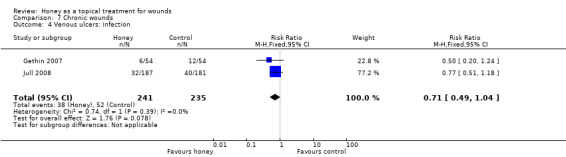
Main results: We identified 26 eligible trials (total of 3011 participants). Three trials evaluated the effects of honey in minor acute wounds, 11 trials evaluated honey in burns, 10 trials recruited people with different chronic wounds including two in people with venous leg ulcers, two trials in people with diabetic foot ulcers and single trials in infected post-operative wounds, pressure injuries, cutaneous Leishmaniasis and Fournier's gangrene. Two trials recruited a mixed population of people with acute and chronic wounds. The quality of the evidence varied between different comparisons and outcomes. We mainly downgraded the quality of evidence for risk of bias, imprecision and, in a few cases, inconsistency.There is high quality evidence (2 trials, n=992) that honey dressings heal partial thickness burns more quickly than conventional dressings (WMD -4.68 days, 95%CI -5.09 to -4.28) but it is unclear if there is a difference in rates of adverse events (very low quality evidence) or infection (low quality evidence).There is very low quality evidence (4 trials, n=332) that burns treated with honey heal more quickly than those treated with silver sulfadiazine (SSD) (WMD -5.12 days, 95%CI -9.51 to -0.73) and high quality evidence from 6 trials (n=462) that there is no difference in overall risk of healing within 6 weeks for honey compared with SSD (RR 1.00, 95% CI 0.98 to 1.02) but a reduction in the overall risk of adverse events with honey relative to SSD. There is low quality evidence (1 trial, n=50) that early excision and grafting heals partial and full thickness burns more quickly than honey followed by grafting as necessary (WMD 13.6 days, 95%CI 9.82 to 17.38).There is low quality evidence (2 trials, different comparators, n=140) that honey heals a mixed population of acute and chronic wounds more quickly than SSD or sugar dressings.Honey healed infected post-operative wounds more quickly than antiseptic washes followed by gauze and was associated with fewer adverse events (1 trial, n=50, moderate quality evidence, RR of healing 1.69, 95%CI 1.10 to 2.61); healed pressure ulcers more quickly than saline soaks (1 trial, n= 40, very low quality evidence, RR 1.41, 95%CI 1.05 to 1.90), and healed Fournier's gangrene more quickly than Eusol soaks (1 trial, n=30, very low quality evidence, WMD -8.00 days, 95%CI -6.08 to -9.92 days).The effects of honey relative to comparators are unclear for: venous leg ulcers (2 trials, n= 476, low quality evidence); minor acute wounds (3 trials, n=213, very low quality evidence); diabetic foot ulcers (2 trials, n=93, low quality evidence); Leishmaniasis (1 trial, n=100, low quality evidence); mixed chronic wounds (2 trials, n=150, low quality evidence).
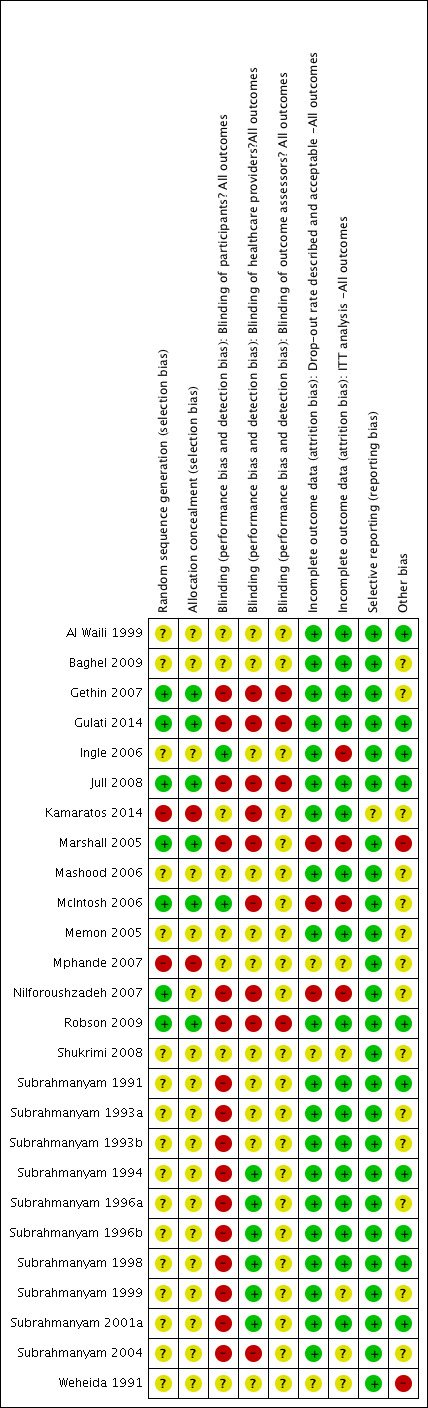
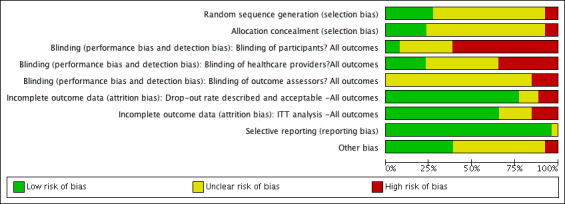
Authors' conclusions: It is difficult to draw overall conclusions regarding the effects of honey as a topical treatment for wounds due to the heterogeneous nature of the patient populations and comparators studied and the mostly low quality of the evidence. The quality of the evidence was mainly downgraded for risk of bias and imprecision. Honey appears to heal partial thickness burns more quickly than conventional treatment (which included polyurethane film, paraffin gauze, soframycin-impregnated gauze, sterile linen and leaving the burns exposed) and infected post-operative wounds more quickly than antiseptics and gauze. Beyond these comparisons any evidence for differences in the effects of honey and comparators is of low or very low quality and does not form a robust basis for decision making.
Conflict of interest statement
Andrew Jull, Natalie Walker and Anthony Rodgers were investigators in the Honey as Adjuvant Leg ulcer Treatment (HALT) trial (ISRCTN 06161544), one of the trials included in this review. The Clinical Trials Research Unit, which employed Andrew Jull, Natalie Walker and Antony Rodgers received a small, unconditional cash contribution from a manufacturer of honey dressings for the conduct of the HALT trial. Dr Walker is supported by a Heart Foundation Douglas Senior Fellowship in Heart Health (Prevention). She has provided consultancy to the manufacturers of smoking cessation medications, received honoraria for speaking at a research meeting and received benefits in kind and travel support from a pharmaceutical company that makes smoking cessation medications. She has also received product in kind from a pharmaceutical company that makes smoking cessation medications, for use in an investigator initiated phase III clinical trial.  She has been contracted by two companies to undertake clinical trials for them ‐ one company wanted her to evaluate a treatment for leg ulcers (but this was not honey) and the second was an asthma trial for a New Zealand Crown entity that decides, on behalf of District Health Boards, which medicines and pharmaceutical products are subsidised for use in the community and public hospitals.Â
Figures
Update of
-
Honey as a topical treatment for wounds.Cochrane Database Syst Rev. 2013 Feb 28;(2):CD005083. doi: 10.1002/14651858.CD005083.pub3. Cochrane Database Syst Rev. 2013. Update in: Cochrane Database Syst Rev. 2015 Mar 06;(3):CD005083. doi: 10.1002/14651858.CD005083.pub4. PMID: 23450557 Updated.
References
References to studies included in this review
Al Waili 1999 {published data only}
-
- Al‐Waili NS, Saloom KY. Effects of topical honey on post‐operative wound infections due to gram positive and gram negative bacteria following caesarean sections and hysterectomies. European Journal of Medical Research 1999;4(3):126‐30. - PubMed
Baghel 2009 {published data only}
Gethin 2007 {published and unpublished data}
-
- Gethin G. Manuka honey versus hydrogel ‐ a prospective, open label, multicentre, randomised controlled trial to compare desloughing efficacy and healing outcomes in venous ulcers. Unpublished PhD thesis 2007. - PubMed
-
- Gethin G, Cowman S. Bacteriological changes in sloughy venous leg ulcers treated with manuka honey or hydrogel: an RCT. Journal of Wound Care 2008;17(6):241‐7. - PubMed
-
- Gethin G, Cowman S. Manuka honey versus hydrogel to deslough venous leg ulcers: a randomised controlled trial. 17th European Wound Management Association conference, Glasgow, 2‐4 May. 2007:29.
-
- Gethin G, Cowman S. Manuka honey vs. hydrogel ‐ a prospective, open label, multicentre, randomised controlled trial to compare desloughing efficacy and healing outcomes in venous ulcers. Journal of Clinical Nursing 2009;18(3):466‐74. - PubMed
Gulati 2014 {published data only}
Ingle 2006 {published and unpublished data}
-
- Ingle R, Levin J, Polinder K. Wound healing with honey ‐ a randomised controlled trial. South African Medical Journal 2006;96(9):831‐5. - PubMed
Jull 2008 {published and unpublished data}
-
- Jull A. Honey and venous leg ulceration: a systematic review and randomised controlled trial. Unpublished PhD thesis, University of Auckland 2007.
-
- Jull A, Walker N, Parag V, Molan P, Rodgers A, on behalf of the Honey as Adjuvant Leg Ulcer Therapy trial collaborators. Randomized clinical trial of honey‐impregnated dressings for venous leg ulcers. British Journal of Surgery 2008;95(2):175‐82. - PubMed
-
- Jull A, Walker N, Rodgers A, Bennett D, Molan P, Arroll B, et al. Honey for leg ulcers ‐ The HALT Trial. [Poster]. 2nd World Union of Wound Healing Societies Meeting, Paris, 8‐13 July. 2004:88.
Kamaratos 2014 {published data only}
Marshall 2005 {published data only}
-
- Marshall C, Queen J, Manjooran J. Honey vs povidine iodine following toenail surgery. Wounds UK 2005;1(1):10‐8.
Mashood 2006 {published data only}
-
- Mashhood AA, Khan TA, Sami AN. Honey compared with 1% silver sulfadiazine cream in the treatment of superficial and partial thickness burns. Journal of Pakistan Association of Dermatologists 2006;16(1):14‐9.
McIntosh 2006 {published data only}
-
- Marshall CD, Thomson C. The effect of honey dressings on post‐operative healing following toenail surgery: a randomised controlled study. 2nd World Union of Wound Healing Societies Meeting, Paris, 8‐13 July. 2004:A 012 (page 8 oral).
-
- McIntosh CD, Thomson CE. Honey dressing versus paraffin tulle gras following toenail surgery. Journal of Wound Care 2006;15(3):133‐6. - PubMed
Memon 2005 {published data only}
-
- Memon AR, Tahir SM, Khushk IA, Ali Memon G. Therapeutic effects of honey versus silver sulfadiazine in the management of burn injuries. Journal of Liaquat University Medicine and Health Sciences 2005;4(3):100‐4.
Mphande 2007 {published and unpublished data}
-
- Mphande ANG, Killow C, Phalira S, Wynn Jones H, Harrison WJ. Effects of honey and sugar dressings on wound healing. Journal of Wound Care 2007;16(7):317‐9. - PubMed
Nilforoushzadeh 2007 {published and unpublished data}
Robson 2009 {published data only}
-
- Robson V, Dodd S, Thomas S. Standardized antibacterial honey (Medihoney) with standard therapy in wound care: randomized clinical trial. Journal of Advanced Nursing 2009;65(3):565‐75. - PubMed
Shukrimi 2008 {published data only}
-
- Shukrimi A, Sulaiman AR, Halim AY, Azril A. A comparative study between honey and povidone iodine as dressing solution for Wagner type II diabetic foot ulcers. Medical Journal of Malaysia 2008;63(1):44‐6. - PubMed
Subrahmanyam 1991 {published and unpublished data}
-
- Subrahmanyam M. Topical application of honey in treatment of burns. British Journal of Surgery 1991;78(4):497‐8. - PubMed
Subrahmanyam 1993a {published and unpublished data}
-
- Subrahmanyam M. Honey impregnated gauze versus polyurethane film (OpSite) in the treatment of burns ‐ a prospective randomised study. British Journal of Plastic Surgery 1993;46(4):322‐3. - PubMed
Subrahmanyam 1993b {published data only}
-
- Subrahmanyam M. Honey as a surgical dressing for burns and ulcers. Indian Journal of Surgery 1993;55(9):468‐73.
Subrahmanyam 1994 {published and unpublished data}
-
- Subrahmanyam M. Honey‐impregnated gauze versus amniotic membrane in the treatment of burns. Burns 1994;20(4):331‐3. - PubMed
Subrahmanyam 1996a {published and unpublished data}
-
- Subrahmanyam M. Honey dressing for burns ‐ an appraisal. Annals of Burns and Fire Disasters 1996;IX(1):33‐5.
Subrahmanyam 1996b {published and unpublished data}
-
- Subrahmanyam M. Honey dressing versus boiled potato peel in the treatment of burns: a prospective randomized study. Burns 1996;22(6):491‐3. - PubMed
Subrahmanyam 1998 {published and unpublished data}
-
- Subrahmanyam M. A prospective randomised clinical and histological study of superficial burn wound healing with honey and silver sulfadiazine. Burns 1998;24(2):157‐61. - PubMed
Subrahmanyam 1999 {published data only}
-
- Subrahmanyam M. Early tangential excision and skin grafting of moderate burns is superior to honey dressing: a prospective randomised trial. Burns 1999;25(8):729‐31. - PubMed
Subrahmanyam 2001a {published and unpublished data}
-
- Subrahmanyam M, Sahapure AG, Nagane NS, Bhagwat VR, Ganu JV. Effects of topical application of honey on burn wound healing. Annals of Burns and Fire Disasters 2001;XIV(3):143‐5.
Subrahmanyam 2004 {published and unpublished data}
-
- Subrahmanyam M, Ugane SP. Honey dressing beneficial in treatment of Fournier's gangrene. Indian Journal of Surgery 2004;66(2):75‐7.
Weheida 1991 {published data only}
-
- Weheida SM, Nagubib HH, El‐Banna HM, Marzouk S. Comparing the effects of two dressing techniques on healing of low grade pressure ulcers. Journal of the Medical Research Institute 1991;12(2):259‐78.
References to studies excluded from this review
Abdelatif 2008 {published data only}
-
- Abdelatif M, Yakoot M, Etmaan M. Safety and efficacy of a new honey ointment on diabetic foot ulcers: a prospective pilot study. Journal of Wound Care 2008;17(3):108‐10. - PubMed
Ahmed 2003 {published data only}
-
- Ahmed AKJ, Hoekstra MJ, Hage JJ, Karim RB. Honey‐medicated dressing: transformation of an ancient remedy. Annals of Plastic Surgery 2003;50(2):143‐8. - PubMed
Albietz 2006 {published data only}
-
- Albietz JM, Lenton LM. Effect of antibacterial honey on the ocular flora in tear deficiency and Meibomian gland disease. Cornea 2006;25(9):1012‐9. - PubMed
Al Waili 2003 {published data only}
-
- Al Waili NS. Topical application of natural honey, beeswax and olive oil mixture for atopic dermatitis or psoriasis: partially controlled, single‐blinded study. Complementary Therapies in Medicine 2003;11(4):226‐34. - PubMed
Al Waili 2004a {published data only}
-
- Al‐Waili NS. Investigating the antimicrobial activity of natural honey and its effects on the pathogenic bacterial infections of surgical wounds and conjunctiva. Journal of Medicinal Food 2004;7(2):210‐22. - PubMed
Al Waili 2004b {published data only}
-
- Al‐Waili NS. Effect of honey on antibody production against thymus‐dependent and thymus‐independent antigens in primary and secondary immune responses. Journal of Medicinal Food 2004;7(4):491‐4. - PubMed
Al Waili 2004c {published data only}
-
- Al‐Waili NS. Topical honey application vs. acyclovir for the treatment of recurrent herpes simplex lesions. Medical Science Monitor 2004;10(8):MT94‐8. - PubMed
Al Waili 2005 {published data only}
-
- Al Waili NS. Clinical and mycological benefits of topical application of honey, olive oil and beeswax in diaper dermatitis. Clinical Microbiology and Infection 2005;11(2):160‐3. - PubMed
Bangroo 2005 {published data only}
-
- Bangroo AK, Ramji K, Smita C. Honey dressing in pediatric burns. Journal of the Indian Association Pediatric Surgeons 2005;10(2):172‐5.
Berchtold 1992 {published data only}
-
- Berchtold E, Maibach R, Muller U. Reduction of side effects from rush‐immunotherapy with honey bee venom by pretreatment with terfenadine. Clinical and Experimental Allergy 1992;22(1):59‐65. - PubMed
Biswal 2003 {published data only}
-
- Biswal BM, Zakaria A, Ahmad NM. Topical application of honey in the management of radiation mucositis. A preliminary study. Support Care Cancer 2003;11:242‐8. - PubMed
Bose 1982 {published data only}
-
- Bose B. Honey or sugar in treatment of infected wounds?. Lancet 1982;1(8278):963. - PubMed
Calderon Espina 1989 {published data only (unpublished sought but not used)}
-
- Calderon Espina LE. Use of honey in surgical wound dehiscence after surgery of obstetric patients [Uso de miel de abeja en heridas operatorias dehiscentes en pacientes post‐cirugía obstétrica]. Universidad de San Carlos de Guatemala 1989.
Chokotho 2005 {published data only}
Dunford 2004 {published data only}
-
- Dunford CE, Hanano R. Acceptability to patients of a honey dressing for non‐healing venous leg ulcers. Journal of Wound Care 2004;13:193‐7. - PubMed
Freeman 2010 {published data only}
-
- Freeman A, May K, Wraight P. Honey: the bee's knees for diabetic foot ulcers?. Wound Practice and Research 2010;18(3):144‐7.
Gad 1988 {published data only}
-
- Gad ESM, Ali MA, Sherif ME, Hamdy HE. The use of honey in dressing of septic wounds versus cetrimide 15%+ chlorhexidine gluconate 1.5% (Savlon): randomized controlled clinical trial. Medical Journal of Cairo University 1988;56:257‐64.
Gethin 2005 {published data only}
Heidari 2013 {published data only}
-
- Heidari T, Roozbahani N, Amiri Farahani L, Attarha M, Akbari Torkestani N, Jamilian M, Bekhradi R. Does Iranian Astragalus gossypinus honey assist in healing caesarean wounds and scars?. European Journal of Integrative Medicine 2013;5(3):226‐233..
Jeffery 2008 {published data only}
-
- Jeffery S. A honey‐based dressing for diabetic foot ulcers: A controlled study. Diabetic Foot Journal 2008;11(2):87‐91.
Johnson 2005 {published data only}
-
- Johnson DW, Eps C, Mudge DW, Wiggins KJ, Armstrong K, Hawley CM, et al. Randomized, controlled trial of topical exit‐site application of honey (MediHoney) versus mupirocin for the prevention of catheter‐associated infections in hemodialysis patients. American Journal of Nephrology 2005;16(5):1456‐62. - PubMed
Lund‐Nielsen 2011 {published data only}
-
- Lund‐Nielsen B, Adamsen L, Gottrup F, Rorth M, Tolver A, Kolmos HJ. Qualitative bacteriology in malignant wounds ‐ a prospective, randomized, clinical study to compare the effect of honey and silver dressings. Ostomy Wound Management 2011;57(7):28‐36. - PubMed
-
- Lund‐Nielsen B, Adamsen L, Kolmos HJ, Rorth M, Tolver A, Gottrup F. The effect of honey‐coated bandages compared with silver‐coated bandages on treatment of malignant wounds‐a randomized study. Wound Repair and Regeneration 2011;19(6):664‐70. - PubMed
Lusby 2002 {published data only}
-
- Lusby PE. Honey: a potent agent for wound healing?. Journal of Wound, Ostomy and Continence Nursing 2002;29(6):295‐300. - PubMed
Malik 2010 {published data only}
Marshall 2002 {published data only}
-
- Marshall C. The use of honey in wound care: a review article. British Journal of Podiatry 2002;52(2):47‐9.
Mat Lazim 2013 {published data only}
-
- Mat Lazim N, Abdullah B, Salim R. The effect of Tualang honey in enhancing post tonsillectomy healing process. An open labelled prospective clinical trial. International Journal of Pediatric Otorhinolaryngology 2013;77(4):457‐461. - PubMed
Mayer 2014 {published data only}
-
- Mayer A, Slezak V, Takac P, Olejnik J, Majtan J. Treatment of non‐healing leg ulcers with honeydew honey. Journal of Tissue Viability 2014;23(3):94‐97. - PubMed
Misirligou 2003 {published data only}
-
- Misirlioglu A, Eroglu S, Karacaglan N, Akan M, Akoz T, Yildirim S. Use of honey as an adjunct in the healing of split‐thickness skin graft donor site. Dermatologic Surgery 2003;29(2):168‐72. - PubMed
Moghazy 2010 {published data only}
-
- Moghazy AM, Shams ME, Adly OA, Abbas AH, El‐Badawy MA, Elsakka DM, Hassan SA, Abdelmohsen WS, Ali OS, Mohamed BA. The clinical and cost effectiveness of bee honey dressing in the treatment of diabetic foot ulcers. Diabetes Res Clin Pract 2010;29(3):303‐9. - PubMed
Molan 2002 {published data only}
-
- Molan PC. Re‐introducing honey in the management of wounds and ulcers ‐ theory and practice. Ostomy/Wound Management 2002;48(11):28‐40. - PubMed
Molan 2006 {published data only}
-
- Molan PC. The evidence supporting the use of honey as a wound dressing. International Journal of Lower Extremity Wounds 2006;5(1):40‐54. - PubMed
Muller 1985 {published data only}
-
- Muller U, Lanner A, Schmid P, Bischof M, Dreborg S, Hoigne R. A double blind study on immunotherapy with chemically modified honey bee venom: monomethoxy polyethylene glycol‐coupled versus crude honey bee venom. International Archives of Allergy and Applied Immunology 1985;77(1‐2):201‐3. - PubMed
Mwipatayi 2004 {published data only}
-
- Mwipatayi BP, Angel D, Norrish J, Hamilton MJ, Scott A, Sieunarine K. The use of honey in chronic leg ulcers: a literature review. Primary Intention 2004;12(3):107‐12.
Nagane 2004 {published data only}
Okeniyi 2005 {published data only}
-
- Okeniyi JAO, Olubanjo OO, Ogunlesi TA, Oyelami OA. Comparison of healing of incised abscess wounds with honey and EUSOL dressing. Journal of Alternative and Complementary Medicine 2005;11(3):511‐3. - PubMed
Oluwatosin 2000 {published data only}
-
- Oluwatosin OM, Olabanji JK, Oluwatosin OA, Tijani LA, Onyechi HU. A comparison of topical honey and phenytoin in the treatment of chronic leg ulcers. African Journal of Medicine and Medical Science 2000;29:31‐4. - PubMed
Pascoe 2013 {published data only}
Quadri 1998 {published data only}
-
- Quadri KHM, Tanimu DZ, Iqbal A, Bachand R, Al Saggabi AA, Abu Romeh S, et al. A prospective randomized controlled trial of topical honey versus povidine iodine in the prevention of hemodialysis catheter related sepsis. Journal of the American Society of Nephrology 1998;9:180‐1A.
Quadri 1999 {published data only}
-
- Quadri KHM, Huraib SO. Manuka honey for central vein catheter exit site care. Seminars in Dialysis 1999;12:397‐8.
Rivero Varona 1999 {published data only (unpublished sought but not used)}
-
- Rivero Varona T. Therapeutic use of honey in the treatment of alveolitis [Uso terapéutico de la miel en el tratamiento de las alveolitis]. Revista Archivo Médico de Camagüey 1999;3:43‐7.
Robson 2002 {published data only}
-
- Robson V. Leptospermum honey used as a debriding agent. Nurse 2 Nurse 2002;2:66‐8.
Robson 2012 {published data only}
-
- Robson V, Yorke J, Sen RA, Lowe D, Rogers SN. Randomised controlled feasibility trial on the use of medical grade honey following microvascular free tissue transfer to reduce the incidence of wound infection. British Journal of Oral and Maxillofacial Surgery 2012;50(4):321‐327. - PubMed
Rogers 2010 {published data only}
-
- Rogers S, Robson V, Barrow S, Sen R, Lowe D, York J. The feasibility of a randomised control trial on the use of medical grade honey to reduce the incidence of wound infection following free tissue transfer in head and neck cancer. Clinical Oncology 2010;22:900.
Rucigaj 2006 {published data only}
-
- Planinsek Rucigaj T. Comparative effects of honey based and silver/charcoal based dressings on the healing of venous leg ulcers: a randomized clinical study. 17th Conference of the European Wound Management Association; 2007, 2‐4 May; Glasgow, Scotland. 2007.
-
- Planinsek Rucigaj T. Comparative effects of polyhydrated ionogens/honey based dressings and silver based dressings on the healing of venous leg ulcers. Proceedings of 16th Annual Meeting of the European Tissue Repair Society, Pisa, 13‐16 September. 2006.
Saha 2012 {published data only}
Schumacher 2004 {published data only}
-
- Schumacher HH. Use of medical honey in patients with chronic venous leg ulcers after split‐skin grafting. Journal of Wound Care 2004;13:451‐2. - PubMed
Somaratne 2012 {published data only}
-
- Somaratne K, Banagala A, Senanayake K, Seneviratne T, Thelikorala S, Tissera W. Controlled trial on the use of bee's honey on wounds where methicillin resistant staphylococcus aureas (MRSA) is isolated. 4th Congress of the World Union of Wound Healing Societies, September 2012, Yokohama, Japan. 2012.
Subrahmanyam 1993 {published data only}
-
- Subrahmanyam M. Storage of skin grafts in honey. Lancet 1993;341(8836):63‐4. - PubMed
Subrahmanyam 1996c {published and unpublished data}
-
- Subrahmanyam M. Addition of antioxidants and polyethylene glycol 4000 enhances the healing property of honey in burns. Annals of Burns and Fire Disasters 1996;IX(2):93‐5.
Subrahmanyam 2001b {published data only}
-
- Subrahmanyam M, Hemmady A, Pawar S. Antibacterial activity of honey on bacteria isolated from wounds. Annals of Burns and Fire Disaster 2001;XIV:22‐4.
Subrahmanyam 2003 {published data only}
-
- Subrahmanyam M, Shahapure AG, Nagane NS, Bhagwat VR, Ganu JV. Free radical control ‐ the main mechanism of the action of honey in burns. Annals of Burns and Fire Disaster 2003;XVI:135‐7.
Thurnheer 1983 {published data only}
-
- Thurnheer U, Muller U, Stoller R, Lanner A, Hoigne R. Venom immunotherapy in hymenoptera sting allergy. Comparison of rush and conventional hyposensitization and observations during long‐term treatment. Allergy 1983;38(7):465‐75. - PubMed
Tostes 1994 {published data only}
-
- Tostes ROG, Leite FE. New insights about topical sugar and honey treatment of wounds [Novas consideraçöes sobre o uso tópico de açúcar e mel em feridas]. Revista Médica de Minas Gerais 1994;4:35‐9.
Ur‐Rehman 2013 {published data only}
-
- Ur‐Rehman E, Afzal MO, Ali A, Qureshi A‐RZ‐U‐R, Rashid M. Comparison between honey and povidone‐iodine/normal saline dressing for management of Wagner's grade I & II diabetic foot ulcers. Pakistan Journal of Medical and Health Sciences 2013;7(4):1082‐1085.
Vijaya 2012 {published data only}
Visscher 1996 {published data only}
-
- Visscher P, Vetter R, Camazine S. Removing bee stings. Lancet 1996;348(9023):301‐2. - PubMed
Yapucu Gunes 2007 {published data only}
-
- Yapucu Gunes U, Eser I. Effectiveness of a honey dressing for healing pressure ulcers. Journal of Wound Ostomy and Continence Nursing 2007;34(2):184‐90. - PubMed
References to studies awaiting assessment
Askarpour 2009 {published data only}
-
- Askarpour S, Rashidi I, Daei SS, Mahmoodi M. Effect of honey in wound repair in patients whom underwent laparotomy. Internet Journal of Surgery 2010;23:2.
Jan 2012 {published data only}
-
- Jan WA, Shah H, Khan M, Fayaz M, Ullah N. Comparison of conventional pyodine dressing with honey dressing for the treatment of diabetic foot ulcers. Journal of Postgraduate Medical Institute 2012;26(4):402‐407.
Additional references
Adams 1939
-
- Adams F. The genuine works of Hippocrates. Baltimore: Williams & Wilkins, 1939.
Bergman 1983
-
- Bergman A, Yanai J, Weiss J, Bell D, David MP. Acceleration of wound healing by topical application of honey. An animal model. American Journal of Surgery 1983;145:374‐6. - PubMed
Blomfield 1973
-
- Blomfield R. Honey for decubitis ulcers. JAMA 1973;224(6):905. - PubMed
Breasted 1930
-
- Breasted JH. The Edwin Smith papyrus: published in facsimile and hieroglyphic transliteration. Chicago: University of Chicago Press, 1930.
Brennan 1985
-
- Brennan SS, Leaper DJ. The effect of antiseptics on wound healing: a study using the rabbit ear chamber. British Journal of Surgery 1985;72(10):780‐2. - PubMed
Cutting 2005
-
- Cutting KF, White RJ. Criteria for identifying wound infection. Ostomy/Wound Management 2005;51(1):28‐34. - PubMed
Efem 1988
-
- Efem SEE. Clinical observations on the wound healing properties of honey. British Journal of Surgery 1988;75:679‐81. - PubMed
Fu 2001
-
- Fu X, Wang Z, Sheng Z. Advances in wound healing research in China: from antiquity to present. Wound Repair and Regeneration 2001;9:2‐10. - PubMed
Hajar 2002
-
- Hajar R. Honey from folklore to medical marvel. Heart Views 2002;3:180‐8.
Higgins 2003
Higgins 2011
-
- Higgins JPT, Green S (editors). Cochrane Handbook for Systematic Reviews of Interventions Version 5.1.0 [updated March 2011]. Available from www.cochrane‐handbook.org, The Cochrane Collaboration, 2011.
Hróbjartsson 2012
-
- Hróbjartsson A, Thomsen AS, Emanuelsson F, Tendal B, Hilden J, Boutron I, Ravaud P, Brorson S. Observer bias in randomised clinical trials with binary outcomes: systematic review of trials with both blinded and non‐blinded outcome assessors. BMJ 2012;344:1119. [DOI: ] - PubMed
Ioannidis 2008
Johnson 1992
-
- Johnson A. A short history of wound dressings: from animal grease and lint to hydorcolloids and alginates. Ostomy/Wound Management 1992;38:36‐40. - PubMed
Jull 2004
Jull 2008a
Langendam 2013
Lazarus 1994
-
- Lazarus GS, Cooper DM, Knighton DR, Margolis DJ, Pecoraro RE, Rodeheaver G, et al. Definitions and guidelines for assessment of wounds and evaluation of healing. Archives of Dermatology 1994;130(4):489‐93. - PubMed
Leaper 1986
-
- Leaper DJ, Simpson RA. The effect of antiseptics and topical antimicrobials on wound healing. Journal of Antimicrobial Chemotherapy 1986;17(2):135‐7. - PubMed
Lefebvre 2011
-
- Lefebvre C, Manheimer E, Glanville J, on behalf of the Cochrane Information Retrieval Methods Group. Chapter 6: Searching for studies. In: Higgins JPT, Green S (editors). Cochrane Handbook for Systematic Reviews of Interventions Version 5.1.0 [updated March 2011]. The Cochrane Collaboration, 2011. Available from www.cochrane‐handbook.org.
Mavric 2008
-
- Mavric E, Wittmann S, Barth G, Henle T. Identification and quantification of methylglyoxal as the dominant antibacterial constituent of Manuka (Leptospermum scoparium) honeys from New Zealand. Molecular Nutrition and Food Research 2008;52(4):483‐9. - PubMed
Molan 1999
-
- Molan PC. Why honey is effective as a medicine. 1. Its use in modern medicine. Bee World 1999;80:80‐92.
Molan 2001
-
- Molan PC. Why honey is effective as medicine. 2. The scientific explanation of its effects. Bee World 2001;82:22‐40.
Moore 2001
-
- Moore OA, Smith LA, Campbell F, Seers K, McQuay HJ, Moore RA. Systematic review of the use of honey as a wound care dressing. BMC Complementary & Alternative Medicine 2001;1(2):http://www.biomedcentral.com/1472‐6882/1/2. - PMC - PubMed
Ndayisaba 1993
-
- Ndayisaba G, Bazira L, Habonimana E, Muteganya D. Clinical and bacteriological results in wounds treated with honey. Journal of Orthopaedic Surgery 1993;7(2):202‐4. - PubMed
NZGG 2007
-
- New Zealand Guidelines Group. Management of burns and scalds in primary care. Evidence‐based practice guideline. Wellington: Accident Compensation Corporation, 2007.
Oryan 1998
-
- Oryan A, Zaker SR. Effects of topical application of honey on cutaneous wound healing in rabbits. Journal of Veterinary Medicine Series A 1998;45(3):181‐3. - PubMed
Postmes 1997
-
- Postmes TJ, Bosch MMC, Dutrieux R, Baare J, Hoekstra MJ. Speeding up healing of burns with honey. An experimental study with histological assessment of wound biopsies. In: Mizrahi A, Lensky Y editor(s). Bee Products: Properties, Applications and Apitherapy. New York: Plenum Press, 1997.
Riddle 1985
-
- Riddle JM. Dioscorides on pharmacy and medicine. Austin: University of Texas Press, 1985.
Rűttermann 2013
Sato 2000
-
- Sato T, Miyata G. The nutraceutical benefit, part III: honey. Nutritional Pharmaceuticals 2000;16(6):468‐9. - PubMed
Schulz 2010
SIGN 2008
-
- Scottish Intercollegiate Guidelines Network (SIGN). Search filters. http://www.sign.ac.uk/methodology/filters.html#random (accessed 27 May 2008).
Trevisanato 2006
-
- Trevisanato SI. Treatments for burns in the London Medical Papyrus show the first seven biblical plagues of Egypt are coherent with Santorini's volcanic fallout. Medical Hypotheses 2006;66(1):193‐6. - PubMed
Vandamme 2013
Publication types
MeSH terms
Grants and funding
LinkOut - more resources
Full Text Sources
Other Literature Sources
Medical
