


Common marmosets show social plasticity and group-level similarity in personality
- PMID: 25743581
- PMCID: PMC5155412
- DOI: 10.1038/srep08878
Common marmosets show social plasticity and group-level similarity in personality
Abstract
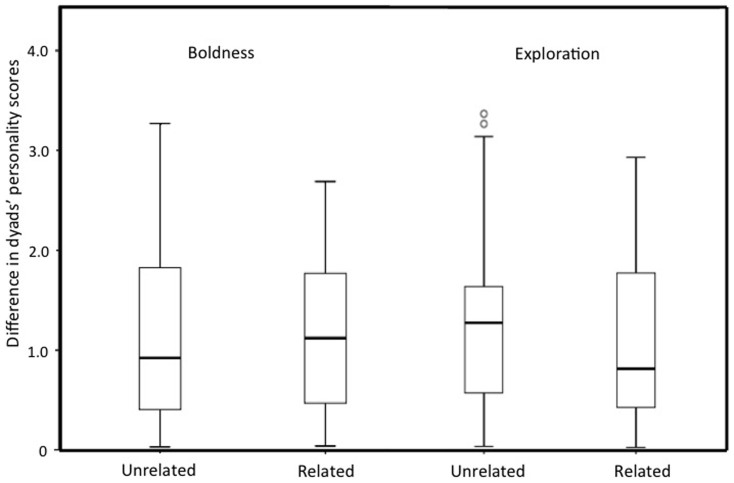
The social environment influences animal personality on evolutionary and immediate time scales. However, studies of animal personality rarely assess the effects of the social environment, particularly in species that live in stable groups with individualized relationships. We assessed personality experimentally in 17 individuals of the common marmoset, living in four groups. We found their personality to be considerably modified by the social environment. Marmosets exhibited relatively high plasticity in their behaviour, and showed 'group-personality', i.e. group-level similarity in the personality traits. In exploratory behaviour this was maintained only in the social environment but not when individuals were tested alone, suggesting that exploration tendency is subjected to social facilitation. Boldness, in contrast, showed higher consistency across the social and solitary conditions, and the group-level similarity in trait scores was sustained also outside of the immediate social environment. The 'group-personality' was not due to genetic relatedness, supporting that it was produced by social effects. We hypothesize that 'group-personality' may be adaptive for highly cooperative animals through facilitating cooperation among individuals with similar behavioural tendency.
Figures

References
-
- Réale D., Reader S. M., Sol D., McDougall P. T. & Dingemanse N. J. Integrating animal temperament within ecology and evolution. Biol. Rev. 82, 291–318. (2007). - PubMed
-
- Dingemanse N. J., Kazem A. J. N., Réale D. & Wright J. Behavioural reaction norms: animal personality meets individual plasticity. Trends Ecol. Evol. 25, 81–89. (2010). - PubMed
-
- Han C. S. & Brooks R. C. Long-term effect of social interactions on behavioral plasticity and lifetime mating success. Am. Nat. 183, 431–444. (2014). - PubMed
Publication types
MeSH terms
LinkOut - more resources
Full Text Sources
Other Literature Sources
