


Innate Susceptibility to Norovirus Infections Influenced by FUT2 Genotype in a United States Pediatric Population
- PMID: 25744498
- PMCID: PMC4447782
- DOI: 10.1093/cid/civ165
Innate Susceptibility to Norovirus Infections Influenced by FUT2 Genotype in a United States Pediatric Population
Abstract
Background: Norovirus is a leading cause of acute gastroenteritis (AGE). Noroviruses bind to gut histo-blood group antigens (HBGAs), but only 70%-80% of individuals have a functional copy of the FUT2 ("secretor") gene required for gut HBGA expression; these individuals are known as "secretors." Susceptibility to some noroviruses depends on FUT2 secretor status, but the population impact of this association is not established.
Methods: From December 2011 to November 2012, active AGE surveillance was performed at 6 geographically diverse pediatric sites in the United States. Case patients aged <5 years were recruited from emergency departments and inpatient units; age-matched healthy controls were recruited at well-child visits. Salivary DNA was collected to determine secretor status and genetic ancestry. Stool was tested for norovirus by real-time reverse transcription polymerase chain reaction. Norovirus genotype was then determined by sequencing.
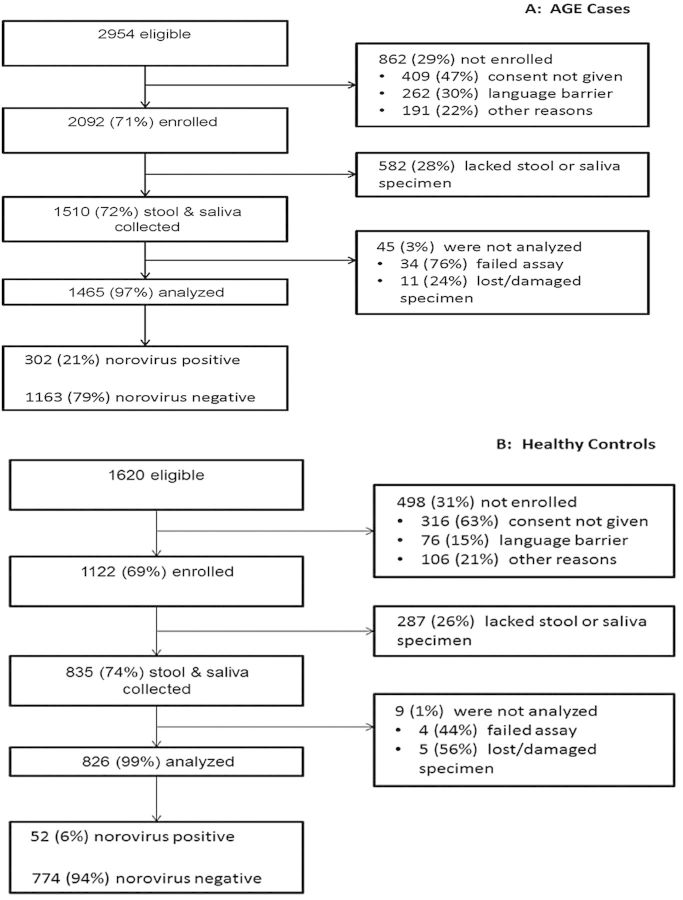
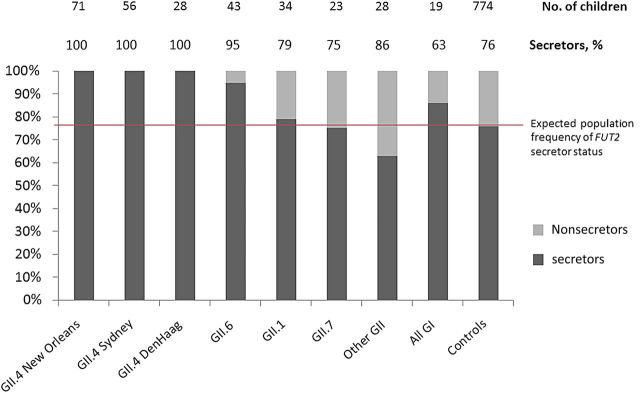
Results: Norovirus was detected in 302 of 1465 (21%) AGE cases and 52 of 826 (6%) healthy controls. Norovirus AGE cases were 2.8-fold more likely than norovirus-negative controls to be secretors (P < .001) in a logistic regression model adjusted for ancestry, age, site, and health insurance. Secretors comprised all 155 cases and 21 asymptomatic infections with the most prevalent norovirus, GII.4. Control children of Meso-American ancestry were more likely than children of European or African ancestry to be secretors (96% vs 74%; P < .001).
Conclusions: FUT2 status is associated with norovirus infection and varies by ancestry. GII.4 norovirus exclusively infected secretors. These findings are important to norovirus vaccine trials and design of agents that may block norovirus-HBGA binding.
Keywords: FUT2; diarrhea; gastroenteritis; histo-blood group antigens; norovirus.
© The Author 2015. Published by Oxford University Press on behalf of the Infectious Diseases Society of America. All rights reserved. For Permissions, please e-mail: journals.permissions@oup.com.
Figures
Comment in
-
Editorial commentary: Ancestry-based differences in norovirus susceptibility: implications for understanding global infection patterns.Clin Infect Dis. 2015 Jun 1;60(11):1639-41. doi: 10.1093/cid/civ168. Epub 2015 Mar 5. Clin Infect Dis. 2015. PMID: 25744497 Free PMC article. No abstract available.
References
Publication types
MeSH terms
Substances
Grants and funding
LinkOut - more resources
Full Text Sources
Other Literature Sources
Medical
