Review
. 2015 May 15;308(10):H1194-204.
doi: 10.1152/ajpheart.00002.2015. Epub 2015 Mar 6.

Myocardial autophagic energy stress responses--macroautophagy, mitophagy, and glycophagy

Affiliations
Review

Myocardial autophagic energy stress responses--macroautophagy, mitophagy, and glycophagy

Lea M D Delbridge et al. Am J Physiol Heart Circ Physiol. .

Abstract

An understanding of the role of autophagic processes in the management of cardiac metabolic stress responses is advancing rapidly and progressing beyond a conceptualization of the autophagosome as a simple cell recycling depot. The importance of autophagy dysregulation in diabetic cardiomyopathy and in ischemic heart disease - both conditions comprising the majority of cardiac disease burden - has now become apparent. New findings have revealed that specific autophagic processes may operate in the cardiomyocyte, specialized for selective recognition and management of mitochondria and glycogen particles in addition to protein macromolecular structures. Thus mitophagy, glycophagy, and macroautophagy regulatory pathways have become the focus of intensive experimental effort, and delineating the signaling pathways involved in these processes offers potential for targeted therapeutic intervention. Chronically elevated macroautophagic activity in the diabetic myocardium is generally observed in association with structural and functional cardiomyopathy; yet there are also numerous reports of detrimental effect of autophagy suppression in diabetes. Autophagy induction has been identified as a key component of protective mechanisms that can be recruited to support the ischemic heart, but in this setting benefit may be mitigated by adverse downstream autophagic consequences. Recent report of glycophagy upregulation in diabetic cardiomyopathy opens up a novel area of investigation. Similarly, a role for glycogen management in ischemia protection through glycophagy initiation is an exciting prospect under investigation.

Keywords: autophagy; cardiac; cardiomyocyte; diabetes; heart; ischemia.


Figures

Fig. 1.
Fig. 1.
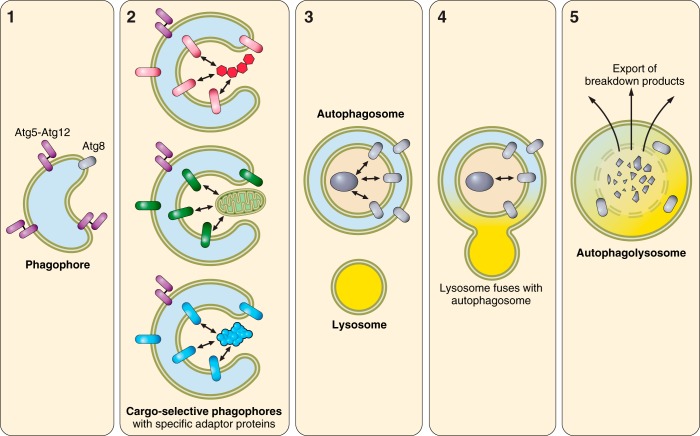
Schematic of autophagy. 1) Formation of the nucleating membrane is initiated by Ulk1 followed by Beclin1 and Vps34. Atg12 is conjugated onto Atg5 by the action of ubiquitin ligase-like enzymes Atg7 and Atg10. Atg8 (e.g., LC3, GABARAP, GABARAPL1) is activated by Atg4 cleavage and then ligated onto membrane phosphatidylethanolamine by the action of Atg3 and Atg7 with the participation of Atg5-12 and Atg16Lcomplex, to form a lipidated Atg8 moiety (e.g., LC3B-II). 2) Specific cargo is tagged with bifunctional adaptor proteins that interact with Atg8 or homologs to facilitate engulfment. 3) Atg5-12 is released from the outer membrane when the phagophore closes upon itself. 4) A lysosome fuses with the autophagosomal outer membrane and delivers its contents. 5) The vacuolar proton ATPase lowers the pH, causing activation of proteases, lipases, nucleases, and glycohydrolases to degrade cargo to single amino acids, fatty acids, nucleotides, and monosaccharides, which are exported across the membrane to the cytosol.
Fig. 2.
Fig. 2.
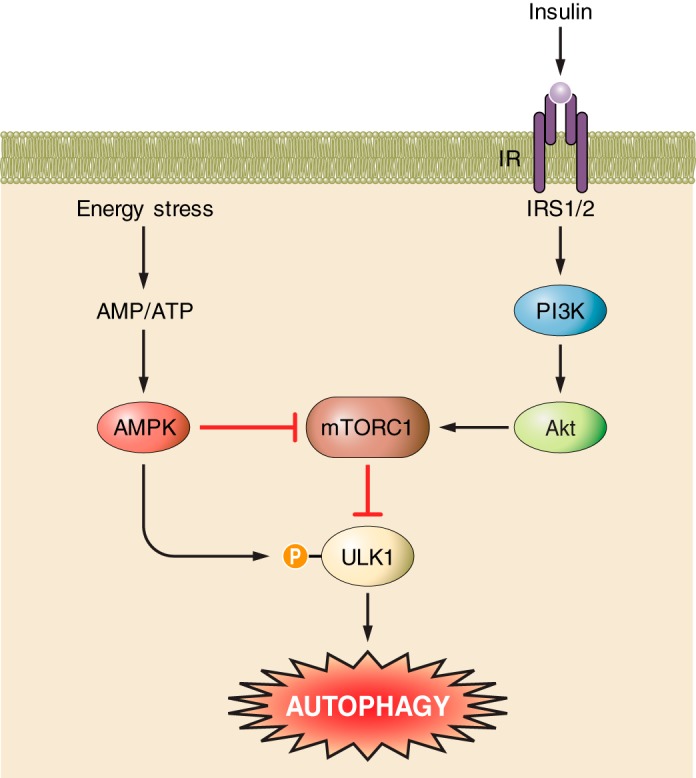
Key signaling regulation of autophagy in the heart. Energy stress increases the AMP-to-ATP ratio and activates AMPK. AMPK has dual action to promote autophagy via inhibition of mTORC1 and activation of ULK1 via phosphorylation. The insulin signaling pathway inhibits autophagy via activation of PI3K/Akt/mTORC1 to inhibit ULK1.
Fig. 3.
Fig. 3.
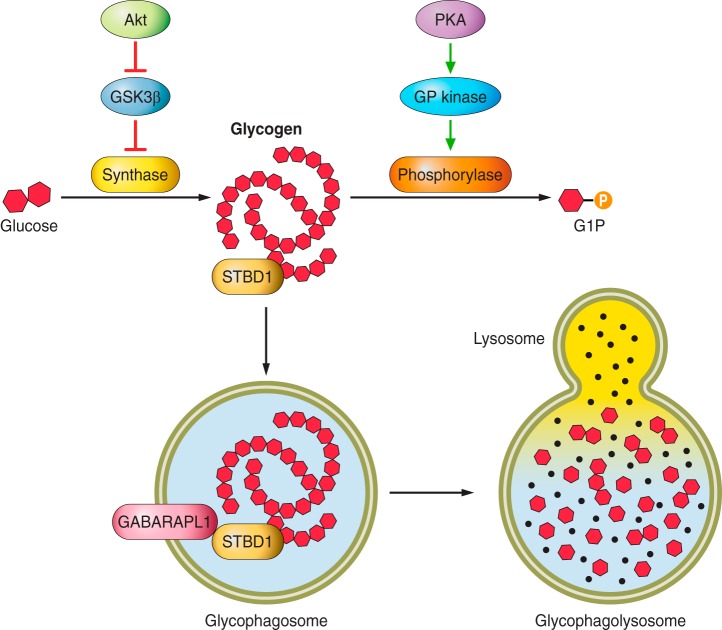
Regulation of glycogen synthesis and degradation in the heart. Akt signaling promotes glycogen synthesis via relieving the GSK3β-mediated inhibition of glycogen synthase. PKA signaling promotes glycogen degradation via activation of glycogen phosphorylase kinase and subsequent activation of glycogen phosphorylase. Phosphorylase removes a glycosyl residue from the glycogen strand to release glucose-1-phosphate. STBD1 tags glycogen for degradation via glycophagy. Glycogen is engulfed by the glycophagosome, which may involve STBD1 binding to GABARAPL1 in the forming glycophagosome membrane. The glycophagosome fuses with a lysosome, and the glycogen is degraded to free glucose by acid α-glucosidase (black dots).
Fig. 4.
Fig. 4.
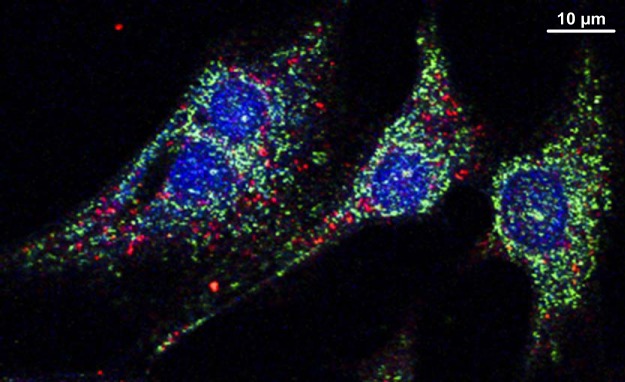
Distinct cardiomyocyte immunohistologic localization of glycogen autophagic trafficking cargo in vitro. STBD1 (green) and LC3B (red) do not colocalize in neonatal ventricular rat myocytes. Confocal image, x63 mag: DAPI (blue) shows nuclei. Reprinted from Ref. with permission.
Fig. 5.
Fig. 5.
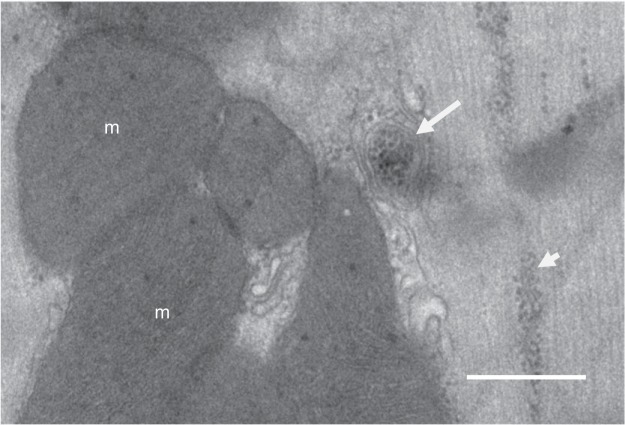
Electron micrograph of glycogen and a glycophagosome in an adult rat ventricular cardiomyocyte. Free glycogen particles (short arrowhead) are aligned between myofibrils. Some glycogen particles are seen sequestered in a glycophagosome (arrow). m, Mitochondria. Bar indicates 500 nm.

References

    1. Aguado C, Sarkar S, Korolchuk VI, Criado O, Vernia S, Boya P, Sanz P, de Cordoba SR, Knecht E, Rubinsztein DC. Laforin, the most common protein mutated in Lafora disease, regulates autophagy. Hum Mol Genet 19: 2867–2876, 2010. - PMC - PubMed
    1. Alfarano C, Suffredini S, Fantappie O, Mugelli A, Cerbai E, Manni ME, Raimondi L. The effect of losartan treatment on the response of diabetic cardiomyocytes to ATP depletion. Pharmacol Res 63: 225–232, 2011. - PubMed
    1. Carreira RS, Lee Y, Ghochani M, Gustafsson AB, Gottlieb RA. Cyclophilin D is required for mitochondrial removal by autophagy in cardiac cells. Autophagy 6: 462–472, 2010. - PMC - PubMed
    1. Chou IP, Chiu YP, Ding ST, Liu BH, Lin YY, Chen CY. Adiponectin receptor 1 overexpression reduces lipid accumulation and hypertrophy in the heart of diet-induced obese mice—possible involvement of oxidative stress and autophagy. Endocr Res 39: 173–179, 2014. - PubMed
    1. Cross HR, Opie LH, Radda GK, Clarke K. Is a high glycogen content beneficial or detrimental to the ischemic rat heart? A controversy resolved. Circ Res 78: 482–491, 1996. - PubMed

Publication types

LinkOut - more resources