Intestinal nematodes from small mammals captured near the demilitarized zone, Gyeonggi province, Republic of Korea
- PMID: 25748722
- PMCID: PMC4384801
- DOI: 10.3347/kjp.2015.53.1.135
Intestinal nematodes from small mammals captured near the demilitarized zone, Gyeonggi province, Republic of Korea
Abstract
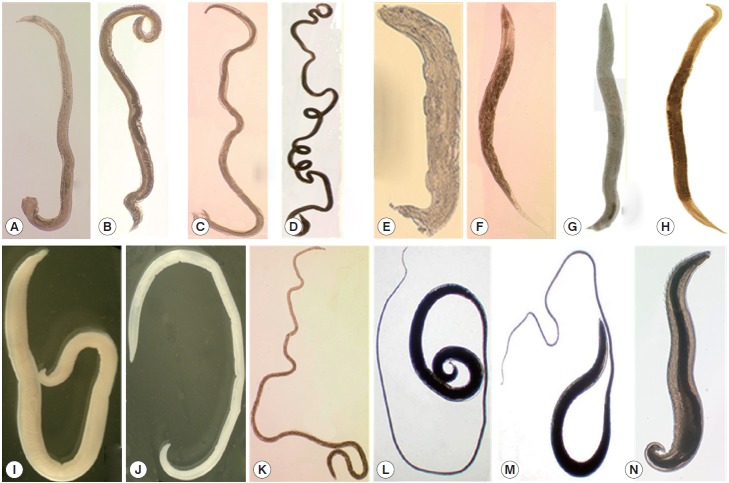
A total of 1,708 small mammals (1,617 rodents and 91 soricomorphs), including Apodemus agrarius (n = 1,400), Microtus fortis (167), Crocidura lasiura (91), Mus musculus (32), Myodes (= Eothenomys) regulus (9), Micromys minutus (6), and Tscherskia (= Cricetulus) triton (3), were live-trapped at US/Republic of Korea (ROK) military training sites near the demilitarized zone (DMZ) of Paju, Pocheon, and Yeoncheon, Gyeonggi Province from December 2004 to December 2009. Small mammals were examined for their intestinal nematodes by necropsy. A total of 1,617 rodents (100%) and 91 (100%) soricomorphs were infected with at least 1 nematode species, including Nippostrongylus brasiliensis, Heligmosomoides polygyrus, Syphacia obvelata, Heterakis spumosa, Protospirura muris, Capillaria spp., Trichuris muris, Rictularia affinis, and an unidentified species. N. brasiliensis was the most common species infecting small mammals (1,060; 62.1%) followed by H. polygyrus (617; 36.1%), S. obvelata (370; 21.7%), H. spumosa (314; 18.4%), P. muris (123; 7.2%), and Capillaria spp. (59; 3.5%). Low infection rates (0.1-0.8%) were observed for T. muris, R. affinis, and an unidentified species. The number of recovered worms was highest for N. brasiliensis (21,623 worms; mean 20.4 worms/infected specimen) followed by S. obvelata (9,235; 25.0 worms), H. polygyrus (4,122; 6.7 worms), and H. spumosa (1,160; 3.7 worms). A. agrarius demonstrated the highest prevalence for N. brasiliensis (70.9%), followed by M. minutus (50.0%), T. triton (33.3%), M. fortis (28.1%), M. musculus (15.6%), C. lasiura (13.2%), and M. regulus (0%). This is the first report of nematode infections in small mammals captured near the DMZ in ROK.
Keywords: Capillaria spp.; Heligmosomoides polygyrus; Heterakis spumosa; Nippostrongylus brasiliensis; Protospirura muris; Rictularia affinis; Syphacia obvelata; Trichuris muris; insectivore; nematode; rodent.
Conflict of interest statement
We have no conflict of interest related to this study.
Figures
References
-
- Yoon BI, Kim HC, Kim JT. Lung worm (Metastrongylus elongatus) infection in wild boars (Sus scrofa) of the demilitarized zone, Korea. J Wildl Dis. 2010;46:1052–1054. - PubMed
-
- Kim KC. Preserving biodiversity in Korea’s demilitarized zone. Science. 1997;278:242–243.
-
- Chai JY, Park JH, Jung BK, Guk SM, Kim JL, Shin EH, Klein TA, Kim HC, Chong ST, Baek LJ, Song JW. Echinostome infections in the striped-field mouse, Apodemus agrarius, and the Ussuri white-toothed shrew, Crocidura lasiura, caught near the demilitarized zone, Gyeonggi-do (Province), Republic of Korea. Korean J Parasitol. 2009;47:311–314. - PMC - PubMed
Publication types
MeSH terms
Supplementary concepts
LinkOut - more resources
Full Text Sources
Other Literature Sources
Miscellaneous